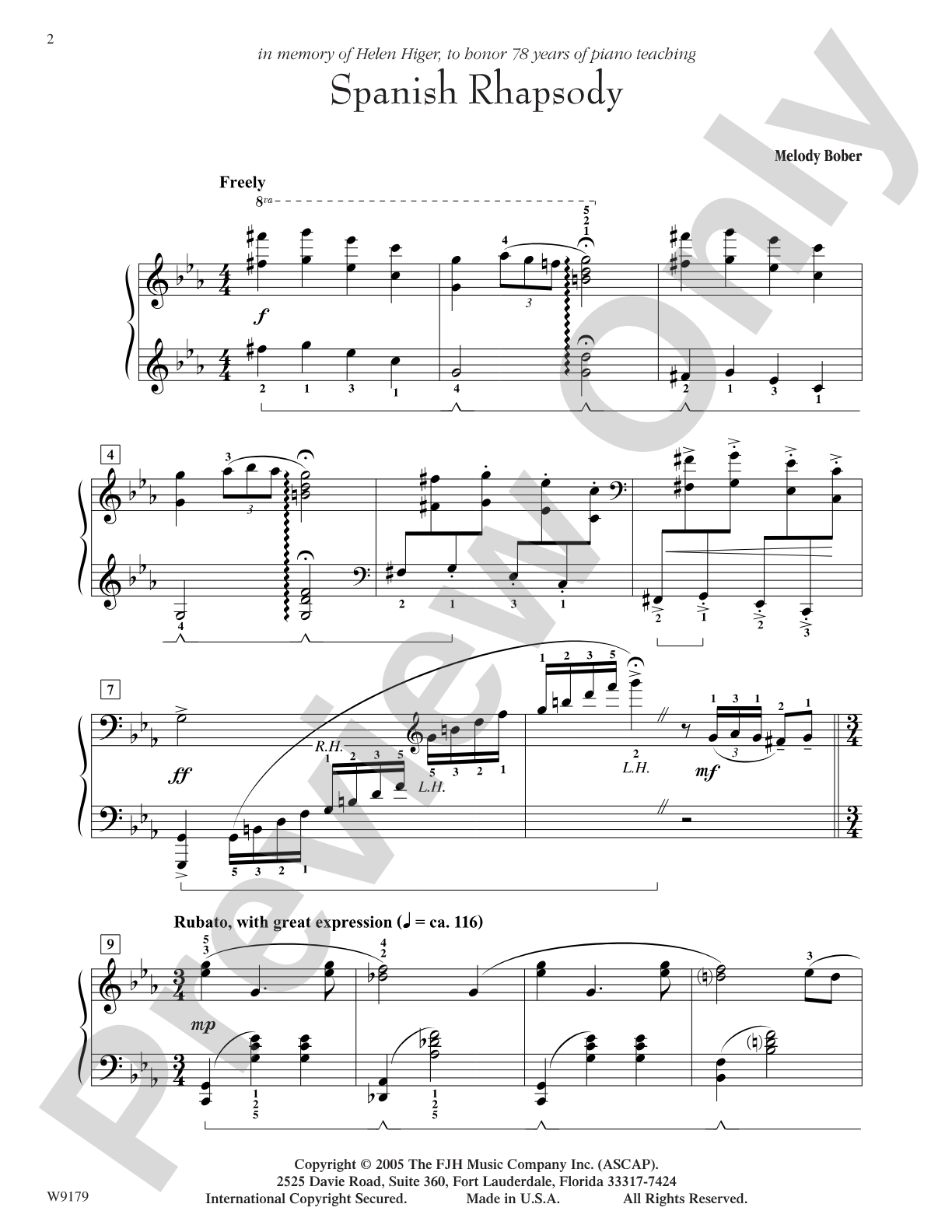
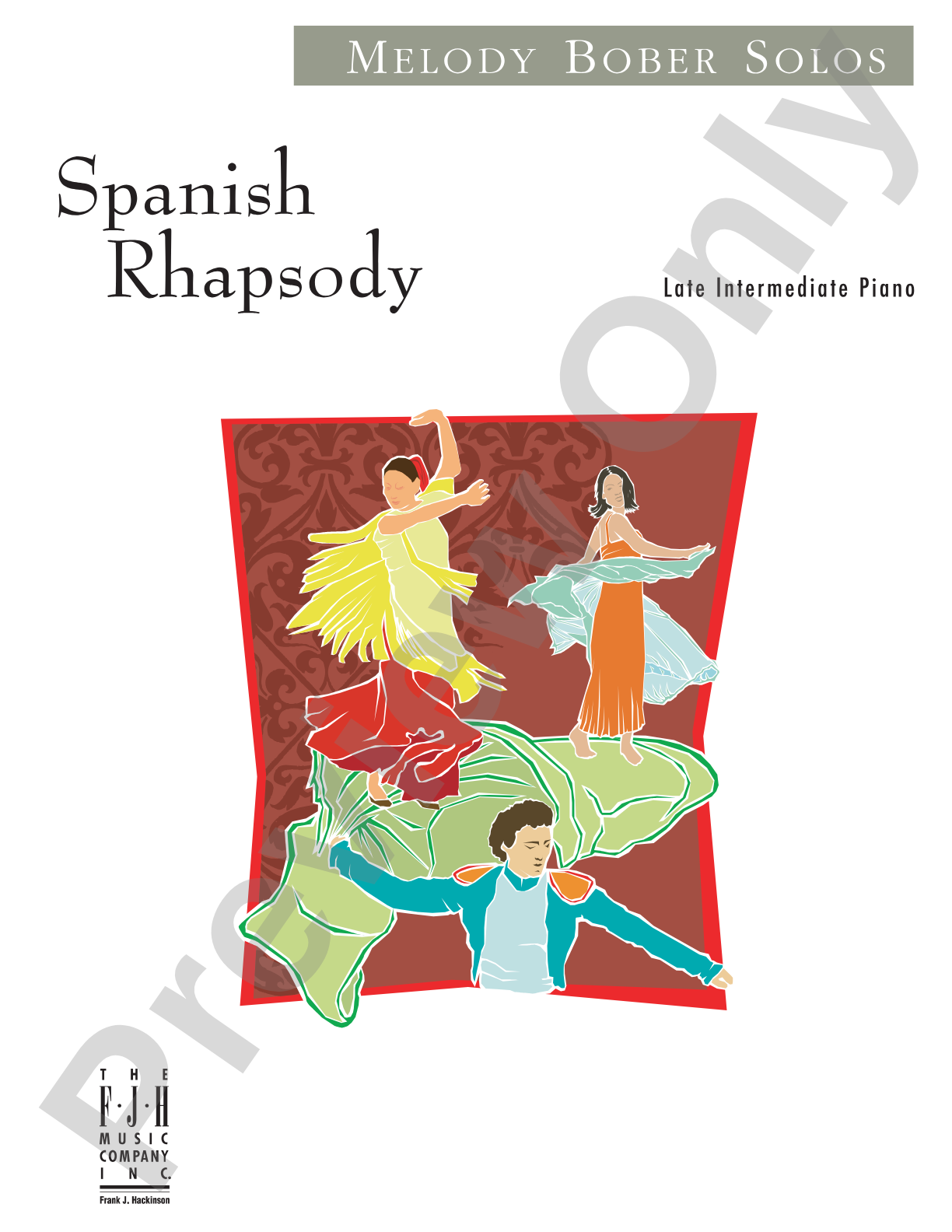
Spanish Rhapsody Sheet Music Preview

Spanish Rhapsody: Piano

By Melody Bober

Item: 98-DW9179

Digital Download
$5.50
Description
Dramatic and rich in style and texture, Spanish Rhapsody is a terrific showpiece. Open octaves, rolled chords, and cross-hand arpeggios add up to a rousing opening introduction, preparing for the waltz theme to make its entrance. The sweeping melody is full of expression and rhythmic tension, great for rubato study. Tenutos appear in the R.H. (thumb) for voicing as the Rhapsody develops. Watch for the opening flourishes to return in a triumphant cadenza.

Spanish Rhapsody: Piano isn't in MakeMusic Cloud just yet...but it could be. Let us know you'd like to see it, and you'll help shape what comes next. In the meantime, start a free trial and dive into thousands of interactive titles your students can play along with today.

Sample Audio
No sample audio found.
Sample Video
Additional Details
Series: Written For You
Publisher: The FJH Music Company, Inc.
SKU: 98-DW9179

More about this title

About the Composer: Melody Bober

Melody Bober

Melody Bober composes piano music grounded in her two decades of classroom teaching and her own journey as a performer. She holds a Bachelor of Music Education from the University of Illinois at Champaign-Urbana and a Master of Arts in Piano Performance from Minnesota State University, Moorhead, where she studied under respected teachers including Joel Shapiro and Andrew Froelich.

Beyond her private studio in Minnesota, Bober has shaped music education in public schools and at the university level, bringing a clinician's insight to conventions and workshops throughout North America. Her work as a church pianist and music director further informs her compositional voice—one that balances musical sophistication with genuine accessibility for developing musicians.

Why we love this

Spanish Rhapsody delivers theatrical flair without sacrificing musicianship. The writing exploits pianistic texture brilliantly—those open octaves and rolled chords in the opening grab attention immediately, while the waltz theme gives students a chance to explore rubato and expressive phrasing over something genuinely singable. It's the kind of piece that makes students feel like accomplished performers.

What to expect

Spanish Rhapsody sweeps you into a world of romantic drama and passionate momentum. The opening crashes with flourish and energy, then settles into a lyrical waltz that invites you to shape every phrase with personal expression. By the triumphant return, you're commanding the full theatrical range of the instrument.

Who it's for

Intermediate to advanced pianists seeking a polished showpiece that combines technical display with genuine musicality. This is ideal for students ready to explore expressive devices like rubato and voicing while building confidence through a piece that rewards dramatic interpretation.

How to get the most out of it

  • Shape the opening flourishes with clear voicing; use the marked tenutos in the right hand to guide listeners through the harmonic movement rather than playing them as mere stylistic ornaments.
  • Approach the waltz theme as a vocal melody. Let the rhythmic tension breathe through rubato while keeping the accompaniment anchored enough to maintain forward momentum.
  • Balance the dramatic return of the opening material in the cadenza. These flourishes should feel like a dramatic climax, not a repeat. Build intensity through tempo and dynamic control.
  • Practice the cross-hand arpeggios slowly to ensure smoothness and clarity. Once the technical foundation is solid, let the arpeggios support the melodic line rather than compete with it.

How to use it

Spanish Rhapsody works beautifully as a solo recital showpiece or as a highlight within a themed concert exploring Spanish or Romantic musical traditions. Its shorter length and dramatic arc make it an excellent closer for a student recital, leaving the audience with a strong final impression.

Skills your students will build

  • Rubato and expressive phrasing over a clear harmonic foundation
  • Voicing through hand position and tenuto articulation
  • Cross-hand arpeggios and rolled chord technique
  • Dramatic shape and structure in multi-section forms
  • Pedal control to support texture without muddying harmony

You May Also Like