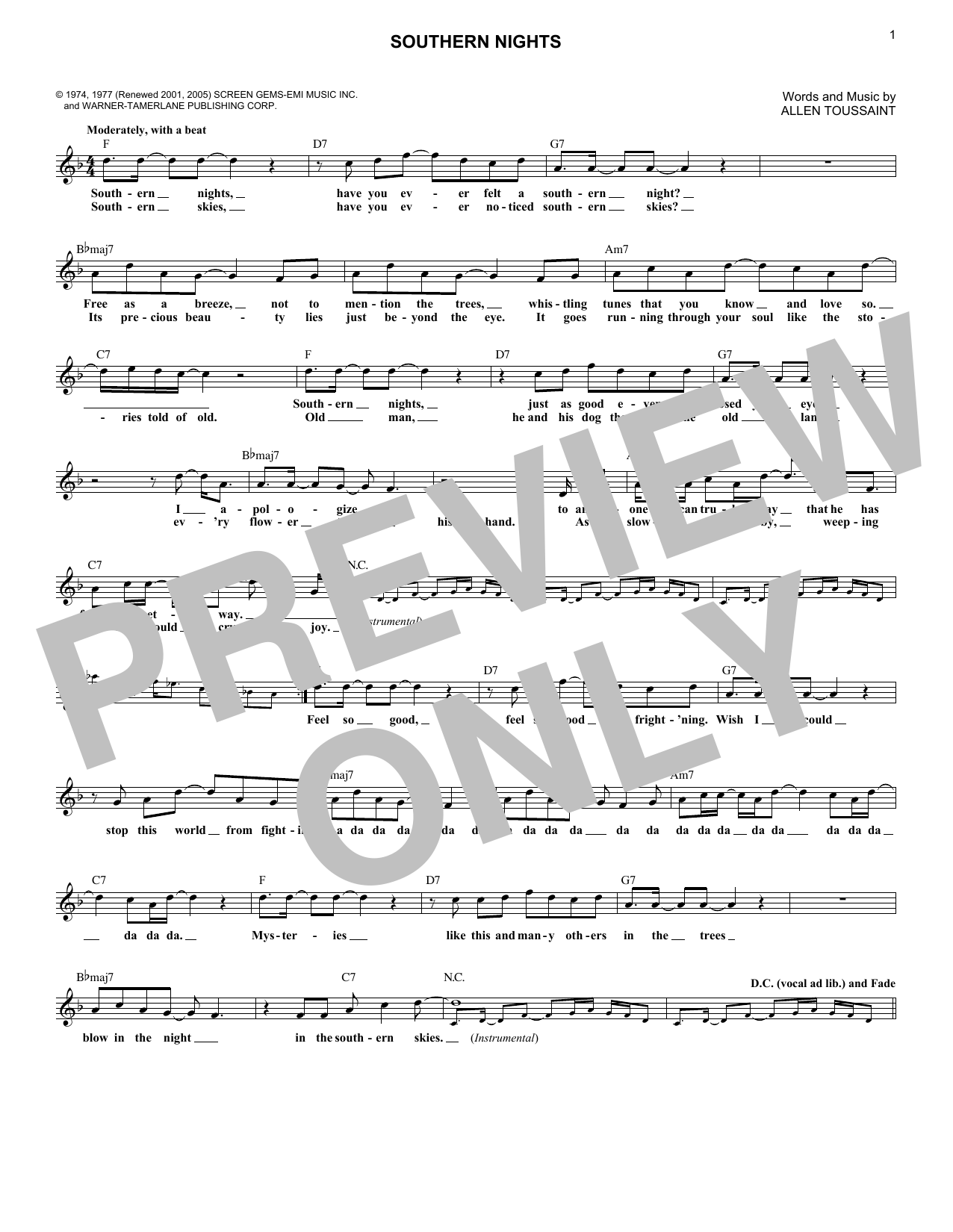
Southern Nights Sheet Music Preview

Southern Nights: Lead Sheet / Fake Book

As performed by Glen Campbell

Item: 35-DS00437294

Digital Download
$3.99
Description

Southern Nights: Lead Sheet / Fake Book isn't in MakeMusic Cloud just yet...but it could be. Let us know you'd like to see it, and you'll help shape what comes next. In the meantime, start a free trial and dive into thousands of interactive titles your students can play along with today.

Sample Audio
No sample audio found.
Sample Video
Additional Details
Publisher: Hal Leonard
Page Count: 1
SKU: 35-DS00437294

More about this title

About the Artist: Glen Campbell

Glen Campbell became one of country music's most versatile and commercially successful artists during the 1960s and 1970s. Before his solo career took off, he worked as a session guitarist in Los Angeles, playing on records by The Beach Boys, Frank Sinatra, and countless others. His combination of genuine country roots and pop sensibility made him a bridge between genres at a time when those worlds were drawing closer together.

Campbell's output included not just country hits but also pop standards and film music, earning him multiple Grammy Awards and a long television variety show. His musicianship set him apart from many of his contemporaries; he could play nearly any instrument competently and understood arrangement and production deeply. For music educators, his catalog represents an important chapter in how country music evolved into the mainstream sound of American popular music.

Why we love this

Southern Nights captures the blend of country and pop sensibility that made Campbell such a compelling performer for diverse audiences. The song's harmonic movement and melodic accessibility make it ideal for teaching how a simple, singable melody can anchor a sophisticated arrangement. Vocalists will appreciate how the melody sits comfortably within a practical range while maintaining genuine emotional color.

What to expect

Warm and unhurried, with the easiness of a late evening conversation. The song carries a gentle melancholy beneath its accessible melody, grounded in harmonic colors that suggest both country tradition and contemporary sophistication. There's no strain in the performance; everything settles into place with natural grace.

Who it's for

Pianists and keyboard players developing their skills in reading lead sheets and comping will find this a rewarding standard. Singers preparing pop and country repertoire or working in jazz and contemporary contexts will benefit from understanding how this tune sits between genres. Music students exploring the intersection of country, pop, and American song tradition should study how Campbell's recording balances authenticity with mainstream appeal.

How to get the most out of it

  • Listen closely to the rhythmic pocket in the original recording; Campbell's version has a gentle swing that sits just behind the beat, creating a relaxed feel that students often rush past.
  • Pay attention to the harmonic movement and chord voicings in the lead sheet; experimenting with upper extensions and substitutions transforms how the tune feels without losing its essential character.
  • Let the lyrics breathe and tell the story rather than overselling the melody; this tune rewards a conversational, understated vocal approach.

How to use it

Include this in a set exploring American songwriting from the 1970s, pairing it with other cross-genre standards that reached both country and pop audiences. It works particularly well in programs highlighting the development of country music's mainstream evolution, or in educational settings where students are learning to navigate lead sheets across multiple stylistic contexts. Consider it a bridge piece between traditional country and contemporary pop in student performances or as a teaching example.

Skills your students will build

  • Reading and performing from lead sheets
  • Comping and harmonic improvisation on piano or keyboard
  • Stylistic singing across genre boundaries
  • Understanding swing and rhythmic feel in pop and country contexts
  • Chord voicing choices and harmonic color

You May Also Like