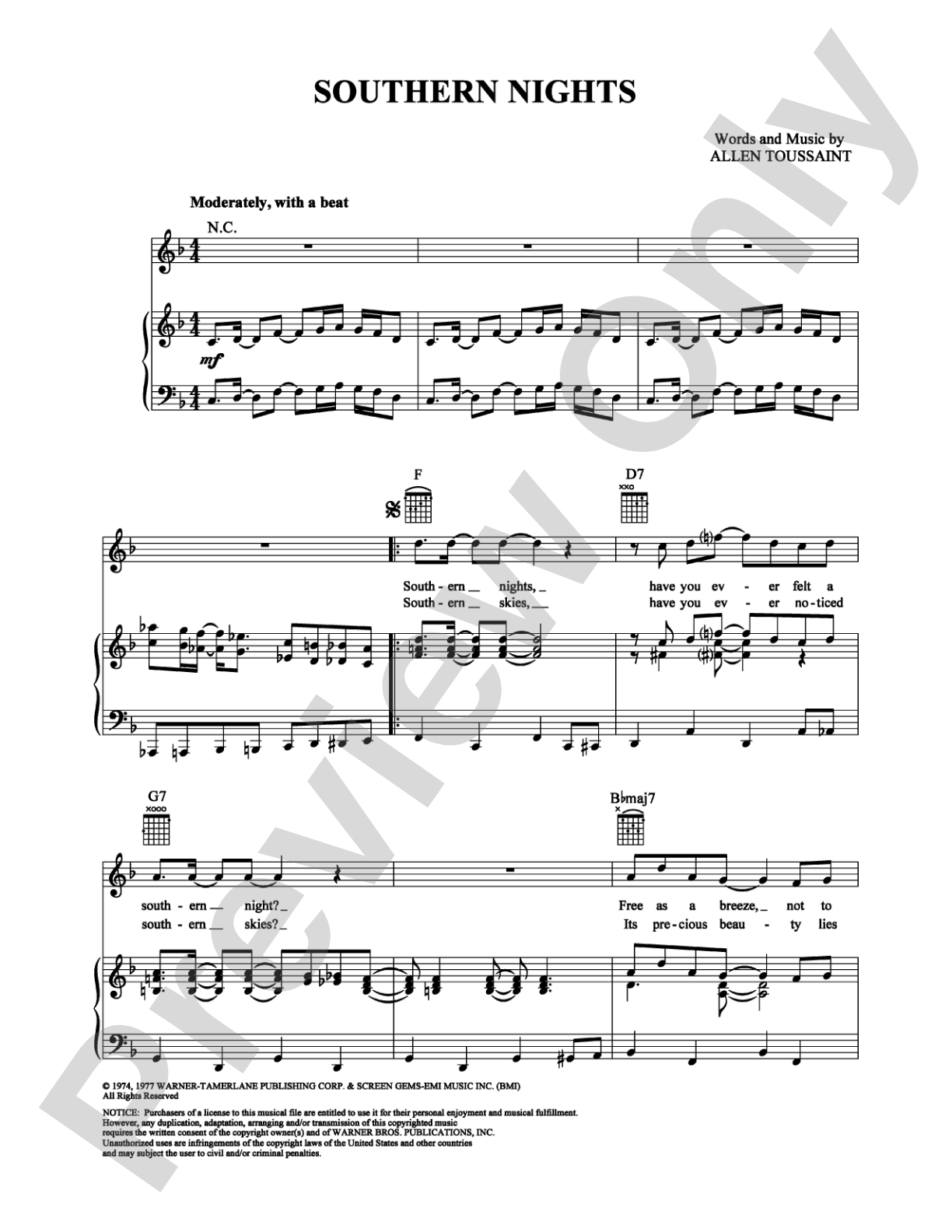
Southern Nights: Piano/Vocal/Chords Digital Sheet Music

Southern Nights: Piano/Vocal/Chords Digital Sheet Music

Glen Campbell, Allen Toussaint

Item: 00-PS-0005467

Digital Download
$3.99
Description

Southern Nights: Piano/Vocal/Chords Digital Sheet Music isn't in MakeMusic Cloud just yet...but it could be. Let us know you'd like to see it, and you'll help shape what comes next. In the meantime, start a free trial and dive into thousands of interactive titles your students can play along with today.

Sample Audio
No sample audio found.
Sample Video
Additional Details
SKU: 00-PS-0005467

More about this title

About the Artist: Glen Campbell

Glen Campbell built his career as one of country music's most versatile performers, equally comfortable with a guitar, at a piano, or in front of a microphone. His ability to blend country sensibility with pop accessibility made him a fixture on radio and television throughout the 1960s and 1970s, and his musicianship earned him respect across multiple genres.

Campbell's instrumental skill and interpretive gifts made him a natural choice for studio sessions and his own recordings. "Southern Nights" exemplifies his gift for finding the emotional core of a song and delivering it with warmth and authenticity, whether in a contemporary pop-rock setting or a more intimate arrangement.

Why we love this

This arrangement captures a song that sits perfectly between country and pop sensibilities, making it accessible for singers and pianists who want to explore cross-genre repertoire without stepping too far from familiar harmonic territory. The piano/vocal/chords format gives students immediate flexibility: they can work from the melody line alone, use the chord symbols to explore improvisation or reharmonization, or lean on the full piano part for support during early rehearsals.

What to expect

Warm, inviting, and subtly reflective. The song settles into a relaxed groove that feels instantly familiar even on first hearing, with harmonic movement that's simple enough to hear clearly but rich enough to hold interest. There's a gentle nostalgia here, paired with an easygoing confidence that makes both singers and pianists feel welcome.

Who it's for

Singers and pianists working at the intermediate level who want a contemporary pop-country standard that doesn't require extensive transposition or revoicing. It's equally valuable for voice students building a recital program that crosses genre boundaries and for pianists seeking accessible yet musically substantial repertoire that lets them accompany or perform solo.

How to get the most out of it

  • Treat the piano part as a conversation partner, not mere accompaniment. Listen to how the keyboard voices respond to the vocal line and mirror that call-and-response quality in your phrasing.
  • Let the chord symbols guide your harmonic understanding. Notice which changes feel restful and which create forward motion, then shape your vocal dynamics to match those harmonic gestures.
  • The pop-rock groove needs pocket and ease. Avoid rushing; lock into the rhythm section feel and prioritize a conversational delivery over strict metronomic precision.
  • Explore the space around the melody line. This song rewards a vocalist who finds moments to sit back and let the piano breathe, then step forward when the emotional temperature rises.

How to use it

Consider pairing this with other contemporary standards or genre-crossing crossover pieces in a recital focused on American popular song. It works well as a closing number or an encore, where its warmth and accessibility can leave an audience satisfied. Voice students can use it as a bridge piece when moving between classical and contemporary repertoire, or pianists can program it alongside jazz standards or singer-songwriter material.

Skills your students will build

  • Reading and interpreting chord symbols in a pop-rock context
  • Balancing melody and accompaniment in a piano/vocal ensemble
  • Phrasing across a long, conversational melodic line
  • Understanding pop and country harmonic conventions
  • Accompanying skills for pianists supporting a vocalist

You May Also Like