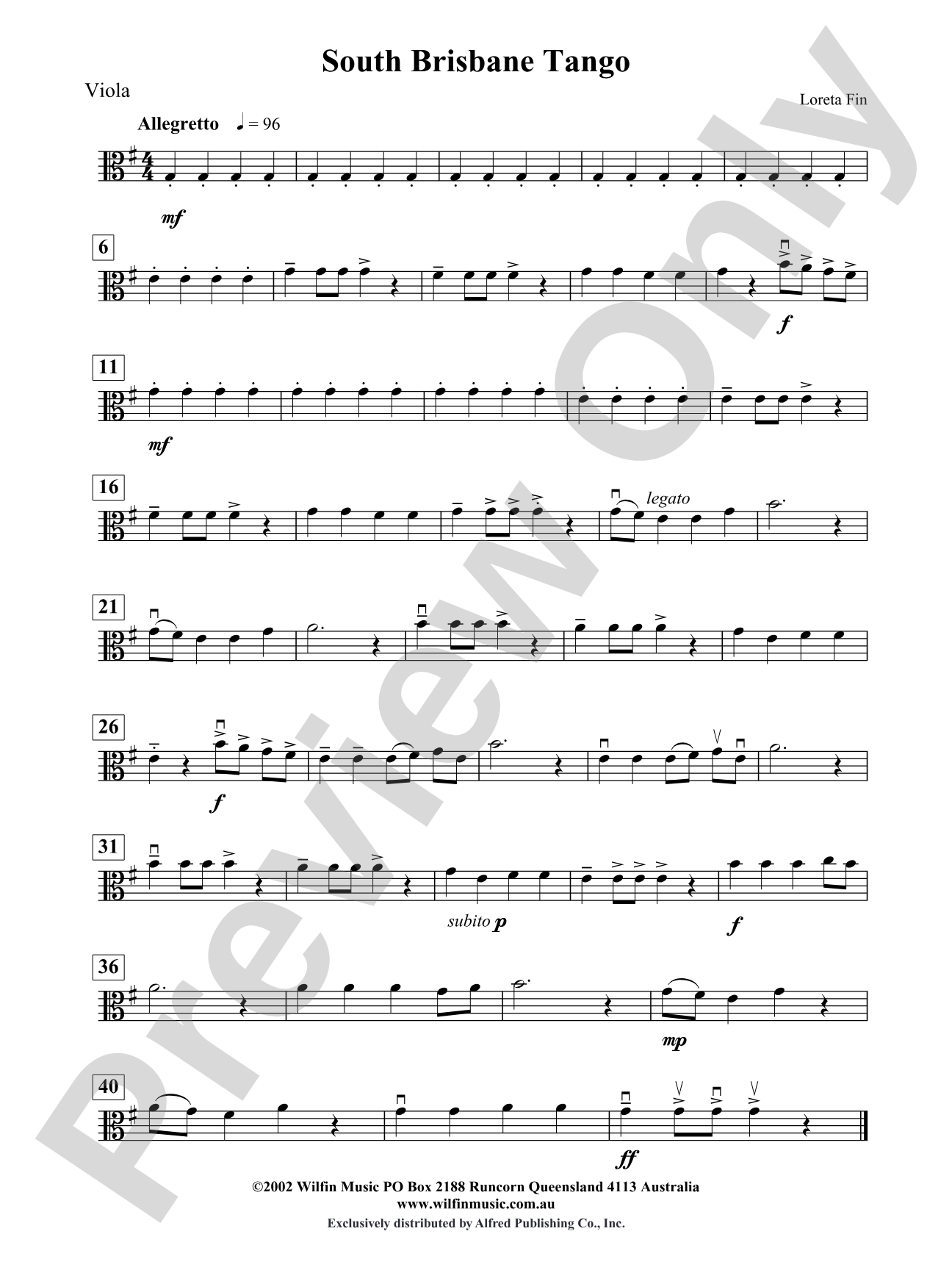
South Brisbane Tango: Viola Sheet Music Preview

South Brisbane Tango: Viola

By Loreta Fin

Grade: 2

Item: 76-PC-0000016_VA1

Digital Download
$5.99
Description
Interesting variety of bowing styles. Melody is shared around the orchestra. Tango style will be easily captured.

South Brisbane Tango: Viola isn't in MakeMusic Cloud just yet...but it could be. Let us know you'd like to see it, and you'll help shape what comes next. In the meantime, start a free trial and dive into thousands of interactive titles your students can play along with today.

Sample Audio
No sample audio found.
Sample Video
Additional Details
Series: Wilfin String Orchestra: Young String Ensemble Series
Publisher: Wilfin Music
Page Count: 66
SKU: 76-PC-0000016_VA1

More about this title

About the Composer: Loreta Fin

Loreta Fin

Loreta Fin AM is an Australian composer and string educator with deep roots in both performance and pedagogy. A first violinist with the Sydney Youth Orchestra and later principal viola with the Queensland Pops Orchestra, she studied at the Sydney Conservatorium of Music and has performed regularly in chamber and orchestral settings alongside internationally recognized artists. Since 1993, she has directed strings at Somerville House School in Brisbane, where her work shaped generations of young musicians.

Fin's contributions to music education and the profession have been formally recognized across Australia and internationally. She served as both State and National President of the Australian Strings Association and was honored with a Queensland State Award for services to the organization in 2009. As an examiner with the Australian Music Examinations Board and current State Advisor for Strings, she regularly conducts state and national honors ensembles. Her published output exceeds 100 works for string orchestra, distributed worldwide through Alfred Music, including her Beginner String Ensemble Series. In 2018 and 2019, she conducted the Miri Music Project in Malaysia, and she received the National Award for Services to Music and String Teaching at a recent AUSTA National Conference.

Why we love this

South Brisbane Tango arrives from a composer who understands exactly how young orchestras work and what makes them sound their best. The melody rotates through the ensemble so every player gets a moment in the spotlight, and the varied bowing styles keep the piece from feeling repetitive while building technique naturally. Grade 2 groups rarely encounter tango as a style, which makes this both accessible and genuinely educational.

What to expect

South Brisbane Tango captures the rhythmic drive and dramatic flair of tango in a setting young musicians can actually inhabit and enjoy. The piece pulses with energy while remaining technically accessible, offering players a genuine taste of Latin style without sacrificing the developmental focus that matters at this level.

Who it's for

Grade 2 string orchestras and young string ensembles ready to explore a style beyond standard pedagoical repertoire. Directors seeking pieces that develop technique (bowing variety, style awareness) while keeping all players engaged through shared melody work will find this especially valuable.

How to get the most out of it

  • Establish the rhythm section (violas and cellos) first so they lock the characteristic tango pulse; young orchestras often rush this style, so deliberate practice of the accompaniment figure pays immediate dividends.
  • Rotate the spotlight among players as melody passes around the ensemble, allowing each soloist to feel the shape of the phrase before it moves on.
  • Bring out the color in the bowing variety described in the score; the changes in bow technique are not just ornamental but fundamental to how tango sits rhythmically and stylistically.
  • Use the conductor score to map exactly where melodic responsibility shifts so you can cue transitions cleanly and build confidence in younger players.

How to use it

Program this as a stylistic bridge in a concert that might otherwise lean heavily on standard classical forms. It works well alongside lighter pedagogical pieces from earlier in the program and can anchor a thematic section exploring non-European music traditions. The Grade 2 level also makes it suitable for a spring concert or adjudicated festival where you want to demonstrate both technical growth and musical versatility.

Skills your students will build

  • Bowing variety and articulation control
  • Tango rhythm and stylistic interpretation
  • Shared melody and ensemble listening across the orchestra
  • Maintaining steady pulse in syncopated accompaniment figures

You May Also Like