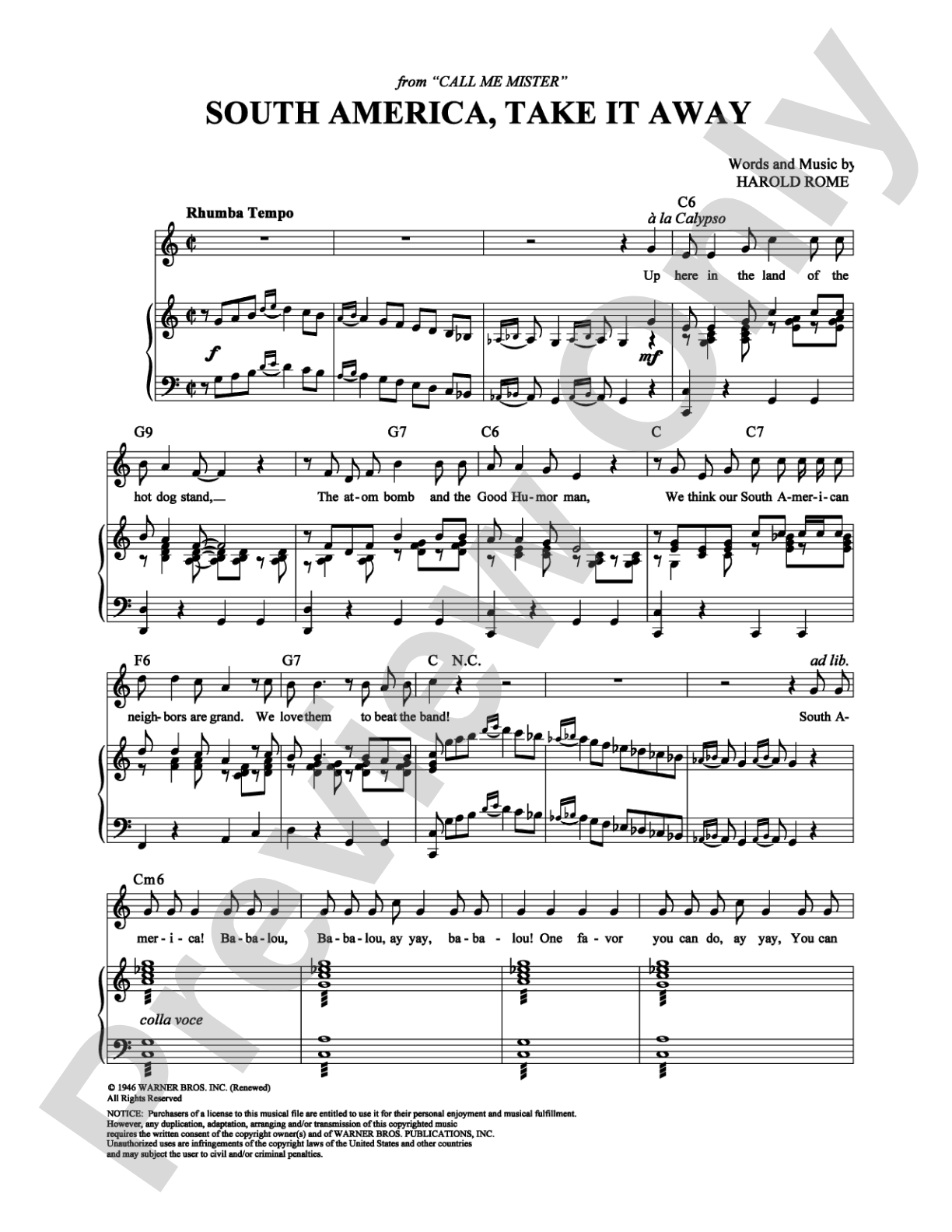
South America, Take It Away: Piano/Vocal/Chords Digital Sheet Music

South America, Take It Away: Piano/Vocal/Chords Digital Sheet Music

Bing Crosby, Harold Rome, The Andrews Sisters

Item: 00-PS-0005356

Digital Download
$3.99
Description

South America, Take It Away: Piano/Vocal/Chords Digital Sheet Music isn't in MakeMusic Cloud just yet...but it could be. Let us know you'd like to see it, and you'll help shape what comes next. In the meantime, start a free trial and dive into thousands of interactive titles your students can play along with today.

Sample Audio
No sample audio found.
Sample Video
Additional Details
SKU: 00-PS-0005356

More about this title

About the Artist: Bing Crosby

Bing Crosby (1903-1977) was an American singer and actor whose influence on vocal style shaped popular music for generations. His relaxed, intimate approach to phrasing and his mastery of swing rhythms made him one of the most recorded artists of the 20th century, and his interpretations remain essential references for singers studying American popular song.

Crosby's ability to blend his voice seamlessly with instrumental accompaniment and ensemble singers made him a natural collaborator. His recordings with The Andrews Sisters exemplified the vocal harmony traditions of the 1940s and remain benchmarks for understanding how to balance solo presence with group cohesion.

Why we love this

This is a classic novelty number with genuine swing appeal, featuring the kind of rhythmic interplay and call-and-response writing that teaches singers how to navigate ensemble passages while maintaining forward momentum. The Andrews Sisters' tight three-part harmony and Crosby's conversational vocal style create a blueprint for performers learning how American popular music from the 1940s balanced instrumental swung rhythms with vocal clarity and personality.

What to expect

Bright and propulsive, with a tropical novelty flavor that never takes itself seriously. The rhythmic drive and playful vocal interplay create an immediate sense of fun and forward motion, supported by a piano part that swings confidently beneath the melody.

Who it's for

Singers and pianist-vocalists preparing American popular music from the swing era, as well as classroom teachers seeking accessible, high-energy material that demonstrates genuine ensemble collaboration. This works well for students tackling vintage vocal arrangements where the piano part carries strong rhythmic and harmonic information.

How to get the most out of it

  • Shape the phrase with the piano's rhythmic pocket rather than fighting it; this piece rewards a relaxed, conversational delivery over metronomic precision.
  • Clarify the ensemble sections by establishing where the vocal blend sits relative to the lead line; mark your part clearly if you're singing one of the harmony roles.
  • Treat the syncopated rhythms as playful rather than rushed; the swing feel depends on laying back slightly against the beat.

How to use it

Include this in a program exploring American popular song from the 1940s, or pair it with other novelty numbers and swing-era arrangements to show how singers managed charm and ensemble precision together. It works particularly well in informal recitals or educational settings where audiences appreciate hearing how popular music of this era balanced theatrical appeal with genuine musicianship.

Skills your students will build

  • Singing swing rhythms and resisting the urge to rush syncopated lines
  • Blending as a secondary voice while maintaining personal vocal color
  • Reading piano/vocal/chord notation and using the chord symbols to inform phrasing
  • Ensemble coordination with a piano accompanist, specifically tracking rhythmic placement

You May Also Like