
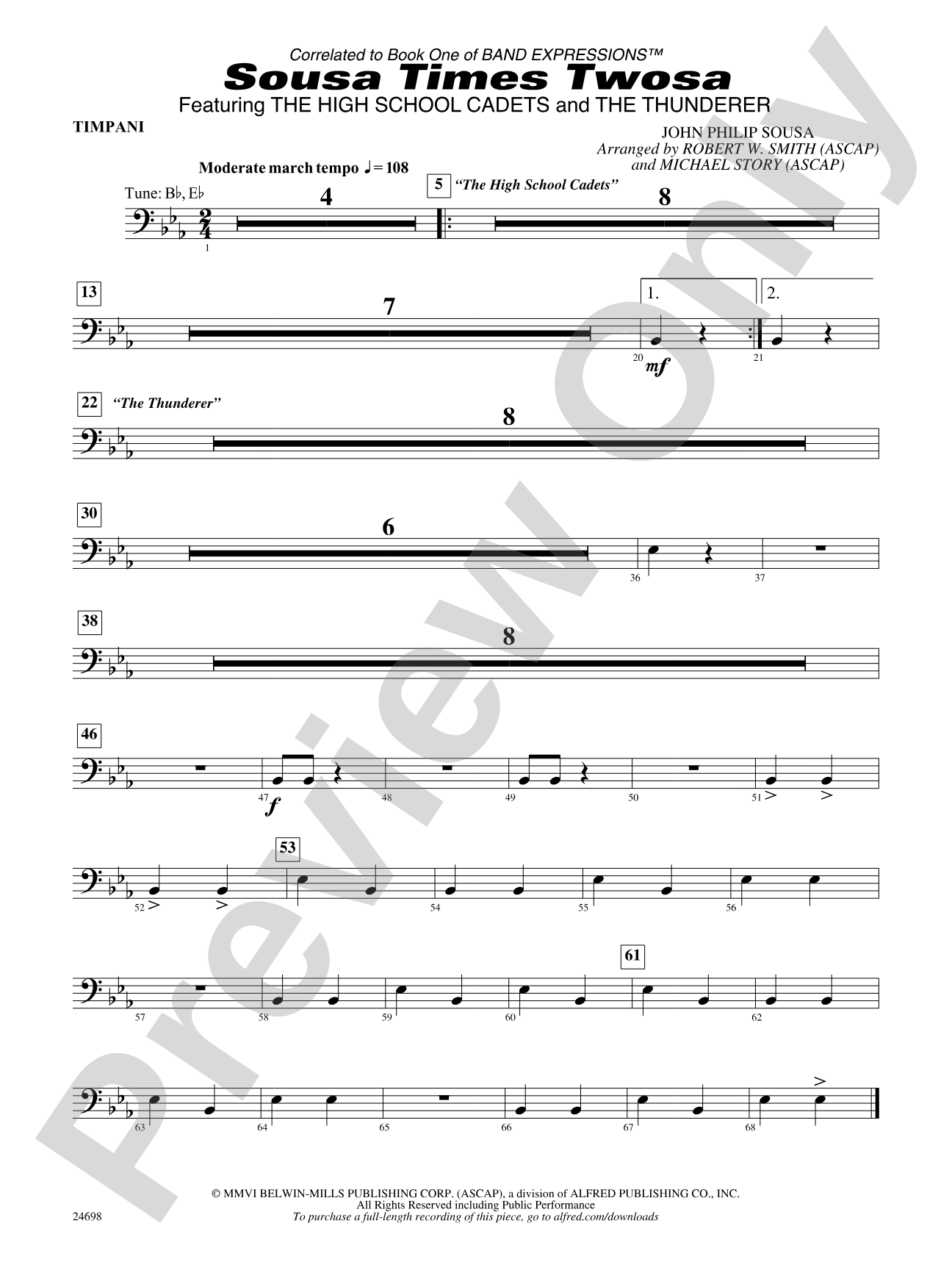

Sousa Times Twosa: Timpani
Featuring: High School Cadets / The Thunderer
Arr. Robert W. Smith and Michael Story
Grade: 1 (Very Easy)
Item: 00-PC-0000858_TMP
$3.00
Pickup currently not available
Description
Sousa's contribution to the band literature is unparalleled. The main themes from "The High School Cadets" and "The Thunderer" have been carefully prepared by Robert W. Smith and Michael Story for your beginners at the end of their first year. Although scored to compliment the end of Band Expressions™ Book One, this march-duo would work well with any beginning class on their concluding program. A worthy teaching and performance choice. This title is available in MakeMusic Cloud.


Don't just read it, hear it, play along with it, and watch your students grow with it. In MakeMusic Cloud, Sousa Times Twosa: Timpani comes alive with professional accompaniment, adjustable tempo, and built-in practice tools that turn solo practice into real progress.
Open in the Player
Jump straight in and assign it today.
Start Your Free Trial
Open this title and explore the full library in minutes.
Sample Audio
1
Audio File
--:--
0:00
0:00
Sample Video
No sample videos found.
Additional Details
Series:
Band Expressions
Publisher:
Alfred Music
Page Count:
138
SKU:
00-PC-0000858_TMP
More about this title
About the Arranger: Robert W. Smith

Robert W. Smith has established himself as a central figure in concert band and orchestral composition, with over 400 published works distributed primarily through Alfred Music. He holds degrees in music education from Troy State University (AL) and a master's degree from the University of Miami (FL). His original compositions, including the symphonies The Divine Comedy and The Odyssey, have reached audiences across North America, Europe, Australia, and Asia, while works like The Tempest have become foundational repertoire for developing ensembles.
Beyond the concert hall, Smith's music has appeared in high-profile contexts ranging from Olympic Games broadcasts to the opening of the Macy's Thanksgiving Day Parade telecast, the Ringling Brothers/Barnum & Bailey Circus, and Opening Day at Dodger Stadium. As both a conductor and clinician, he has led ensembles and presented workshops throughout the United States, Canada, Japan, Australia, Italy, Austria, and the United Kingdom.
Why we love this
Smith and Story have distilled two beloved Sousa marches into an accessible entry point for young bands without sacrificing the character that makes these works enduring favorites. The pairing of main themes from "The High School Cadets" and "The Thunderer" gives students a taste of genuine march tradition while remaining firmly within their technical grasp at the end of first year. Programming this demonstrates to students and audiences alike that serious repertoire, skillfully adapted, can be both achievable and genuinely rewarding.
What to expect
Marching with purpose and energy. These familiar themes carry an inherent lift and confidence that invites young players to experience themselves as musicians performing genuine concert literature. The orchestration breathes at a Grade 1 level, but the music itself never feels compromised or condescended to.
Who it's for
This arrangement is designed for concert bands completing their first year of study, offering repertoire that honors the march tradition while staying within technical reach. It works equally well for students using Band Expressions Book One and any beginning band program ready for a substantial concert or festival closing number.
How to get the most out of it
- Establish a crisp, energetic tempo that lets the march character sing without rushing. Sousa's marches live in clean articulation and steady forward motion.
- Balance the melodic material between sections so that each theme emerges clearly. With a Grade 1 ensemble, clarity often matters more than volume.
- Shape the transitions between the two march themes deliberately. A moment of ensemble control here signals musical intent.
- Attend to the harmonic support in the inner voices. Young musicians often find their musicianship deepens when they hear how their part anchors the overall sound.
How to use it
Reserve this for your end-of-year concert or festival appearance when students have built enough ensemble cohesion to handle multiple themes and moderate complexity. The march genre gives students a natural sense of where the piece is going, building their confidence for performance. Alternatively, use it as a bridge piece on a program pairing classical wind band repertoire with newer works, showing the lineage students are joining.
Skills your students will build
- Idiomatic march articulation and phrasing
- Harmonic independence in support voices
- Ensemble balance across multiple melodic statements
- Sustained tempo control and forward momentum
- Sectional coordination in theme transitions