
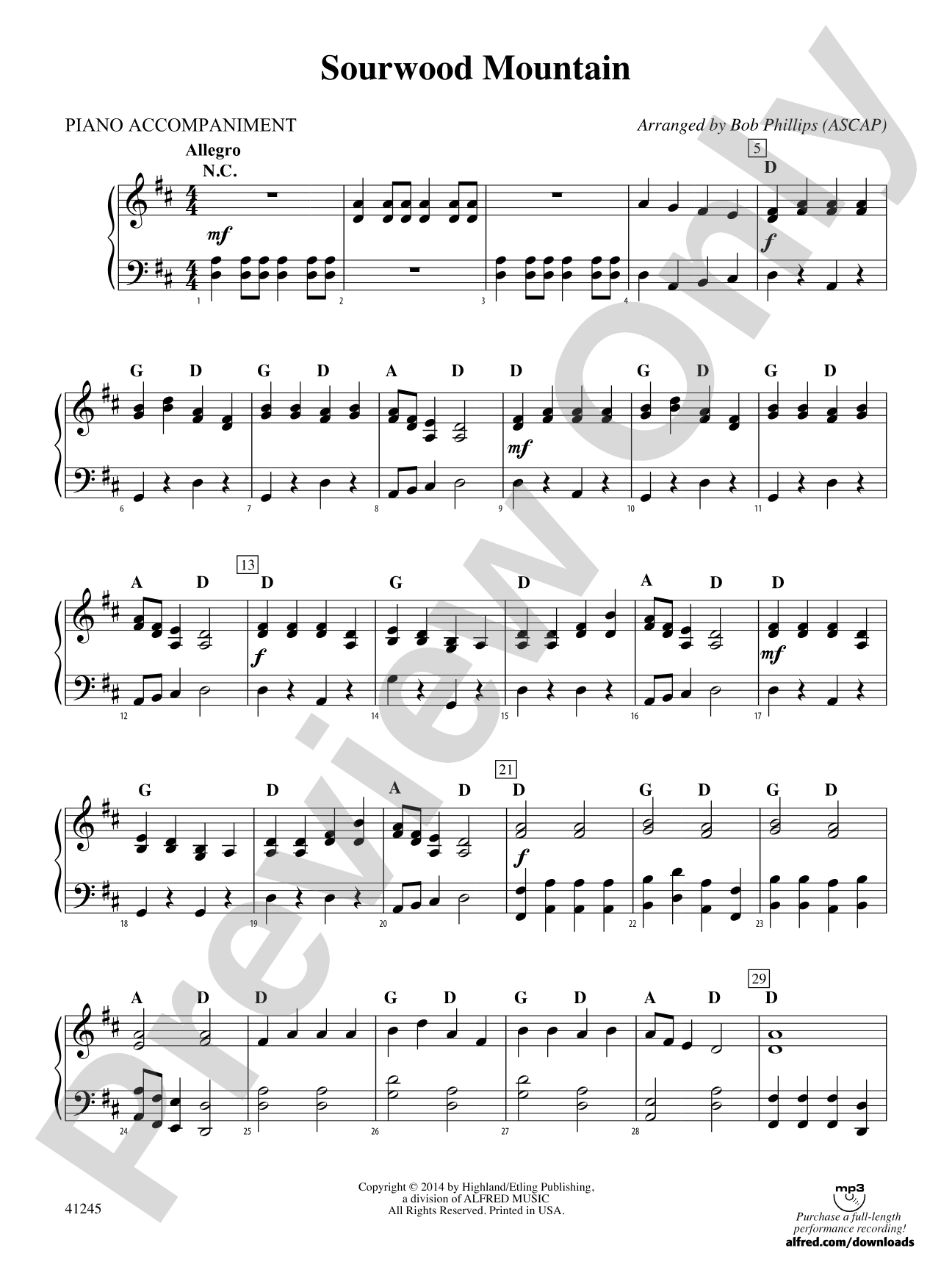

Sourwood Mountain: Piano Accompaniment
Traditional / arr. Bob Phillips
Grade: 1.5
Item: 00-PC-0016365_K
$5.99
Pickup currently not available
Description
Bring a fiddle flavor to your orchestra with this simplified arrangement. Perfect for young players. Add hats, bandanas, and square dancing for a fun concert event. (1:55)
Correlates to Sound Innovations Book 1, Level 4. This title is available in MakeMusic Cloud.


Correlates to Sound Innovations Book 1, Level 4. This title is available in MakeMusic Cloud.
Don't just read it, hear it, play along with it, and watch your students grow with it. In MakeMusic Cloud, Sourwood Mountain: Piano Accompaniment comes alive with professional accompaniment, adjustable tempo, and built-in practice tools that turn solo practice into real progress.
Open in the Player
Jump straight in and assign it today.
Start Your Free Trial
Open this title and explore the full library in minutes.
Sample Audio
1
Audio File
--:--
0:00
0:00
Sample Video
No sample videos found.
Additional Details
Series:
Sound Innovations for String Orchestra
Publisher:
Alfred Music
Page Count:
80
SKU:
00-PC-0016365_K
More about this title
About the Arranger: Bob Phillips

Bob Phillips is a composer and arranger who has shaped string education through innovative pedagogical writing and ensemble direction. Since the 1970s, he has authored over 25 instructional series for strings, including all six levels of Sound Innovations and genre-focused collections like Fiddlers Philharmonic, Jazz Philharmonic, and Rock Philharmonic. His arrangements and original compositions have been performed by thousands of young musicians annually, and his work has earned recognition as an ASCAP award-winning composer whose pieces regularly appear at the Midwest Clinic.
For 27 years, Phillips directed the string program in Saline, Michigan, building it into a nationally recognized model serving over 700 students across classical and eclectic styles. He founded the Saline Fiddlers Philharmonic, which achieved international prominence through extensive performance schedules and appearances at the White House and major festivals. Phillips has also served as resident conductor for the Wintergrass Festival in Seattle and conducted at numerous state honors orchestras, all-state programs, and summer music camps including Blue Lake Fine Arts Camp and Interlochen.
Why we love this
Phillips captures authentic fiddle character without overwhelming young players, preserving the tune's rhythmic swagger while keeping the arrangement melodically clear and technically accessible. The straightforward orchestration lets individual sections shine, making it equally effective as a concert closer or a vehicle for teaching stylistic awareness. Directors consistently choose this because it delivers genuine musical satisfaction at Grade 1.5, proving that simplified does not mean diminished.
What to expect
Infectious and spirited, this arrangement sparkles with the casual joy of a square dance hall. The melody bounces with vernacular charm, inviting listeners to tap their feet and remember why string instruments love folk music.
Who it's for
Young string orchestras at the beginning intermediate level who are ready to explore American folk traditions and fiddle idioms. Students benefit from exposure to a musical style outside the classical canon, while directors gain a piece that entertains audiences and builds sectional confidence.
How to get the most out of it
- Emphasize the lilt of the fiddle style by favoring a lifted bow approach rather than smooth legato; think of the bowing as naturally bouncy rather than lyrical.
- Shape phrases with subtle dynamic swells at phrase peaks, letting the melody breathe like a fiddler would phrase vocally.
- Coordinate the violins carefully during the unison passages; clarity across sections is essential when the arrangement is transparent.
- Use the backing parts as rhythmic anchors; encouraging violas and cellos to feel the pulse internally prevents rushing.
How to use it
This works brilliantly as a finale to a concert themed around American music or folk traditions, especially when paired with staging or dancing that brings the square dance spirit to life. It also fits seamlessly into an educational program showcasing different musical genres, offering a lively contrast to classical repertoire and introducing students to the fiddle tradition.
Skills your students will build
- Playing with stylistic awareness in folk and fiddle idioms
- Maintaining a lifted, bouncy bow attack distinct from classical legato
- Keeping rhythmic precision in unison passages across sections
- Listening for and responding to sectional balance in transparent orchestration