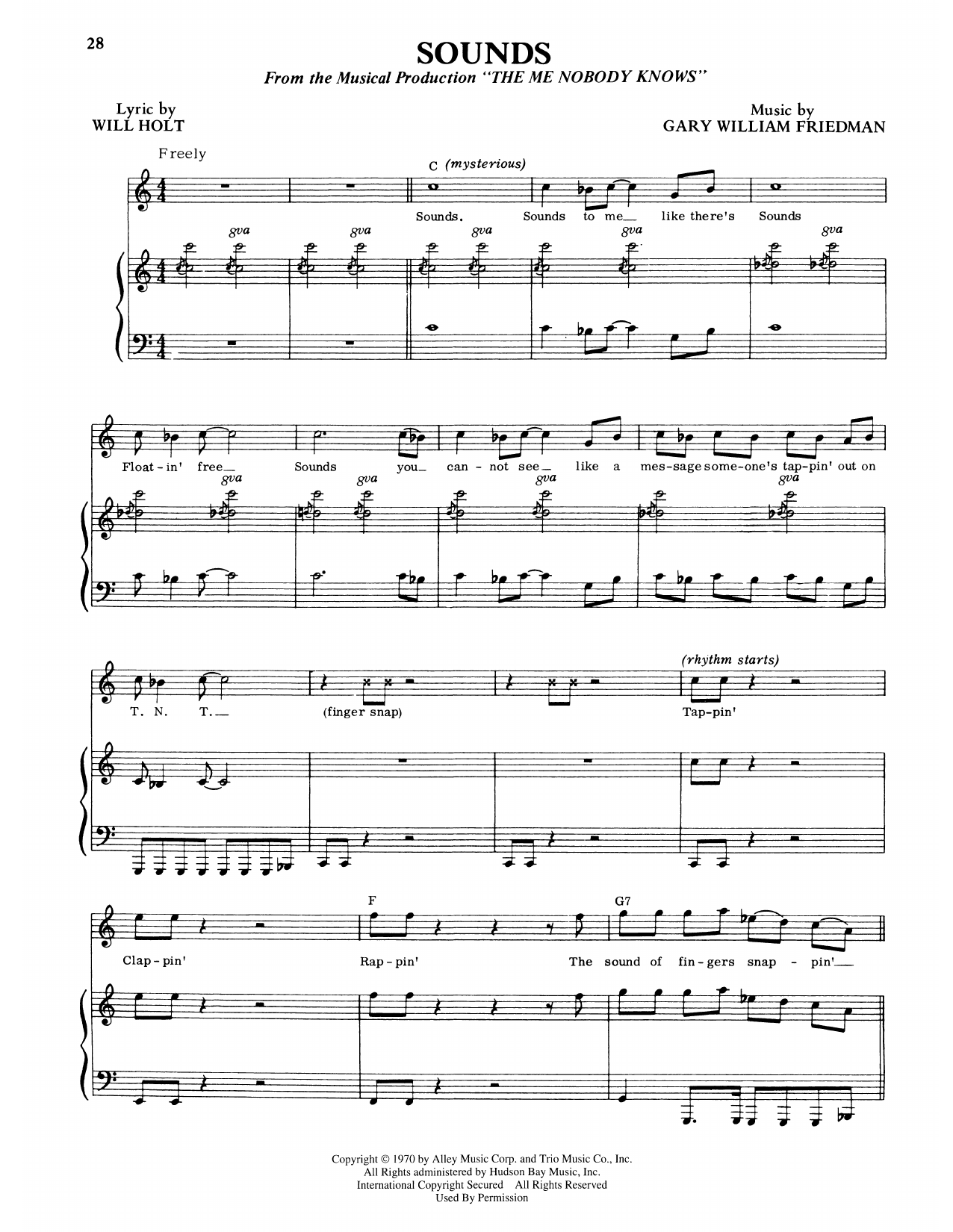
Sounds (from The Me Nobody Knows) Sheet Music Preview

Sounds (from The Me Nobody Knows): Piano Vocal

As performed by Will Holt

Item: 35-DS01739563

Digital Download
$5.99
Description

Sounds (from The Me Nobody Knows): Piano Vocal isn't in MakeMusic Cloud just yet...but it could be. Let us know you'd like to see it, and you'll help shape what comes next. In the meantime, start a free trial and dive into thousands of interactive titles your students can play along with today.

Sample Audio
No sample audio found.
Sample Video
Additional Details
Publisher: Hal Leonard
Page Count: 5
SKU: 35-DS01739563

More about this title

About the Artist: Will Holt

Will Holt was a multifaceted theater artist whose songwriting career spanned musical theater, off-Broadway productions, and children's programming. He composed and co-wrote "The Me Nobody Knows," a groundbreaking 1970 musical that gave voice to the inner lives of New York City schoolchildren through their own writings and poetry. Holt's approach to musical theater was deeply humanistic, favoring intimate character expression over spectacle.

Why we love this

This song captures something rare in musical theater repertoire: genuine emotional vulnerability without sentimentality. The lyric and melodic language feel conversational yet deeply moving, making it an excellent teaching text for singers learning to build character from simple, honest material rather than technical display.

What to expect

Quiet and introspective, with the intimacy of a character speaking directly to the audience from their own private moment. The song lives in restraint and observation rather than big emotional gestures, creating space for the listener to meet the character emotionally.

Who it's for

Vocalists and pianists developing skill with contemporary musical theater material that demands authenticity over virtuosity. Works well for high school and college singers preparing audition repertoire or for voice students learning how to extract meaning from understated writing.

How to get the most out of it

  • Treat the vocal line as speech that occasionally finds melody; avoid over-singing the phrases even when the notes sit comfortably in your range.
  • Listen carefully to the piano accompaniment for emotional cues about pacing and dynamic shaping rather than treating it as mere background.
  • Find the specific moment where the character's emotional truth shifts within the song, then build your interpretation around that turning point.

How to use it

Include this alongside other contemporary musical theater selections to show the diversity of American songwriting beyond the golden age. It works particularly well in programs exploring character-driven theater or in recitals highlighting the art song qualities of contemporary composers.

Skills your students will build

  • Lyric interpretation and finding subtext in understated material
  • Piano/vocal collaboration and ensemble listening
  • Sustaining musical line through sparse accompaniment
  • Emotional authenticity in performance without technical overstatement

You May Also Like