

Sound the Trumpet: 2-Part Choral Octavo
By Henry Purcell / ed. James Erb
Item: 00-PO-0003519
$2.05
Minimum order quantity: 20 copies
Pickup currently not available
Related Items
Sound the Trumpet: 2-Part Choral Octavo |
$2.05
|
View |
Description
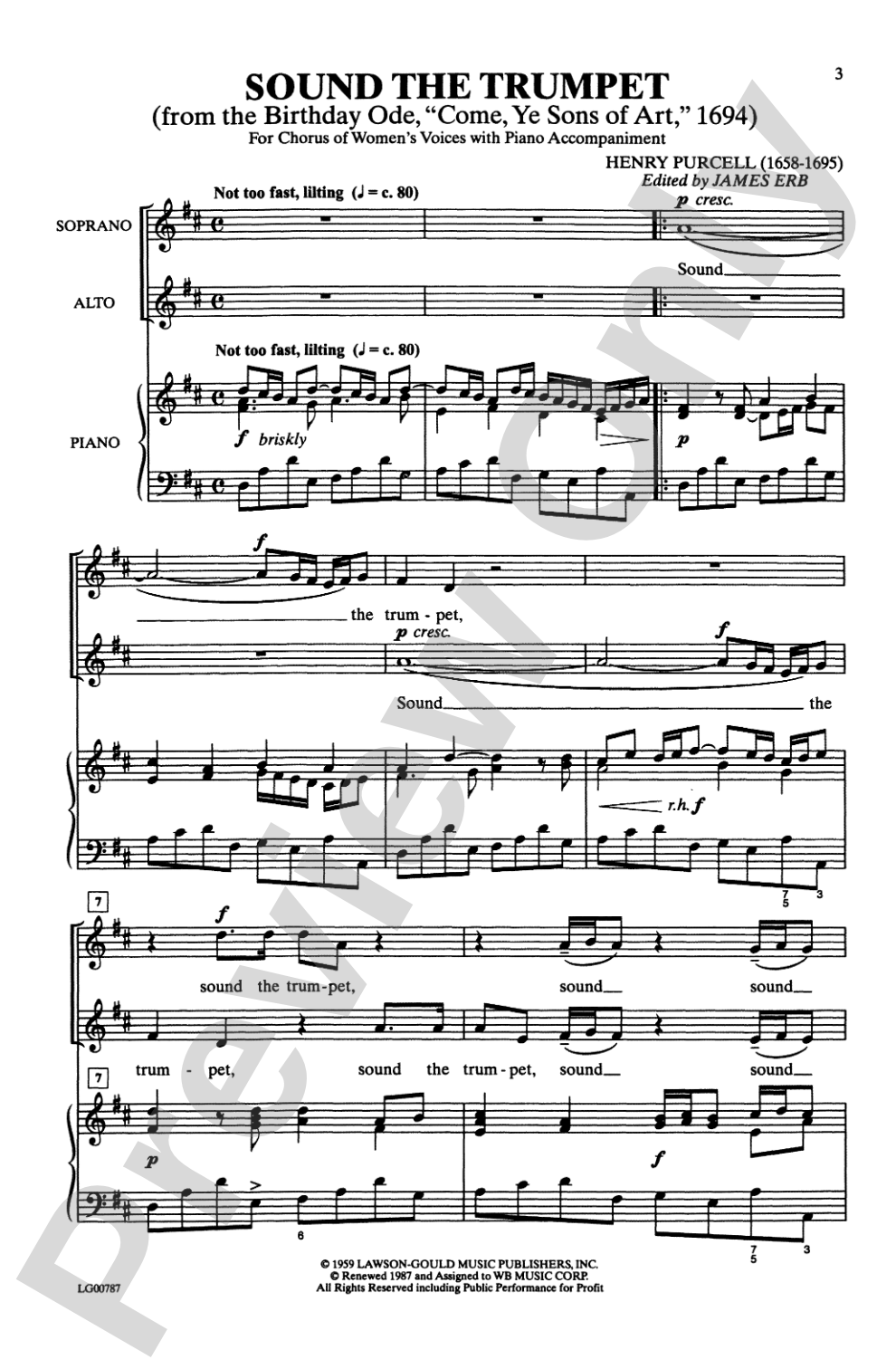
From Come Ye Sons of Art, this majestic piece for treble voices will suit any festive occasion. This title is available in MakeMusic Cloud.


Sound the Trumpet: 2-Part Choral Octavo isn't in MakeMusic Cloud just yet...but it could be. Let us know you'd like to see it, and you'll help shape what comes next. In the meantime, start a free trial and dive into thousands of interactive titles your students can play along with today.
Request This Title
Tell us you want it.
Start Your Free Trial
Explore everything that's ready to play right now.
Sample Audio
1
Audio File
--:--
0:00
0:00
Sample Video
Additional Details
Series:
Lawson-Gould
Publisher:
Alfred Music
Page Count:
8
SKU:
00-PO-0003519
More about this title
About the Composer: Henry Purcell
Henry Purcell (1659-1695) stands as England's greatest Baroque composer and a towering figure in the history of English music. His gift for melody, harmonic sophistication, and theatrical flair earned him the position of Organist of Westminster Abbey and Composer to the Chapel Royal, roles he held while composing prolifically across every genre of his era. His output encompassed sacred music, secular vocal works, instrumental suites, and dramatic compositions that shaped English musical culture for centuries.
Purcell's secular vocal music, particularly his cantatas and welcome songs, showcases his ability to blend Italian elegance with English directness. "Sound the Trumpet" exemplifies his mastery of the voice, moving fluidly between homophonic and contrapuntal writing while maintaining an irresistible lyrical momentum. His influence on the choral tradition remains direct and immediate; teachers and students encounter his music not as historical artifact but as living, performable art.
Why we love this
This setting captures Purcell's gift for writing vocally grateful, transparent lines that sound immediate and alive even at a quick tempo. The piece cuts through the usual early music repertoire by virtue of its sheer melodic confidence and festive character, making it genuinely engaging for singers rather than dutiful. A two-part arrangement opens the piece to treble choirs at various levels of development without sacrificing Purcell's harmonic wit.
What to expect
Majestic and buoyant, with the energy of a ceremonial trumpet call translated into human voices. The music radiates confidence and celebratory brightness without sacrificing the harmonic color that makes Baroque English music distinctly rich. You'll hear both the influence of Italian vocal style and the clarity of English text-setting working in concert, creating a sound that feels both elegant and forthright.
Who it's for
Treble choirs seeking festive, concert-ready repertoire that sits comfortably for voices still developing range and stamina. This piece serves intermediate choirs effectively while remaining rewarding for more experienced ensembles drawn to Baroque style and text-painting. It works equally well for festival performances, special occasions, and concert programming where festive splendor and musical substance are both required.
How to get the most out of it
- Honor the trumpet-like character suggested by the title by approaching the opening gestures with clarity and forward motion; think of the voices as period brass instruments rather than soft, blended choral tone
- Shape the phrases according to the natural speech rhythms of the text rather than resting at every barline; maintain architectural sweep across sections
- Balance the two parts so that melodic material reads clearly; the lower voice often carries harmonic responsibility and should not disappear into accompaniment
- Treat ornaments and melismas as structural elements that propel the music forward, not decorative flourishes to linger over
How to use it
Program this as a concert opener or second piece where you want immediate impact and a shift in mood toward brightness. It pairs naturally with other Purcell or Baroque vocal works, and it stands equally well anchoring a festive concert theme or accentuating a Baroque-focused set. The piece works particularly well in a spring concert, graduation program, or festival context where jubilation is the programming goal.
Skills your students will build
- Reading Baroque melodic style with clear phrasing conventions
- Balancing two-part texture where both voices carry harmonic weight
- Singing with trumpet-like articulation and clarity in secular style
- Maintaining musical momentum across longer, multi-section structures
- Understanding text-painting and how musical gesture reflects meaning