
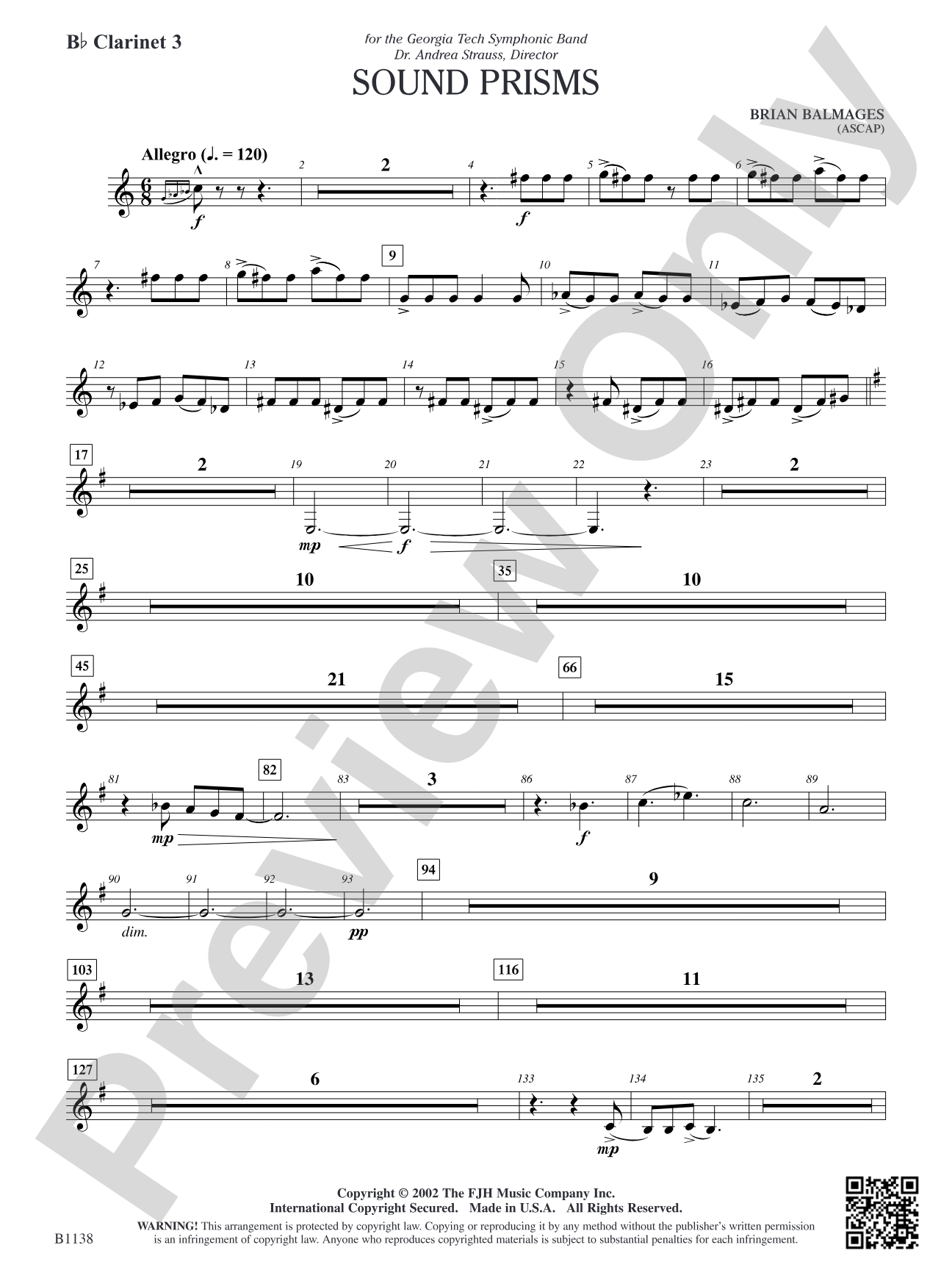

Sound Prisms: B-flat Clarinet 3
By Brian Balmages
Grade: 4
Item: 98-PC-DB1138_C3
$7.00
Pickup currently not available
Description
This exciting fanfare combines traditional, triadic harmonies with splashes of mild and harsh dissonance, especially in the woodwind voices, in a driving 6/8 panorama of sound. The patterns and phrases are heard echoing throughout the full ensemble in an avalanche of changing timbres. The piece builds to a powerful and memorable conclusion. (4:00)


Sound Prisms: B-flat Clarinet 3 isn't in MakeMusic Cloud just yet...but it could be. Let us know you'd like to see it, and you'll help shape what comes next. In the meantime, start a free trial and dive into thousands of interactive titles your students can play along with today.
Request This Title
Tell us you want it.
Start Your Free Trial
Explore everything that's ready to play right now.
Sample Audio
1
Audio File
--:--
0:00
0:00
Sample Video
No sample videos found.
Additional Details
Series:
FJH Concert Band
Publisher:
The FJH Music Company, Inc.
SKU:
98-PC-DB1138_C3
More about this title
About the Composer: Brian Balmages

Brian Balmages has built an internationally recognized career as both composer and conductor, working across orchestral, band, and chamber idioms with equal fluency. His compositions have appeared on stages from Carnegie Hall to the Sydney Opera House, performed by ensembles spanning from professional orchestras to elementary school bands. He holds the A. Austin Harding Award from the American School Band Directors Association and won the 2020 NBA William D. Revelli Composition Contest. His work was featured in the 2013 Presidential Inaugural Prayer Service, and he has been commissioned by major institutions including the University of Miami for presidential inaugurations.
As a guest conductor, Balmages regularly works with all-state and regional ensembles, university groups, and professional orchestras across North America and internationally. He has led clinics at the Midwest Clinic, Western International Band Clinic, and numerous state conferences, and is an elected member of the American Bandmasters Association. He currently serves as Director of MakeMusic Publications and Digital Education for Alfred and MakeMusic.
Why we love this
Sound Prisms delivers exactly what a Grade 4 contest piece needs: immediate impact paired with musical substance. The interplay of traditional harmony against strategic dissonance gives your ensemble something genuinely interesting to sink their teeth into, while the cascading textures and layered patterns keep the full ensemble engaged from top to bottom. The four-minute duration lands squarely in competition sweet spots, and Balmages' gift for building toward a satisfying conclusion means your group will walk off stage confident they've left an impression.
What to expect
Sound Prisms launches with kinetic energy and doesn't let up. The constant interplay of traditional triadic warmth against pockets of dissonance creates an unsettled, forward-moving character that feels modern without severing ties to tonal anchoring. By the end, the piece has constructed a full spectrum of instrumental color into something powerful and genuinely memorable.
Who it's for
Concert bands at the Grade 4 level preparing for contests and festivals will find a piece that sits comfortably within their technical range while offering genuine compositional interest. Directors seeking to program music with contemporary harmonic language without alienating audiences will appreciate how Balmages balances accessibility with sophistication.
How to get the most out of it
- Balance the dissonance in the woodwind passages carefully during early rehearsals. Mark these moments in parts so each section understands they're intentional color choices, not intonation problems.
- Lock the 6/8 pulse across the rhythm section first. Once that foundation sits steady, the echoing patterns and timbral shifts in the upper voices will land with much more clarity.
- Chart where the 'avalanche of changing timbres' occurs and drill those transitions specifically. Smooth timbre shifts feel more professional than abrupt ones, even when the music is meant to build intensity.
- Approach the final climax by tracking the dynamic and textural buildout across the last minute. Conduct with clear intent so every section knows which layered texture is arriving next.
How to use it
Program this as a festival or contest opener that immediately establishes sophistication and energy. It pairs well with ballads or lighter fare on the same concert, since it demands and commands attention. The four-minute length makes it ideal for competition rounds where time slots are tight and impact matters.
Skills your students will build
- Reading and performing in 6/8 meter with precision
- Balancing traditional harmonic progressions against mild and harsh dissonance
- Executing rapid timbral shifts across the full ensemble
- Sustaining energy and focus through layered, repeating textural patterns
- Building intensity collaboratively across multiple sections toward a climactic conclusion