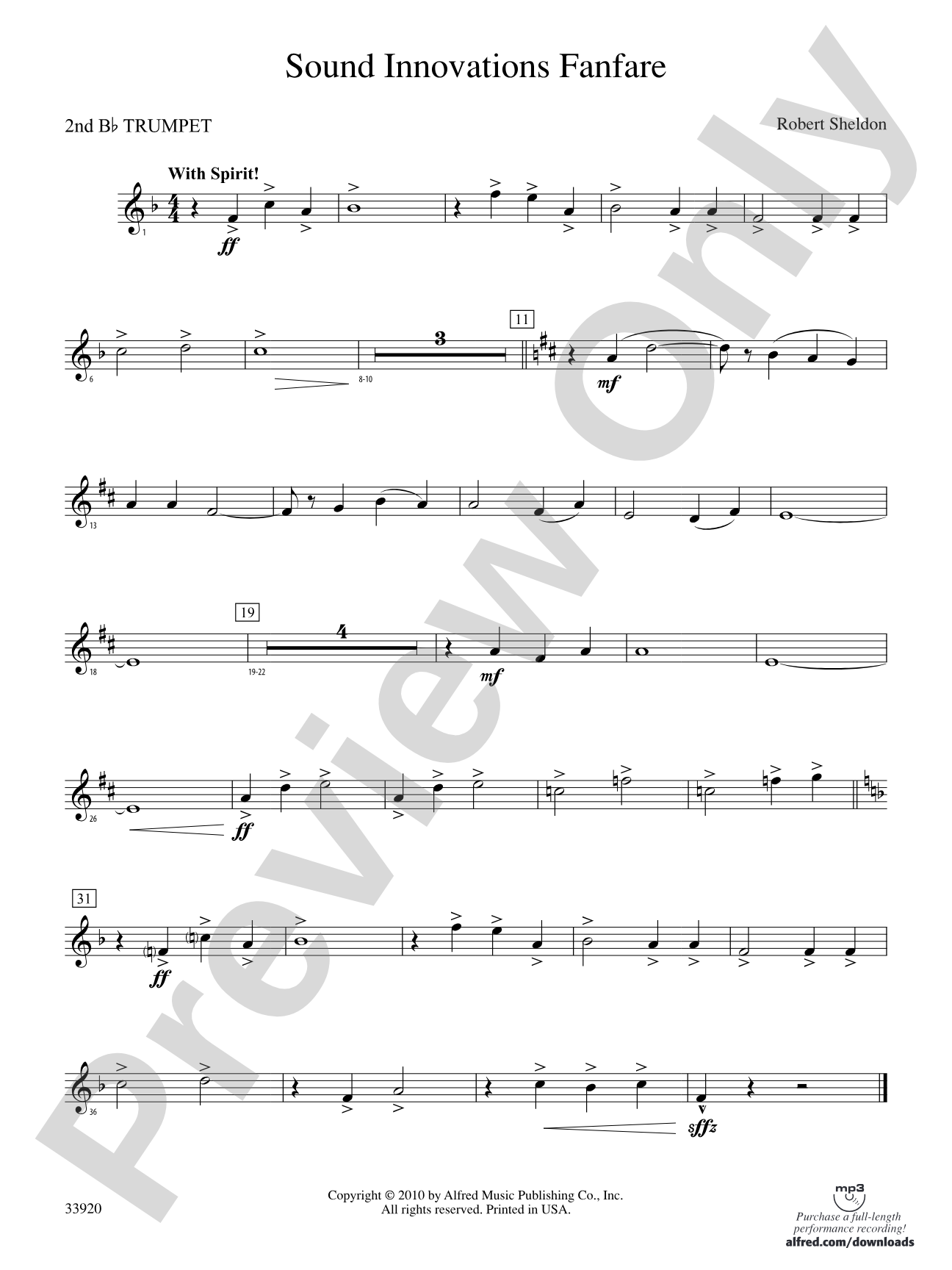
Sound Innovations Fanfare: 2nd B-flat Trumpet Sheet Music Preview

Sound Innovations Fanfare: 2nd B-flat Trumpet

By Robert Sheldon

Grade: 3.5 (Medium)

Item: 00-PC-0014602_T2

Digital Download
$3.00
Description
Sound Innovations Fanfare is a bright and buoyant opener sure to grab the attention of your audience. Filled with tuneful melodies, soaring lines, and fast-paced technical flourishes, this fanfare provides a distinctive way to begin any concert program.

Don't just read it, hear it, play along with it, and watch your students grow with it. In MakeMusic Cloud, Sound Innovations Fanfare: 2nd B-flat Trumpet comes alive with professional accompaniment, adjustable tempo, and built-in practice tools that turn solo practice into real progress.

Sample Audio
0:00
0:00
Sample Video
Additional Details
Series: Alfred Concert Band
Publisher: Alfred Music
Page Count: 138
SKU: 00-PC-0014602_T2

More about this title

About the Composer: Robert Sheldon

Robert Sheldon

Robert Sheldon stands among the most widely performed composers in the wind band repertoire today. His works appear regularly on state and national contest lists, and major concert halls across North America and internationally have hosted performances of his compositions. Beyond composing, Sheldon serves as lead author of Sound Innovations for Concert Band and has received recognition from the American School Band Director's Association, Phi Beta Mu, and ASCAP for his contributions to music education and composition.

A sought-after clinician and guest conductor, Sheldon has led honor bands at the state and regional levels and presented at universities and state music education conferences throughout his career. He has conducted his own works at venues including Carnegie Hall, Orchestra Hall in Chicago, Boston's Symphony Hall, the Sydney Opera House, and the Kennedy Center. In 2020, VanderCook College of Music awarded him an honorary doctorate in recognition of his impact on wind band music.

Why we love this

Sheldon's fanfare succeeds because it balances immediate impact with genuine musicality. The piece opens your concert with energy and clarity while giving your students substantive material to rehearse; technical passages sit naturally within the ensemble, and the tuneful core keeps young players engaged rather than overwhelmed. It's the kind of opener that works equally well in the concert hall and on contest day.

What to expect

Bright and forward-moving from the first measure, this fanfare radiates confidence and polish. Tuneful melodies soar above crisp rhythmic figures, while moments of technical brilliance sparkle without overwhelming the core musical idea. The overall effect is celebratory and engaging, making it an ideal threshold for any concert program.

Who it's for

This fanfare suits Grade 3.5 bands looking for a confident concert opener with real personality. Directors programming competitive festivals or formal concerts will find a piece that impresses an audience while remaining accessible to developing ensembles.

How to get the most out of it

  • Establish the tempo early in rehearsal and return to it frequently. The buoyant character depends on forward motion, so anchor your beat and ask the ensemble to match your clarity.
  • Balance the soaring lines with the rhythmic accompaniment beneath them. Encourage your melody players to shape their phrases while the supporting voices maintain steady, transparent support.
  • Shape the fast-paced technical flourishes by subdividing internally rather than rushing through them. Clarity at tempo communicates more than speed.

How to use it

Open your next concert with this piece and set a tone of musicianship and energy from the start. Pair it with contrasting repertoire (a lyrical ballad or introspective movement) to showcase the range of your ensemble. It also works well as a festival or contest opener when you want the judges' attention immediately.

Skills your students will build

  • Executing fast-paced technical passages with clarity and precision
  • Balancing solo lines with accompanying figures in a full ensemble
  • Maintaining forward momentum and ensemble unity at a buoyant tempo
  • Shaping tuneful melodies across phrase boundaries

You May Also Like