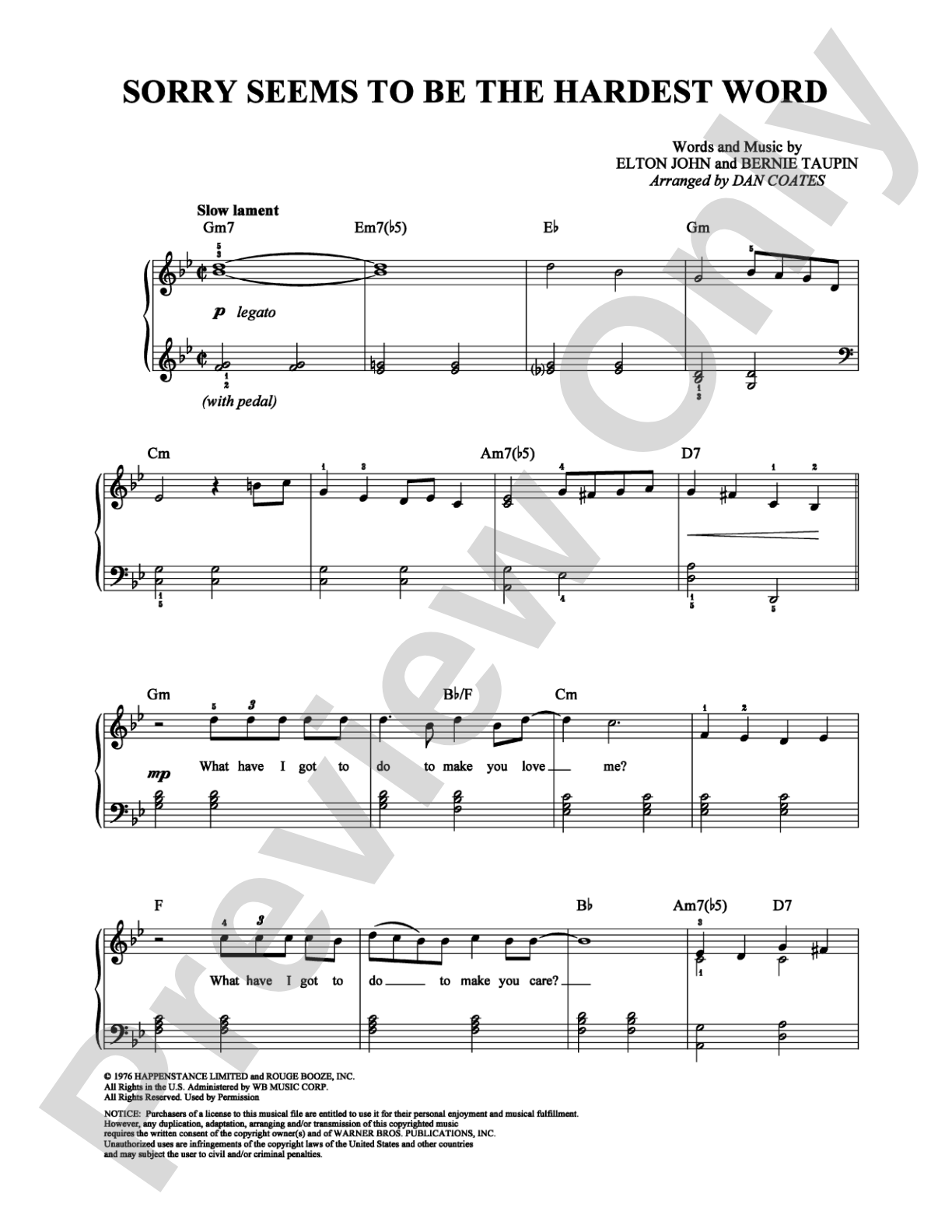
Sorry Seems to Be the Hardest Word: Easy Piano Digital Sheet Music

Sorry Seems to Be the Hardest Word: Easy Piano Digital Sheet Music

Elton John, Bernie Taupin

Item: 00-PS-0004538

Digital Download
$2.95
Description

Sorry Seems to Be the Hardest Word: Easy Piano Digital Sheet Music isn't in MakeMusic Cloud just yet...but it could be. Let us know you'd like to see it, and you'll help shape what comes next. In the meantime, start a free trial and dive into thousands of interactive titles your students can play along with today.

Sample Audio
No sample audio found.
Sample Video
Additional Details
SKU: 00-PS-0004538

More about this title

About the Artist: Elton John

Elton John stands as one of the most prolific and successful songwriters of the modern era, with a catalog spanning rock, pop, and ballad traditions. His partnership with lyricist Bernie Taupin produced some of the most enduring songs in popular music, and his distinctive piano playing has shaped the sound of contemporary popular song since the early 1970s.

Why we love this

This arrangement captures the emotional weight of one of Elton John's most celebrated ballads while remaining genuinely playable at the easy piano level. The piece gives students access to a song they likely know and love, making the work of learning feel purposeful rather than mechanical. It's an excellent bridge between classical piano study and the popular repertoire that keeps young players engaged.

What to expect

A tender, introspective moment that sits comfortably in the middle register of the piano. The accompaniment is warm and supportive rather than flashy, and the overall character invites restraint and emotional directness from the performer.

Who it's for

Pianists in their first year or two of study who want to explore contemporary popular music alongside their classical repertoire. This piece works well for students ages 10 and up who are ready to move beyond strictly pedagogical material and engage with songs that hold genuine cultural resonance.

How to get the most out of it

  • Shape the melody with careful attention to phrase length; resist rushing through the verses and let the emotional arc breathe naturally.
  • Balance the right hand melody against a supporting left hand part; the accompaniment should never overpower the singer's primary line.
  • Find the tempo that allows you to play the accompaniment figures cleanly without sacrificing the song's inherent tenderness.
  • Use the pedal sparingly to sustain harmony without creating muddiness; this piece rewards clarity over wash.

How to use it

Feature this in a recital that balances classical and contemporary repertoire, or use it as a closer to a mixed program where the shift in style and emotional register creates a memorable final impression. It also works well as a standalone performance piece for studios wanting to include popular music in their recital offerings.

Skills your students will build

  • Playing broken chord accompaniment patterns with consistent rhythm
  • Balancing melody against accompaniment in a single staff system
  • Reading and interpreting chord symbols and slash notation
  • Sustaining a singing melody line while maintaining steady harmonic support
  • Managing dynamic control and pedal use in contemporary popular arrangements

You May Also Like