
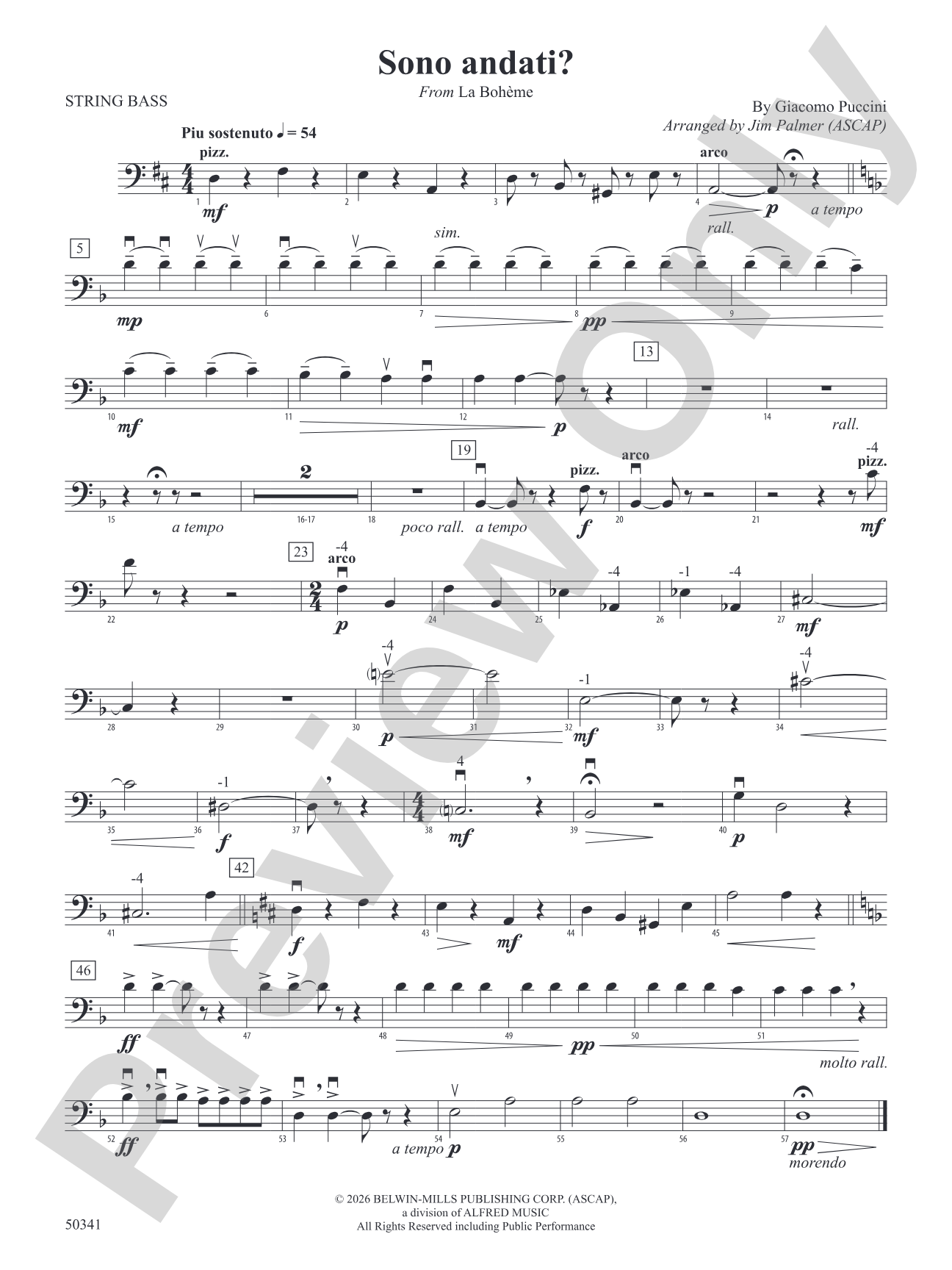

Sono andati?: String Bass
From La Bohème
By Giacomo Puccini / arr. Jim Palmer
Grade: 3.5
Item: 00-PC-0019665_SB
$7.99
Pickup currently not available
Description
Sono andati?, by Giacomo Puccini and arranged for string orchestra by Jim Palmer, is from the beautiful opera La Bohème. Based on a duet sung by Mimi and Rodolfo, this arrangement showcases the rich harmonies and expressive melodies characteristic of the Romantic era. Designed to engage performers, it is well-suited for festivals and concert programs alike, providing students with an opportunity to find their musical voice.


Discover MakeMusic Cloud: thousands of interactive titles your students can play along with today.
Sample Audio
1
Audio File
--:--
0:00
0:00
Sample Video
Additional Details
Series:
Belwin Concert String Orchestra
Publisher:
Alfred Music
SKU:
00-PC-0019665_SB
More about this title
About the Composer: Giacomo Puccini
Giacomo Puccini (1858-1924) stands among the most performed opera composers in the world, and for good reason: his gift for crafting soaring melodies that stick with audiences remains unmatched. A master of dramatic pacing and orchestration, Puccini wrote operas that balance intimate character moments with sweeping ensemble passages, a skill that translates beautifully to string orchestral arrangements.
For music educators, Puccini's work offers an exceptional entry point into late Romantic opera. His melodies are singable, his harmonies are rich enough to sustain interest, and his dramatic sense keeps ensembles engaged. Students encounter immediately recognizable music that rewards careful attention to phrase shape, dynamics, and expressive nuance.
Why we love this
Jim Palmer's arrangement captures the emotional warmth of this iconic duet without losing the vocal character that makes it so memorable. The string writing sits naturally across a Grade 3.5 ensemble, which means players feel like they're performing a "real" piece rather than a simplified version. Sono andati? carries genuine dramatic weight and pairs exceptionally well with other Romantic-era repertoire in festival or concert programming.
What to expect
Warm, nostalgic, and deeply human. The arrangement maintains the conversational intimacy of the original duet while allowing string voices to bloom into the lush harmonies Puccini treasured. There's a bittersweet quality here, the sort of music that makes audiences lean forward and listen.
Who it's for
String orchestra directors programming Grade 3-4 ensembles who want to include recognizable opera literature at an accessible level. This arrangement works equally well for groups preparing for festival competition, concert performances, or chamber-style recitals where authenticity of musical expression matters.
How to get the most out of it
- Shape the main melody with a long-line approach, avoiding the trap of pressing forward rhythmically. This duet lives in legato phrasing; let the bow do the work of connecting notes.
- Balance the divisi passages carefully so that inner voices support rather than overshadow the principal line. Rehearse the accompaniment figures separately to build security.
- Pay attention to dynamic contours within phrases rather than treating whole sections as a single volume level. The emotional arc depends on subtle shifts in weight and color.
- Anchor the ensemble through the harmonic rhythm. Because the melody is so recognizable, ensemble cohesion comes from tracking the underlying chord progressions together.
How to use it
Pair this with other Romantic-era string orchestra pieces to create a cohesive concert theme, or use it as a bridge piece that connects students to the larger opera repertoire. It's also an excellent choice for chamber-focused programming, where smaller ensembles or string quartets can perform it with solo instrumentation if desired.
Skills your students will build
- Sustained legato playing with consistent bow pressure across phrase lengths
- Dynamic shaping within and across phrases, rather than static volume levels
- Voice independence in divisi passages, balancing melodic and accompanimental lines
- Recognition and execution of Romantic-era harmonic language and phrasing conventions
- Ensemble unification through shared awareness of harmonic rhythm