Sonntag Sheet Music Preview

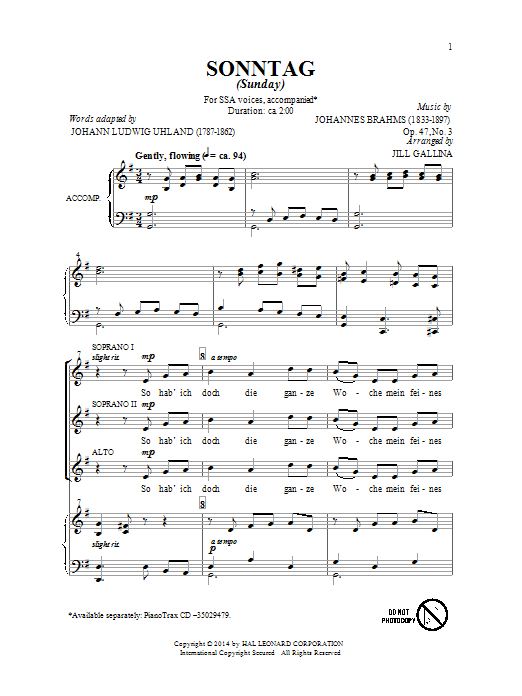
Sonntag: SSA Choral Octavo

By Johannes Brahms / Arranged by Jill Gallina

Item: 35-DS00282210

Digital Download
$2.99
Description

Sonntag: SSA Choral Octavo isn't in MakeMusic Cloud just yet...but it could be. Let us know you'd like to see it, and you'll help shape what comes next. In the meantime, start a free trial and dive into thousands of interactive titles your students can play along with today.

Sample Audio
No sample audio found.
Sample Video
Additional Details
Publisher: Hal Leonard
Page Count: 9
SKU: 35-DS00282210

More about this title

About the Composer: Johannes Brahms

Johannes Brahms (1833-1897) shaped the trajectory of European music in the late 19th century, working across symphonies, concertos, chamber music, and songs while maintaining a deep commitment to choral writing. His mastery of counterpoint and harmonic richness comes through as clearly in his secular choruses as in his larger works, and his settings of German texts reflect both his technical sophistication and his connection to the vocal traditions he admired.

Why we love this

Brahms knew how to write for women's voices with genuine elegance; this arrangement honors that sensibility while opening the piece to singers who might not encounter his choral works otherwise. The harmonic language is sophisticated enough to engage mature musicians without becoming unwieldy, and the text setting feels natural rather than forced.

What to expect

Serene and introspective, with the quietly contemplative quality that Brahms brings to secular German texts. The harmony moves with purpose beneath a lyrical surface, creating a sense of gentle inevitability rather than drama.

Who it's for

Advanced high school choirs and college ensembles seeking repertoire that combines 19th-century compositional craft with accessible voicing. This works equally well for concert programs, competitive festivals, or singers who want to build confidence with Brahms' harmonic language.

How to get the most out of it

  • Shape the phrasing in longer lines by thinking of the text as speech first; this prevents the harmony from sounding static even when Brahms holds a sonority for musical effect.
  • Balance the inner voices carefully during harmonic transitions so that the voice leading remains audible rather than buried under the top line.
  • Let the German vowels inform your diction work; the piece breathes differently when sung with authentic vowel colors appropriate to the language.

How to use it

Pair this with other German art songs or lieder arrangements to create a thematic concert block, or position it as a moment of repose between more energetic contemporary works. Its modest performing forces make it ideal for community concerts or chamber choir settings where intimacy matters.

Skills your students will build

  • Reading and performing Brahms' chromatic voice leading
  • Balancing multiple independent melodic lines in SSA texture
  • German diction and phrasing in classical choral context
  • Sustaining lyrical singing across longer phrases without rhythmic support

You May Also Like