
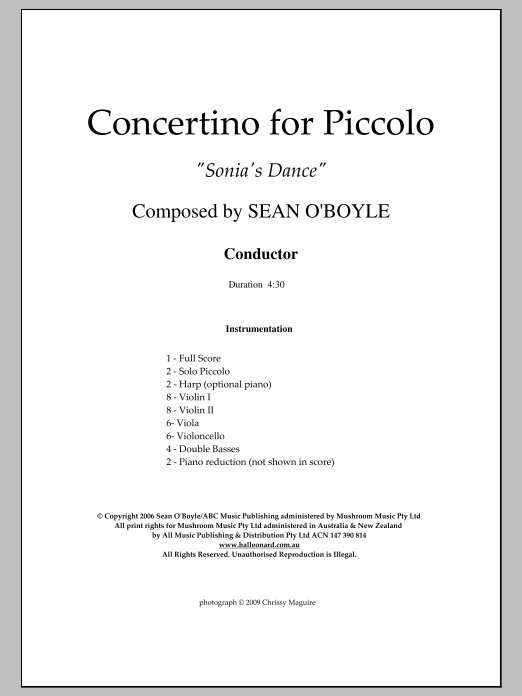

Sonia's Dance Concertino for Piccolo: String Orchestra Conductor Score & Parts
Arranged by Sean O'Boyle
Grade: 3-4
Item: 35-PK00283819
$58.00
Pickup currently not available
Buy Extra Parts (Digital PDF Download)
Parts Added to Cart!
Description
Piccolo Concertina "Sonia's Dance" Written in a Celtic style with strings harp providing the flowing accompaniment. A great piece to feature your piccolo player to showcase a wide variety of sounds this fabulous instrument is capable of producing. Performance history: Premiered on January 25th 2008 by Sonia Croucher the Malaysian Philharmonic; Sean O'Boyle conducting.


Sonia's Dance Concertino for Piccolo: String Orchestra Conductor Score & Parts isn't in MakeMusic Cloud just yet...but it could be. Let us know you'd like to see it, and you'll help shape what comes next. In the meantime, start a free trial and dive into thousands of interactive titles your students can play along with today.
Request This Title
Tell us you want it.
Start Your Free Trial
Explore everything that's ready to play right now.
Sample Audio
No sample audio found.
Sample Video
No sample videos found.
Additional Details
Publisher:
Hal Leonard
SKU:
35-PK00283819
More about this title
About the Arranger: Sean O'Boyle
Sean O'Boyle is an arranger and conductor whose work brings folk traditions into the concert hall with modern orchestration. His arrangement of Sonia's Dance demonstrates his gift for writing idiomatic string parts that support rather than overshadow a featured soloist.
Why we love this
This gives your piccolo player a genuinely rewarding vehicle that moves beyond the typical piccolo cameo. The Celtic idiom sits naturally under the instrument's voice, and O'Boyle's string writing is transparent enough that ensemble balance stays manageable even in Grade 3-4 orchestras. You get a concert moment that audiences actually sit forward for.
What to expect
Graceful and dancing, with the quality of a folk melody that has been refined for the concert stage. The interplay between the piccolo's bright, articulate voice and the sustained warmth of the string sound creates an atmosphere that is both intimate and celebratory.
Who it's for
String orchestras looking to feature a principal piccolo soloist with a piece that respects the instrument's agility and lyrical range. Directors at Grade 3-4 level who want to program something beyond the standard wind ensemble crossover piece and give their strings a focused role in ensemble leadership.
How to get the most out of it
- Balance the piccolo sound by keeping the harp accompaniment and strings at a dynamic floor; this isn't a piece where the soloist fights for projection.
- Shape the melodic line with breathing points that follow the natural phrasing of Celtic music rather than technical passage work; the soloist should sing through ornaments rather than rush them.
- Let the harp anchor the harmonic foundation; its flowing accompaniment is the connective tissue between the piccolo and strings, so its rhythm section role matters more than typical harp doubling.
- Rehearse the ensemble's rhythmic foundation separately before adding the piccolo part, since the string sections need to maintain a steady flow that supports rather than competes with the soloist's rubato.
How to use it
Slot this into a concert devoted to world music or folk traditions, where it can anchor a thematic set. It also works beautifully as a midpoint piece in a standard orchestra concert, giving audiences a tonal and textural shift before moving into weightier repertoire.
Skills your students will build
- Piccolo technical facility across the entire range
- Sustaining melodic line with natural phrasing over accompaniment
- Transparent ensemble balance with featured soloist
- String section awareness of rhythmic and harmonic support functions
- Performing in Celtic stylistic idiom with appropriate articulation and ornamentation