
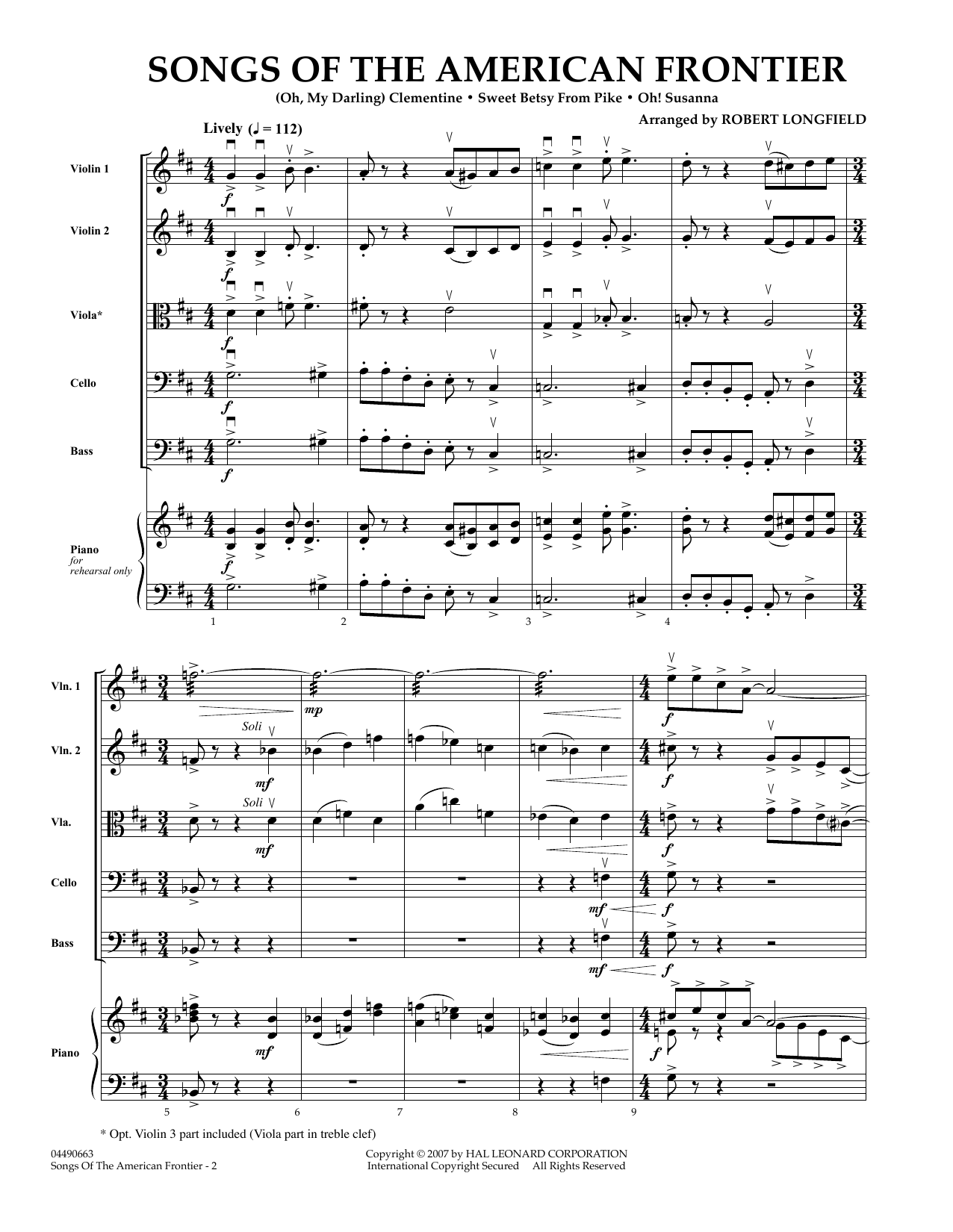

Songs Of The American Frontier: String Orchestra Conductor Score & Parts
Arranged by Robert Longfield
Grade: 2-3
Item: 35-PK00320666
$45.00
Pickup currently not available
Buy Extra Parts (Digital PDF Download)
Parts Added to Cart!
Description
Three song classics that pay tribute to American women during our country's formative years are combined into this delightful folk medley that plays beautifully with string ensemble. As you'd expect from Robert Longfield, the treatments are creative and well designed for student players.
Includes: "(Oh, My Darling) Clementine, Sweet Betsy from Pike," and "Oh! Susanna."
Dur: 3:20


Songs Of The American Frontier: String Orchestra Conductor Score & Parts isn't in MakeMusic Cloud just yet...but it could be. Let us know you'd like to see it, and you'll help shape what comes next. In the meantime, start a free trial and dive into thousands of interactive titles your students can play along with today.
Request This Title
Tell us you want it.
Start Your Free Trial
Explore everything that's ready to play right now.
Sample Audio
No sample audio found.
Sample Video
No sample videos found.
Additional Details
Publisher:
Hal Leonard
SKU:
35-PK00320666
More about this title
About the Arranger: Robert Longfield
Robert Longfield has built a reputation as an arranger who understands what student orchestras need: rewarding musical experiences that don't overwhelm developing players. His work spans multiple genres and ensemble configurations, but he has particular strength in folk material, where his arrangements honor the songs while creating genuine orchestral textures.
Longfield's pedagogical approach balances accessibility with musicianship. He writes parts that give every section meaningful material, avoiding the trap of relegating lower instruments to rhythmic padding. Directors who work with his scores consistently report that students feel invested in the outcome.
Why we love this
Longfield resists the urge to oversimplify these melodies, giving each tune enough harmonic and textural interest to hold an audience's attention while keeping the technical demands genuinely manageable for grades 2 and 3. The medley format lets you program substantial concert material without relying on a single tune, and these particular songs carry enough cultural weight that programming them becomes a teaching moment about American history and women's voices in folk tradition.
What to expect
Warm and unpretentious, with the comfortable familiarity of songs people actually know and love. The arrangements honor the folk character of these melodies while clothing them in genuine string writing that makes the ensemble sound cohesive and intentional rather than merely competent.
Who it's for
String orchestras at the early intermediate level who want to perform folk material with real orchestration. Teachers building a concert that includes American music or women's history content will find this medley both musically satisfying and contextually rich.
How to get the most out of it
- Balance the melody across your first violins and violas; Longfield layers the tune strategically, and pushing it too heavily toward one section flattens the arrangement's design.
- Give the three songs distinct character in rehearsal before linking them. Treat each tune's intro and transition moment as a opportunity to reset the ensemble's focus.
- Let the rhythm section (cellos and basses) anchor the harmonic foundation without rushing; these arrangements rely on clear harmonic support to maintain intonation.
- Bring out any countermelodies or inner voices in the middle strings; they're written for a reason and add dimension without competing with the main tune.
How to use it
This works beautifully as a concert opener that immediately connects with family audiences, or as a thematic anchor for a program exploring American music or cultural heritage. The 3:20 duration gives it weight without monopolizing rehearsal time, making it an ideal pairing with a classical work and a contemporary piece to round out a diverse concert.
Skills your students will build
- Balance and blend within a multi-section texture
- Stylistic clarity in folk idiom
- Transitioning between related tempos and characters
- Reading layered countermelodies and harmonic accompaniment patterns
- Sustained intonation across longer melodic lines