
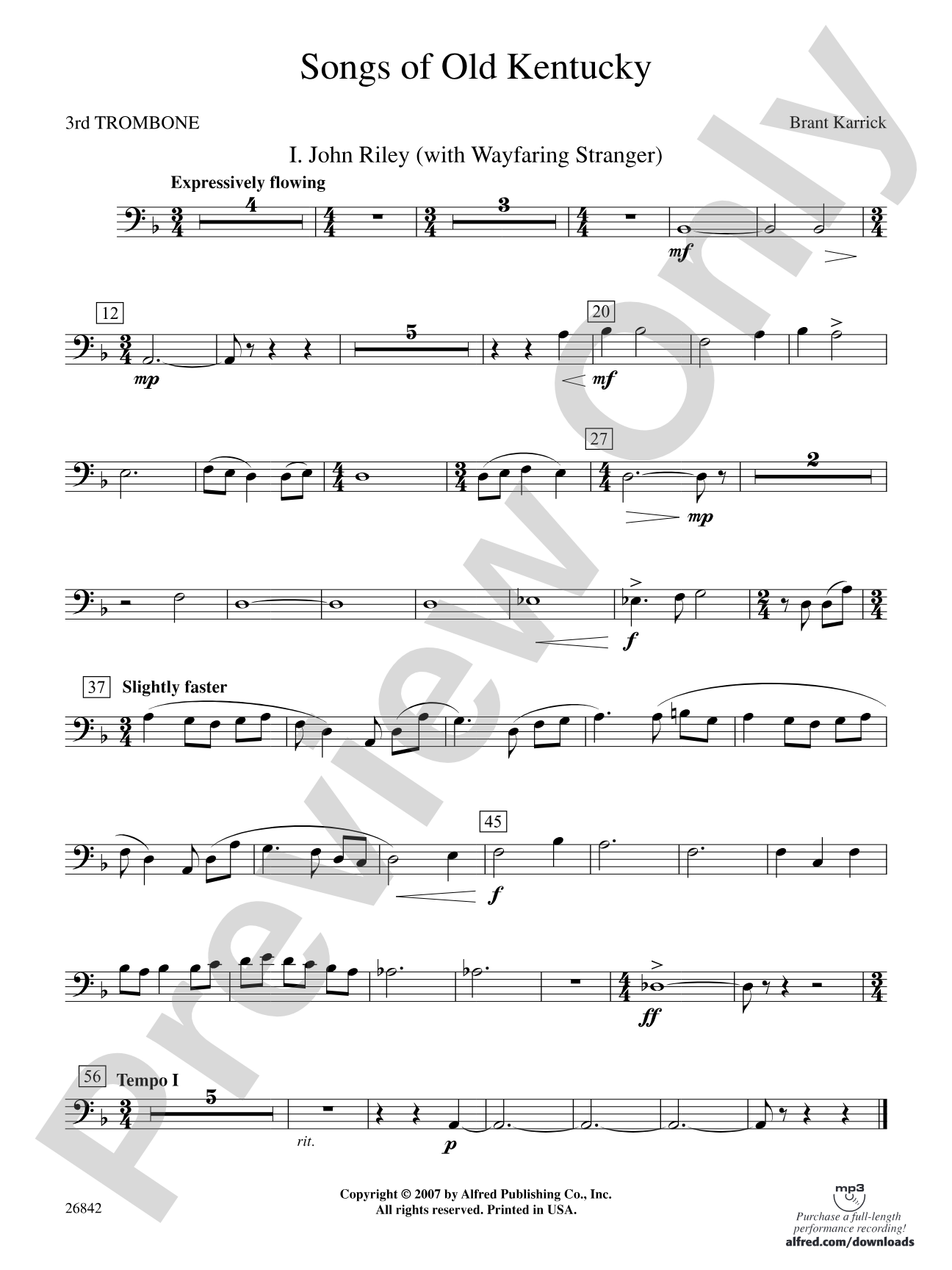

Songs of Old Kentucky: 3rd Trombone
By Brant Karrick
Grade: 3.5 (Medium)
Item: 00-PC-0001280_TN3
$3.00
Pickup currently not available
Description
The Kentucky mountaineers have preserved a proud heritage of traditional ballads and other old Scottish and English folk songs brought to America by their ancestors. Borrowing from this wonderful genre of folk songs, this outstanding setting of "John Riley," "The Lonesome Scenes of Winter," "Sourwood Mountain," "Frog Went-a-Courting," and "Loving Hannah" is destined to become a band classic. Skillfully scored and imaginative in setting, Songs of Old Kentucky provides a charming vehicle for expressive playing. A delightful addition to your next concert! (6:00) This title is available in MakeMusic Cloud.


Don't just read it, hear it, play along with it, and watch your students grow with it. In MakeMusic Cloud, Songs of Old Kentucky: 3rd Trombone comes alive with professional accompaniment, adjustable tempo, and built-in practice tools that turn solo practice into real progress.
Open in the Player
Jump straight in and assign it today.
Start Your Free Trial
Open this title and explore the full library in minutes.
Sample Audio
1
Audio File
--:--
0:00
0:00
Sample Video
Additional Details
Series:
Alfred Concert Band
Publisher:
Alfred Music
Page Count:
244
SKU:
00-PC-0001280_TN3
More about this title
About the Composer: Brant Karrick

Brant Karrick earned his Bachelor of Music Education from the University of Louisville (1982) and Master of Arts in Education from Western Kentucky University (1984) before completing his Ph.D. in music education at Louisiana State University in 1994. His composition teachers included David Livingston, Steve Beck, and Cecil Karrick, while his conducting studies with Frank Wickes shaped his approach to both the podium and the page.
Karrick served nine years at the University of Toledo and seven years teaching in Kentucky public schools before joining Northern Kentucky University in 2003, where he directs the band program and teaches conducting, orchestration, and instrumental methods. His compositions and arrangements have been performed across North America, Europe, South Africa, South America, Japan, and Australia. Active as a guest conductor, clinician, and adjudicator, he remains deeply involved in music teacher preparation and holds memberships in NAFME, ASCAP, the College Band Directors National Association, and the Kentucky Music Educators Association.
Why we love this
Karrick's treatment of these five folk melodies respects their genuine character while giving them sophisticated harmonic and orchestral underpinnings that engage all sections of your band. The six-minute arc builds naturally and leaves audiences with the satisfied feeling of having encountered both authenticity and artistry. At Grade 3.5, it delivers real musical substance without becoming a burden on developing ensembles.
What to expect
Honest and deeply American. These are melodies that have traveled across oceans and through generations, now heard through a modern band lens that honors their roots while giving them orchestral color and sophistication. The music breathes with the character of Kentucky's mountain traditions, blending warmth, slight melancholy, and enduring strength.
Who it's for
Concert bands at the Grade 3-4 level who want to program authentic American folk material with real musical depth. This works equally well for groups seeking a non-march lighter work or for ensembles interested in exploring cultural heritage through band repertoire.
How to get the most out of it
- Balance the folk melody against the inner harmonies that support it; these parts are not accompaniment filler but integral to Karrick's arrangement, so make sure every voice can be heard in rehearsal before worrying about blend.
- Shape each folk tune as if it were a song being sung, giving attention to natural phrase breathing and expressive shape rather than treating sections as march-like blocks.
- The 6:00 length gives you room to take phrases without rushing; trust the arrangement's pacing and let the stories these melodies tell come through.
- Consider the cultural weight of these mountain ballads and invite your students to research their origins; understanding why these songs mattered helps them play with genuine warmth.
How to use it
Program this as a contrasting second work in a concert that includes a march or a more contemporary composition; its six-minute duration allows breathing room without dominating your set. It also serves festival and contest play beautifully, offering judges something genuinely musical that showcases your band's ability to shape lyrical material.
Skills your students will build
- Balancing melodic lines with supporting harmonies in multi-textured arrangements
- Shaping and breathing extended lyrical phrases without losing momentum
- Reading and performing folk-based material with style-appropriate expression and articulation
- Understanding the cultural context of traditional American music and performing with appropriate musicality