
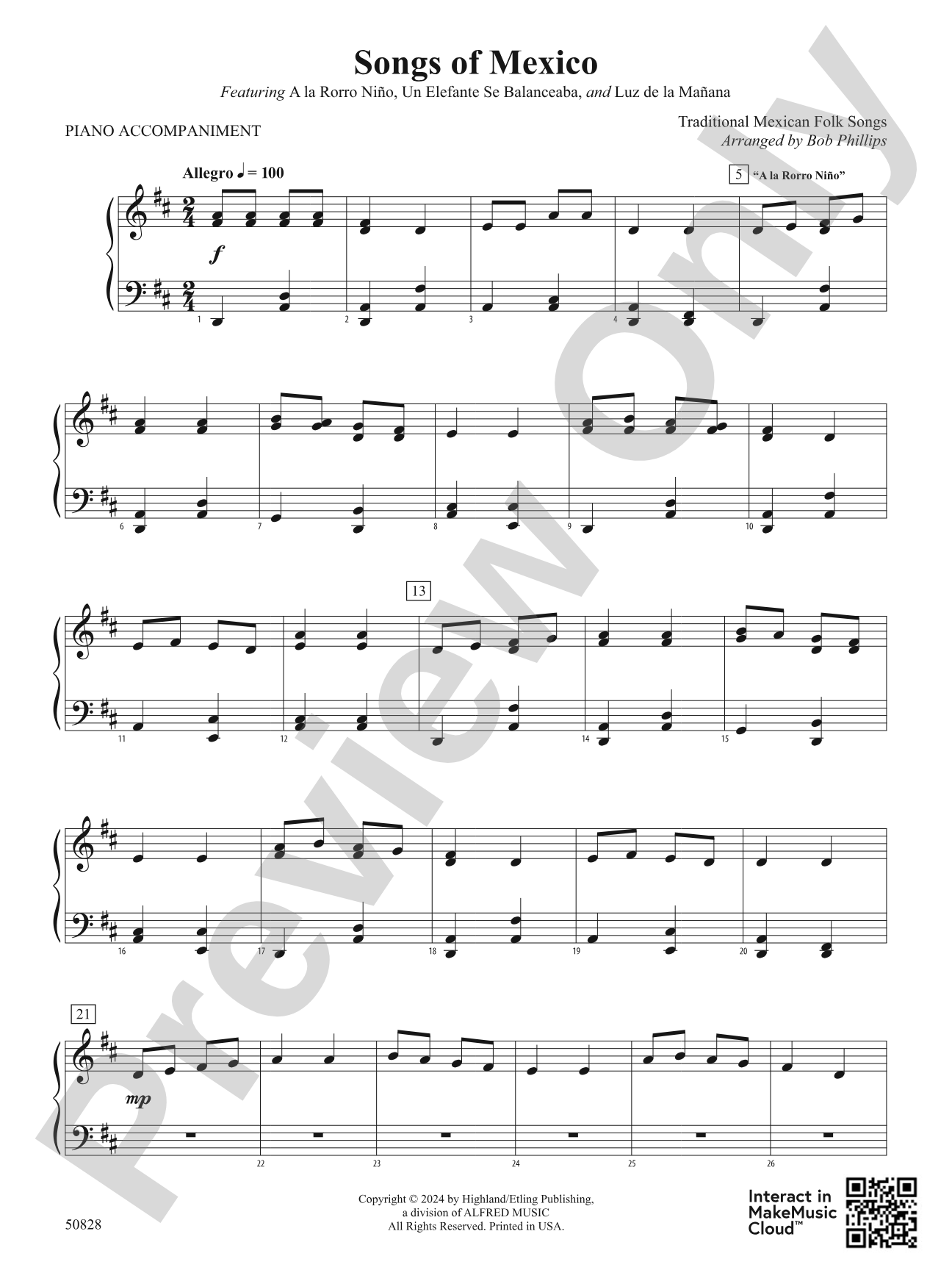

Songs of Mexico: Piano Accompaniment
Featuring: A la Rorro Niño / Un Elefante Se Balanceaba / Luz de la Mañana
Arranged by Bob Phillips
Grade: 1
Item: 00-PC-0019190_K
$3.00
Pickup currently not available
Description
Three beautiful tunes in an easy medley! Songs of Mexico is a set of three traditional Mexican folk songs arranged by Bob Phillips for beginning string orchestra. The entire piece can be played on the D and A strings for violins, violas, and cellos, while basses play on the D and G strings. "A la Rorro Niño" (to the boy/special/darling child) is an infant slumber song. "Un Elefante Se Balanceaba" (one elephant was balancing) is about an elephant balancing on a spider web with more elephants joining as the song progresses; for example, the second verse would be two elephants, the third verse would be three elephants, and so on. "Luz de la Mañana" (morning light) is a children's song about morning. (2:05) Correlates to Sound Innovations, Book 1, Level 4.


Don't just read it, hear it, play along with it, and watch your students grow with it. In MakeMusic Cloud, Songs of Mexico: Piano Accompaniment comes alive with professional accompaniment, adjustable tempo, and built-in practice tools that turn solo practice into real progress.
Open in the Player
Jump straight in and assign it today.
Start Your Free Trial
Open this title and explore the full library in minutes.
Sample Audio
1
Audio File
--:--
0:00
0:00
Sample Video
Additional Details
Series:
Sound Innovations for String Orchestra
Publisher:
Alfred Music
SKU:
00-PC-0019190_K
More about this title
About the Composer: Bob Phillips

Bob Phillips has shaped string education through decades of large ensemble teaching and composing. Based on 27 years building a string program in Saline, Michigan that grew to over 700 students, he developed a curriculum spanning both classical repertoire and eclectic musical styles. His approach emphasizes accessibility without sacrificing musicality, proven by the thousands of string students who perform his compositions annually.
Beyond the classroom, Phillips founded the Saline Fiddlers Philharmonic and has arranged for professional ensembles and festivals nationwide. He has conducted at state honors orchestras, youth symphonies, and major camps including Interlochen and Blue Lake Fine Arts Camp. An ASCAP award-winning composer, he has published over 200 works and authored the six-level Sound Innovations series alongside specialty collections in jazz, rock, Latin, and mariachi styles.
Why we love this
This medley introduces students to authentic Mexican folk melodies while respecting their ability as early learners. The strategic use of only D and A strings (and D and G for basses) removes unnecessary technical barriers, allowing ensemble cohesion and musical confidence to develop without fingering complexity. The three contrasting songs give beginning orchestras a complete, polished performance experience in one manageable package.
What to expect
This set captures the warmth and accessibility of folk music across three distinct moods: a quiet lullaby that asks for gentle playing, a playful counting song with built-in energy, and a bright, optimistic morning song. Together they form a satisfying arc that feels both culturally grounded and emotionally honest, without pretense.
Who it's for
Beginning string orchestras in their first year of ensemble playing, particularly those using the Sound Innovations curriculum at Book 1 level. Students with basic bow control and open string fluency will experience success here while gaining confidence in a full orchestral context.
How to get the most out of it
- Balance the melody between first and second violins carefully during the opening of each song; younger players often play mechanically rather than phrase, so encourage the leading voice to shape the line while the harmony voice supports underneath.
- The progressive nature of 'Un Elefante Se Balanceaba' (adding more elephants with each verse) provides a natural momentum builder; use this narrative quality to help students understand why the energy and texture should gradually swell rather than staying static.
- Maintain consistent bow weight during the shifts between songs to preserve the medley's flow; these transitions are brief, so treating them as movements within one piece rather than three separate selections will strengthen the overall performance.
- Emphasize the lyrical quality of 'Luz de la Mañana' to provide musical variety; after the playfulness of the elephant song, this final piece should feel gentle and introspective, giving students practice with dynamic restraint.
How to use it
Program this as a complete medley on a fall or winter concert to showcase your orchestra's early musical maturity and cultural diversity. It also works well as a festival piece, where the moderate length and clear three-part structure give judges a clear sense of your ensemble's musicianship and blend.
Skills your students will build
- Playing open string melodies with consistent tone across the ensemble
- Understanding folk song phrasing and lyrical shapes
- Managing transitions between contrasting sections in medley format
- Building cultural awareness through authentic traditional music
- Developing listening skills by tracking countermelodies and harmony parts