Song without Words: 1st Trombone Sheet Music Preview

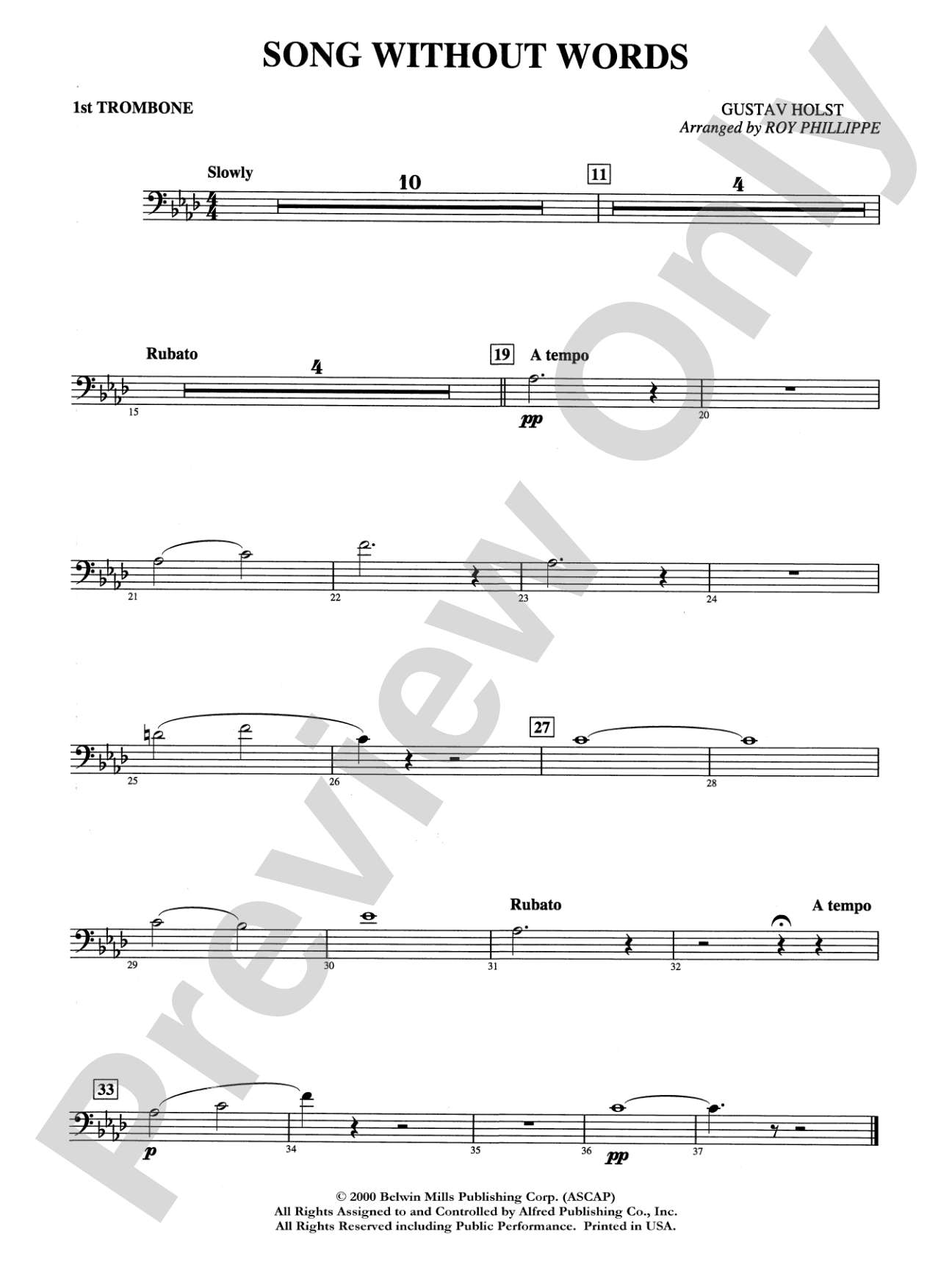
Song without Words: 1st Trombone

By Gustav Holst / arr. Roy Phillippe

Grade: 3.5

Item: 00-PC-0002220_TN1

Digital Download
$3.00
Description
With gentle grace, your orchestra, setting into motion the performance of one of Gustav Holst's most famous themes, quietly introduces this charismatic melody. The legato styling offers a magnificent teaching opportunity to reinforce musicianship while also serving as a performance vehicle. Great care has been taken to maintain the integrity of the original composition.

Don't just read it, hear it, play along with it, and watch your students grow with it. In MakeMusic Cloud, Song without Words: 1st Trombone comes alive with professional accompaniment, adjustable tempo, and built-in practice tools that turn solo practice into real progress.

Sample Audio
0:00
0:00
Sample Video
Additional Details
Series: Belwin Concert Full Orchestra
Publisher: Alfred Music
Page Count: 104
SKU: 00-PC-0002220_TN1

More about this title

About the Arranger: Roy Phillippe

Roy Phillippe

Roy Phillippe studied composition and orchestration at Kent State University before moving to Los Angeles, where he has spent decades working as an arranger for film, television, and concert music. His training under Phil Rizzo, director of theory for the Stan Kenton Jazz Orchestra, grounded him in both classical and jazz idioms. His arrangements have been recorded by Count Basie, the L.A. Express, and numerous symphony orchestras, and his published works are performed by student and professional ensembles worldwide.

Beyond his arranging work, Phillippe has been deeply involved in music education and preservation. He served as executive secretary of the American Society of Music Arrangers and Composers and edited Henry Mancini's film scoring text. His professional affiliations include ASCAP and the American Federation of Musicians, reflecting his standing across multiple sectors of the music world.

Why we love this

Phillippe's hand here respects Holst's original intent while creating something genuinely playable for developing orchestras. The legato writing doesn't skim the surface; it demands real breath control and phrase awareness from every section, making this as much a musicianship builder as it is a performance showcase. At grade 3.5, it's accessible without feeling watered down.

What to expect

Quiet dignity. The melody unfolds with an unhurried warmth that invites listeners in rather than demanding attention. Each sustained line feels spacious and inviting, like watching light move across a room.

Who it's for

Orchestras working at the intermediate to early advanced level who want to tackle a recognizable Holst theme without requiring professional-level technical facility. It works equally well for young musicians building their ear for phrasing and for established ensembles seeking repertoire that resonates with audiences.

How to get the most out of it

  • Shape the opening melody with a clear arc rather than treating each bar as a self-contained unit. The legato style Phillippe uses asks your players to hear where the phrase breathes, not just where it ends.
  • Balance the inner voices carefully during the theme statement. With full orchestra, strings and winds can easily mask each other; conduct with transparency in mind.
  • Allow the piece to settle into its own tempo rather than rushing. The gentle grace mentioned in the description comes from restraint, not from playing it cautiously.

How to use it

This fits naturally into a concert built around 20th century arrangements or masterworks suites. It also serves as an elegant bridge between classical staples and contemporary programming, offering audiences a moment of genuine repose without feeling lightweight.

Skills your students will build

  • Legato phrasing across multiple measures
  • Dynamic control and shaping in sustained passages
  • Section balance and transparency in orchestral texture
  • Conductor clarity in maintaining linear momentum without rushing
  • Intonation stability in long-tone playing

You May Also Like