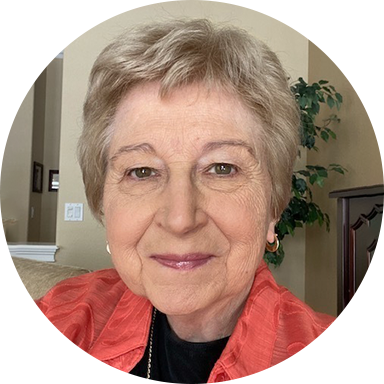
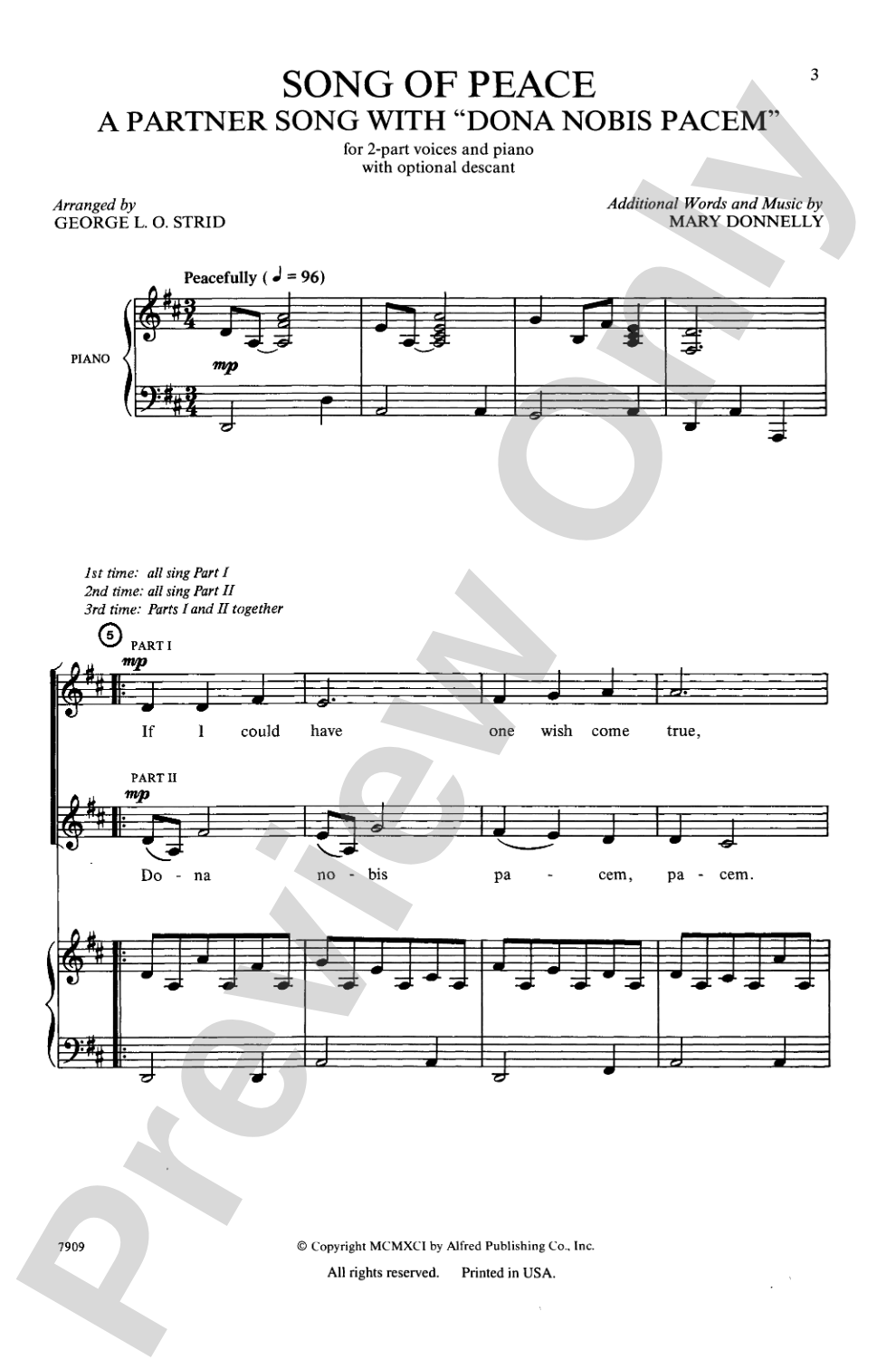
Song of Peace (Dona Nobis Pacem) Sheet Music Preview

Song of Peace (Dona Nobis Pacem): 2-Part Choral Octavo

Music by Mary Donnelly / arr. George L. O. Strid

Item: 00-PO-0003490

Digital Download
$2.05

Minimum order quantity: 20 copies

Description
It's a partner song with the famous "Dona Nobis Pacem" canon. Mary Donnelly's simple new melody, her touching text "If I could have one wish come true, it would be peace for me and you." and George Strid's easy, but effective arrangement make this 2-part work with optional descants a winner.

Song of Peace (Dona Nobis Pacem): 2-Part Choral Octavo isn't in MakeMusic Cloud just yet...but it could be. Let us know you'd like to see it, and you'll help shape what comes next. In the meantime, start a free trial and dive into thousands of interactive titles your students can play along with today.

Sample Audio
0:00
0:00
Sample Video
Additional Details
Series: Alfred Choral Designs
Publisher: Alfred Music
Page Count: 8
SKU: 00-PO-0003490

More about this title

About the Composer: Mary Donnelly

Mary Donnelly

Mary Donnelly grew up in Reno, Nevada and studied English and French at the University of Nevada, Reno. While still an undergraduate, she founded two children's choruses, an experience that redirected her career toward music education. She later earned a Master's Degree in Education from Lesley College in Cambridge, Massachusetts, where she focused on arts integration across the curriculum.

Donnelly taught general music and choir in elementary and middle schools throughout the Washoe County School District for three decades before retiring. She began her prolific songwriting partnership with arranger George Strid in 1985 when they collaborated on a musical for a sixth-grade Reading Week project. Since then, they have created over two hundred songs and twenty-five musicals together. She holds memberships in ACDA, NEA, and ASCAP.

Why we love this

Donnelly's gift for matching accessible melodies to meaningful text shines here. The companion melody works seamlessly alongside the beloved "Dona Nobis Pacem" canon, giving directors a sophisticated programming option that feels organic rather than forced, while Strid's arrangement stays lean enough for developing singers without sacrificing musical substance.

What to expect

Warm and earnest. The melody unfolds with genuine simplicity, never reaching for false emotion, while the harmonic support adds quiet richness. There's a sense of collective reaching toward something hopeful without ever straining.

Who it's for

Middle school and high school choirs ready to explore partner songs and layered textures. The 2-part voicing makes it accessible to developing ensembles while the optional descants offer depth for more experienced singers.

How to get the most out of it

  • Balance the two parts independently during early rehearsals before combining them, especially if your singers are newer to harmony. This helps each line find its melodic integrity.
  • Experiment with the optional descants by starting without them, then adding them once the main parts are secure. This layering strategy builds confidence and clarifies the harmonic structure.
  • Consider the text as the emotional anchor. The direct simplicity of "If I could have one wish come true, it would be peace for me and you" asks for genuine delivery, not oversinging.
  • If pairing this with the "Dona Nobis Pacem" canon, rehearse them separately first, then create a moment in your rehearsal schedule specifically for learning how they interact as partner pieces.

How to use it

Program this as a centerpiece for peace-themed concerts or brotherhood celebrations. Its pairing capability with the traditional "Dona Nobis Pacem" canon makes it ideal for creating a thematic suite or for closing a concert with a double-layer message of unity.

Skills your students will build

  • singing partner songs and layered melodic lines
  • balancing two independent vocal lines while maintaining harmonic cohesion
  • expressive singing with restrained emotion
  • sight-reading accessible but non-trivial 2-part choral writing
  • understanding optional descants and when to add textural complexity

You May Also Like