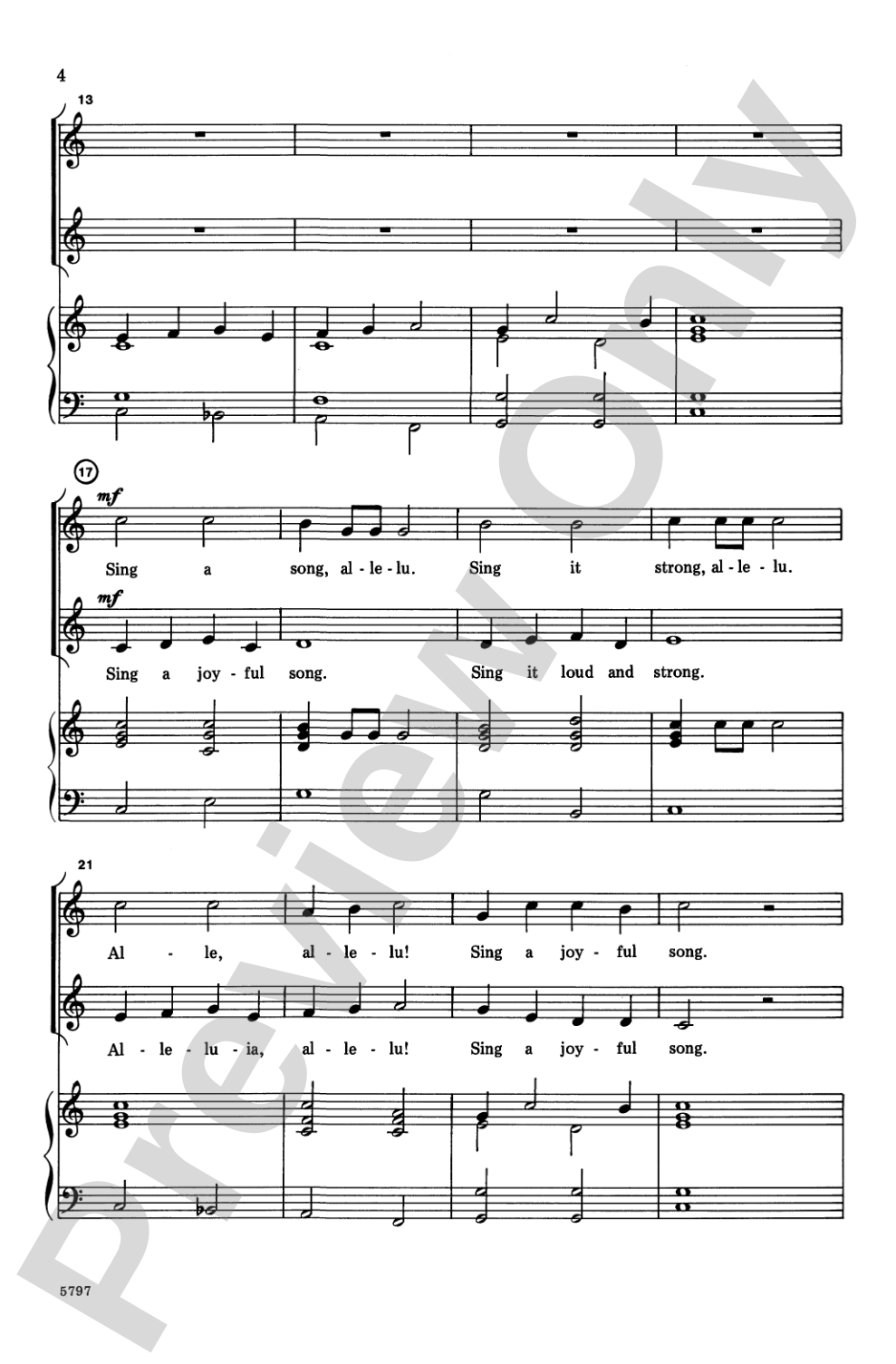
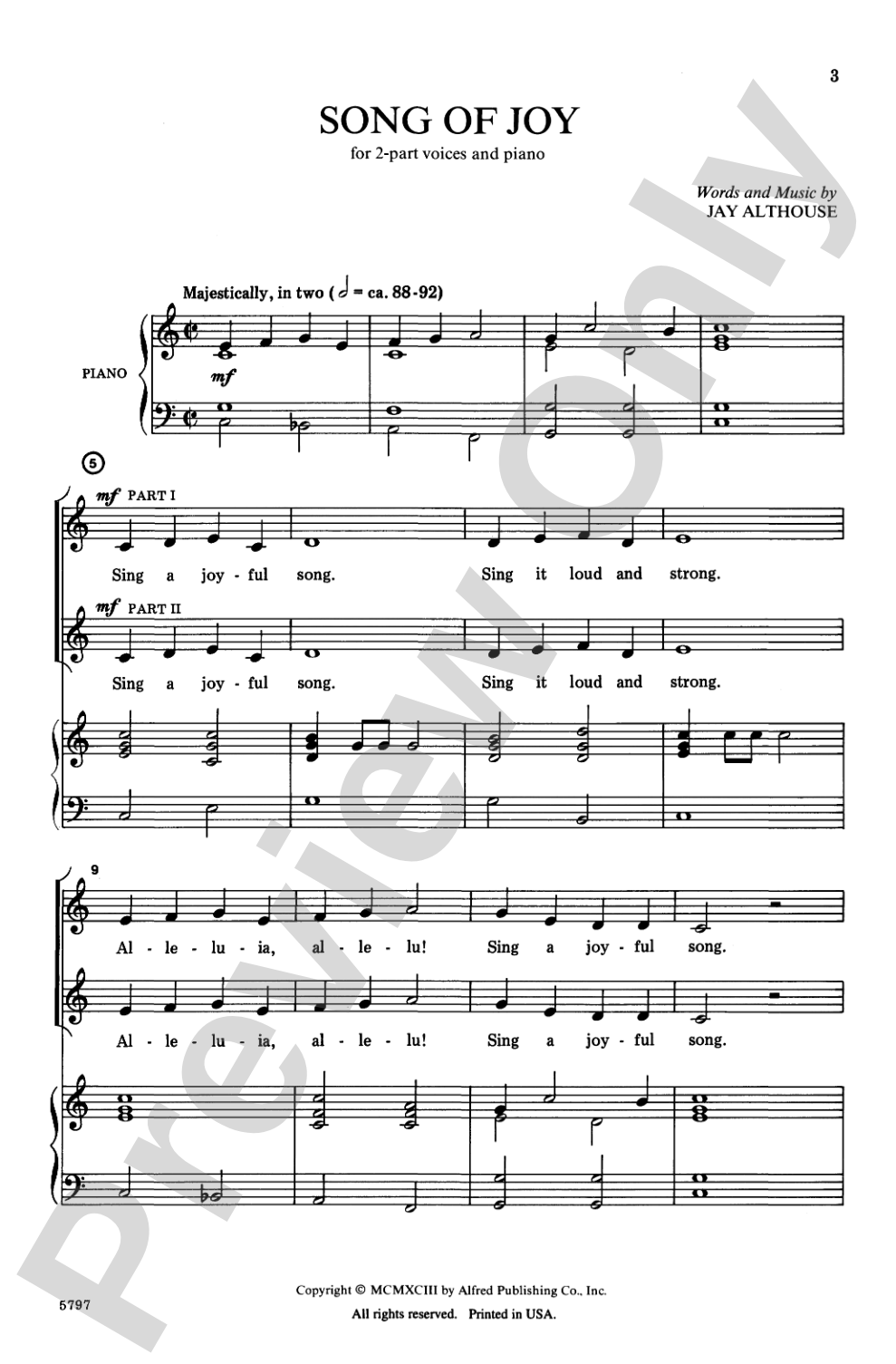
Song of Joy Sheet Music Preview

Song of Joy: 2-Part Choral Octavo

Music by Jay Althouse

Item: 00-PO-0004484

Digital Download
$2.25

Minimum order quantity: 20 copies

Description
A wonderful teaching piece for young singers. The melodies are easy so you can focus on choral techniques such as a clear vocal tone, phrasing, and diction. It's a quick-learn, jubilant piece written especially for today's young choirs by Jay Althouse. Features a flowing "A" melody and a contrasting "Alleluia" section. For general or Christmas use.

Song of Joy: 2-Part Choral Octavo isn't in MakeMusic Cloud just yet...but it could be. Let us know you'd like to see it, and you'll help shape what comes next. In the meantime, start a free trial and dive into thousands of interactive titles your students can play along with today.

Sample Audio
No sample audio found.
Sample Video
Additional Details
Series: Alfred Archive Edition: Alfred Choral Designs
Publisher: Alfred Music
Page Count: 12
SKU: 00-PO-0004484

More about this title

About the Composer: Jay Althouse

Jay Althouse

Jay Althouse holds degrees in Music Education and Music from Indiana University of Pennsylvania, where he was later honored as a Distinguished Alumnus. Early in his career, he worked for eight years in rights and licenses administration at a major educational music publisher and served on the Executive Board of the Music Publishers Association of America.

With over 800 choral compositions in print, Althouse has established himself as a prolific voice in music for singers of all levels. His work appears regularly in choirs across the English-speaking world, and he is a songwriter member of ASCAP, a regular recipient of the ASCAP Special Award. Beyond composing, he has co-created children's musicals with Sally K. Albrecht, compiled vocal solo collections, written influential books on choral technique and music history, and contributed to the Folk Art Society of America. He lives in Wake Forest, North Carolina.

Why we love this

Althouse designed this piece specifically with young choir development in mind, deliberately keeping the melodic writing simple so that singers can concentrate on tone quality, phrasing, and clear diction rather than wrestling with complex intervals. The dual purpose structure (general or Christmas) and the quick-learn factor mean you can add this to your concert within a reasonable rehearsal timeline without sacrificing musical substance.

What to expect

The piece radiates genuine joy and forward momentum without relying on complexity. Its flowing main melody feels natural to sing, while the contrasting 'Alleluia' section adds buoyancy and light, making this a piece that singers leave the rehearsal room feeling energized and accomplished.

Who it's for

This octavo works beautifully for middle school and young high school choirs, particularly those still developing ensemble awareness and individual vocal technique. It also serves well for community youth choirs, church youth groups, and any ensemble seeking accessible material that does not compromise on musicianship.

How to get the most out of it

  • Shape the flowing 'A' melody with deliberate phrase breathing to help singers understand the arc of a musical line; mark suggested breath points in scores before rehearsal begins.
  • Emphasize clean diction in the 'Alleluia' section by having singers articulate consonants together; this rhythmic precision will give the contrasting material its intended brightness.
  • Build vocal tone through focused warm-ups on the sustained vowels in the main melody; this piece rewards singers who commit to a connected, supported sound.

How to use it

Program this as an opener or mid-concert selection when you want to showcase developing voices in music that is musically sincere and emotionally direct. The dual general/Christmas designation also makes it a reliable choice for year-end concerts or holiday programs where you need quality repertoire that fits the season without requiring substantial preparation time.

Skills your students will build

  • Sustained vocal tone production across phrases
  • Phrasing and breath placement in legit melody
  • Clear diction in both lyrical and rhythmic text
  • Ensemble blend in two-part writing
  • Musical interpretation through contrast (flowing verse and jubilant section)

You May Also Like