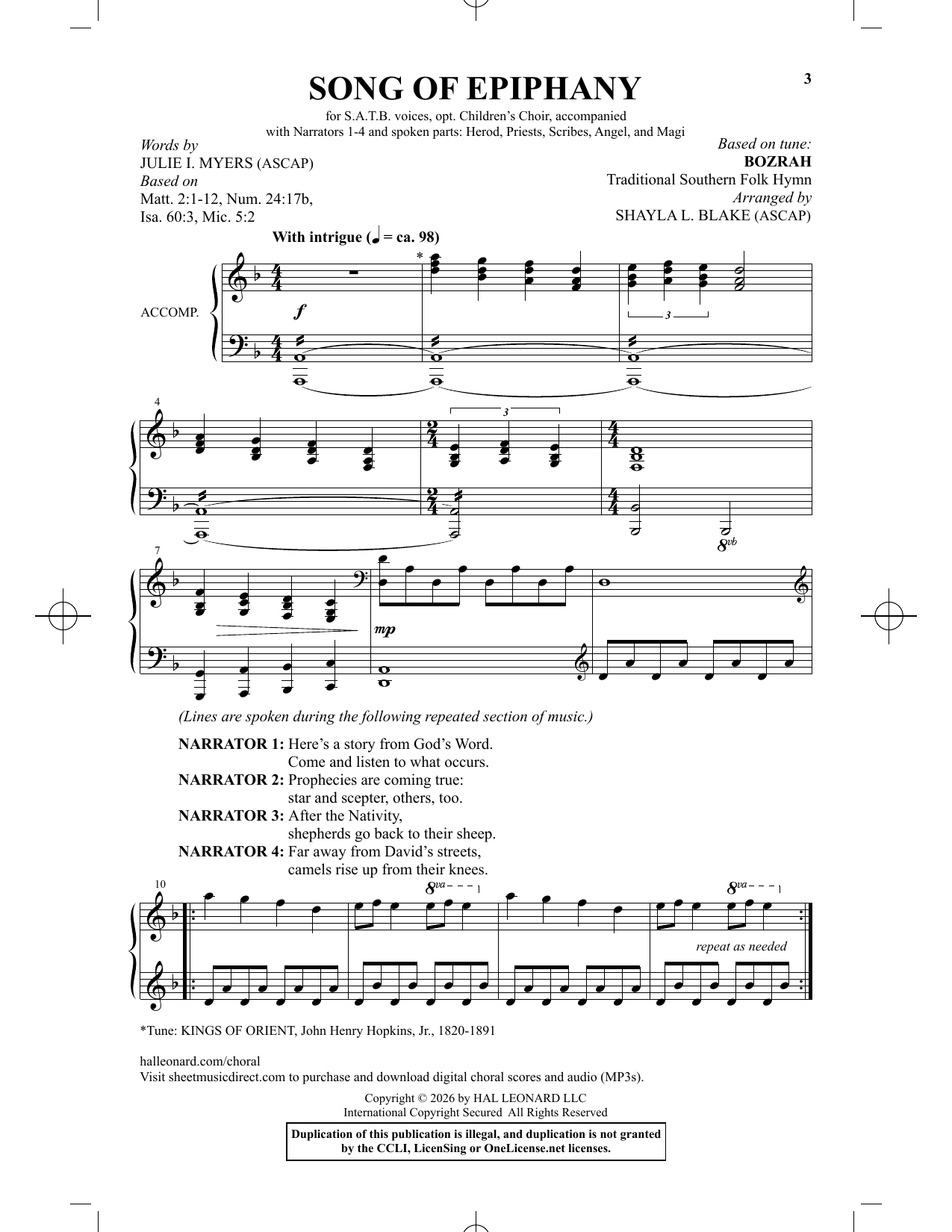
Please note: Under U.S. copyright law, you must purchase the exact number of copies needed for your ensemble. Printing, duplicating or sharing additional copies is strictly prohibited.
Pickup currently not available
Description
Discover MakeMusic Cloud: thousands of interactive titles your students can play along with today.
Shayla Blake is a collaborative pianist, flute instructor, and choral arranger on the faculty at Louisiana Tech University's School of Music, where she teaches piano, flute, songwriting, and choral arranging. Her educational background includes degrees in piano performance from both Stetson University and Texas Tech University, where she studied with Geoffrey Gilbert (flute) and William Westney (piano), and earned recognition as a finalist in the Graduate Concerto Competition.
As a prolific composer and arranger, Blake's work appears with major publishers including Choristers Guild, Lorenz, Shawnee Press, Hal Leonard, and Alfred Music. Her pieces have been performed at the Vatican and at regional conferences like TMEA, and she received a 2020 fellowship at Hambidge Center for the Arts. Beyond her publishing work, Blake is an active collaborative pianist, duo performer, and director of the North Louisiana Parkinson's Chorale, where she applies music therapeutically with patients and their families.
Why we love this
Blake brings both a pianist's harmonic sensibility and a choral arranger's practical instincts to her work. This arrangement sits comfortably for SATB voices while maintaining musical substance, making it accessible for developing choirs without sacrificing artistry.
What to expect
The piece carries the contemplative quality of Epiphany's theme: revelation, reflection, and the profound recognition of sacred presence. Blake's arrangement balances clarity of text with harmonic richness, creating moments of hushed reverence alongside fuller sonorities that allow the choir's collective voice to resonate.
Who it's for
This octavo works for intermediate to advanced SATB choirs seeking sacred repertoire with genuine musical substance. It suits church choirs preparing for Epiphany season, academic ensembles building their sacred catalog, or any director wanting an arrangement that respects both the liturgical text and the singers performing it.
How to get the most out of it
Highlight the text painting opportunities that the arrangement likely offers; these details often emerge most clearly once singers hear themselves recorded alongside the accompaniment.
Balance your section strength early in rehearsal so sopranos and altos can lock the upper harmonic line before tenors and basses join the texture.
Shape the piece's dynamic arc intentionally rather than singing it uniformly; even modest 11-page arrangements reward attention to subtle crescendos and diminuendos that reflect the poetry.
How to use it
Position this during the Epiphany season (January through early February) as a reflective moment in liturgical services or winter concert programs. Its moderate length makes it an excellent companion piece alongside shorter anthems or as a centerpiece within a sacred choral suite.
Skills your students will build
SATB blend and balance in four-part writing
Phrasing and text expression in liturgical contexts
Reading Blake's harmonic language and voice leading
Sustaining vocal tone across longer phrase lines
You May Also Like
Scan to Complete Your Purchase
Use your phone's camera to scan the code below
You'll log in on your phone and the order will be added to your account