Song of a Summer Night: Bells Sheet Music Preview

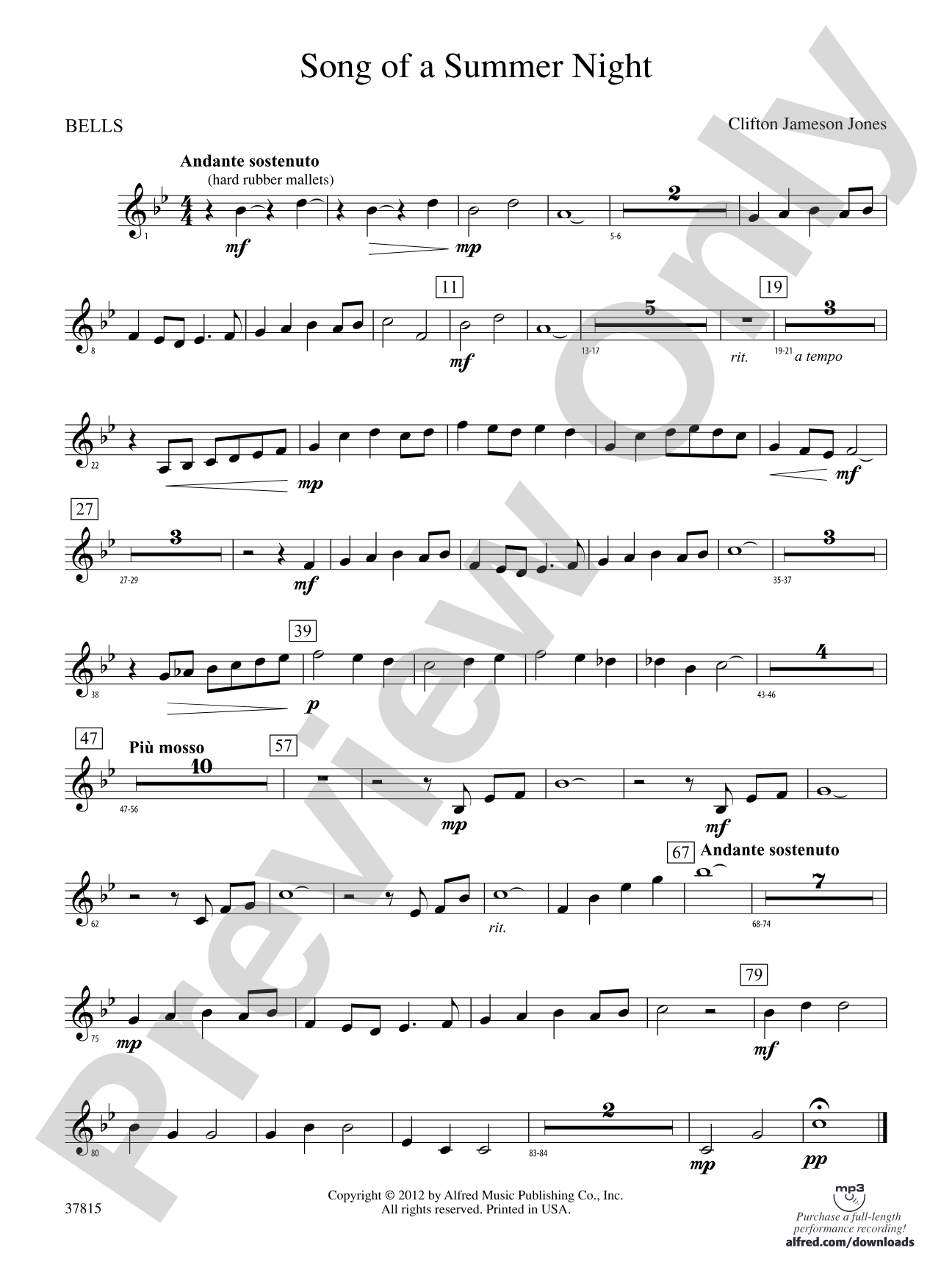
Song of a Summer Night: Bells

By Clifton Jameson Jones

Grade: 2 (Medium Easy)

Item: 00-PC-0015345_B

Digital Download
$3.00
Description
"Song of a Summer Night" evokes the tranquility of a warm summer night as a breeze from the south stirs the trees. The lyrical melody evolves and transforms throughout the piece until it reaches an unexpected but satisfying conclusion. The well-crafted orchestration provides an opportunity for the clarinets to display the chalumeau register and for percussionists to explore a variety of different color possibilities. (4:10)

Don't just read it, hear it, play along with it, and watch your students grow with it. In MakeMusic Cloud, Song of a Summer Night: Bells comes alive with professional accompaniment, adjustable tempo, and built-in practice tools that turn solo practice into real progress.

Sample Audio
0:00
0:00
Sample Video
Additional Details
Series: Young Symphonic
Publisher: Alfred Music
Page Count: 180
SKU: 00-PC-0015345_B

More about this title

About the Composer: Clifton Jameson Jones

Clifton Jameson Jones

Clifton Jameson Jones is a composer and arranger based in Texas with deep roots in both classical and jazz traditions. He studied composition and theory at Trinity University and the University of Houston, and arranging at San Jacinto College. His versatility spans band, orchestra, jazz ensemble, and woodwind literature, and he remains active in the Austin Symphonic Band as a clarinetist.

Jones brings classroom experience to his writing, having taught woodwind methods and directed jazz ensemble at the high school level in College Station. His work with student ensembles informs his compositional choices, making his pieces both musically engaging and pedagogically sound. He holds membership in the Texas Music Educators Association, Texas Jazz Educators Association, and ASCAP.

Why we love this

Jones captures genuine atmospheric writing without resorting to gimmick or oversimplification. The piece gives your band real musical work to do: the clarinet writing demands attention to the chalumeau register's tonal qualities, and the percussion section gets to develop textural sensitivity across multiple colors rather than marking time. The arc from peaceful opening to unexpected conclusion rewards careful rehearsal.

What to expect

A gentle evening unfolds through this piece as a warm breeze moves through trees, the orchestration suggesting rustling leaves and distant sounds. The melody evolves organically, shifting perspective as the night deepens, until the ending arrives with quiet surprise rather than fanfare. It's contemplative and evocative without being saccharine.

Who it's for

This Grade 2 work suits bands with solid fundamentals who are ready to explore lyrical writing and orchestral color. It works well for groups developing ensemble balance and sensitive dynamic control without requiring virtuosic technique.

How to get the most out of it

  • Balance the clarinet melody in the chalumeau register so it sings through without forcing; this lower tessitura requires support from the middle voices without overwhelming it.
  • Establish the character of the opening breeze through air movement and ensemble unity before introducing the main melody; this foundation makes the subsequent transformations more effective.
  • Work with percussionists on their color choices throughout the piece so each instrumental change reads as intentional contrast rather than random variation.

How to use it

This piece opens programming possibilities for concerts that don't rely solely on marches and fanfares. Pair it with contrasting energetic works to showcase your band's range, or use it as a palate-cleansing closer that leaves the audience in a reflective mood. Its manageable length (4:10) and Grade 2 level make it ideal for mid-season programming when students have developed ensemble cohesion.

Skills your students will build

  • Tone production in the clarinet chalumeau register
  • Ensemble balance between melody and accompaniment
  • Sustained dynamic control and phrasing in lyrical contexts
  • Percussion color selection and textural awareness
  • Following harmonic and melodic transformation across phrases

You May Also Like