
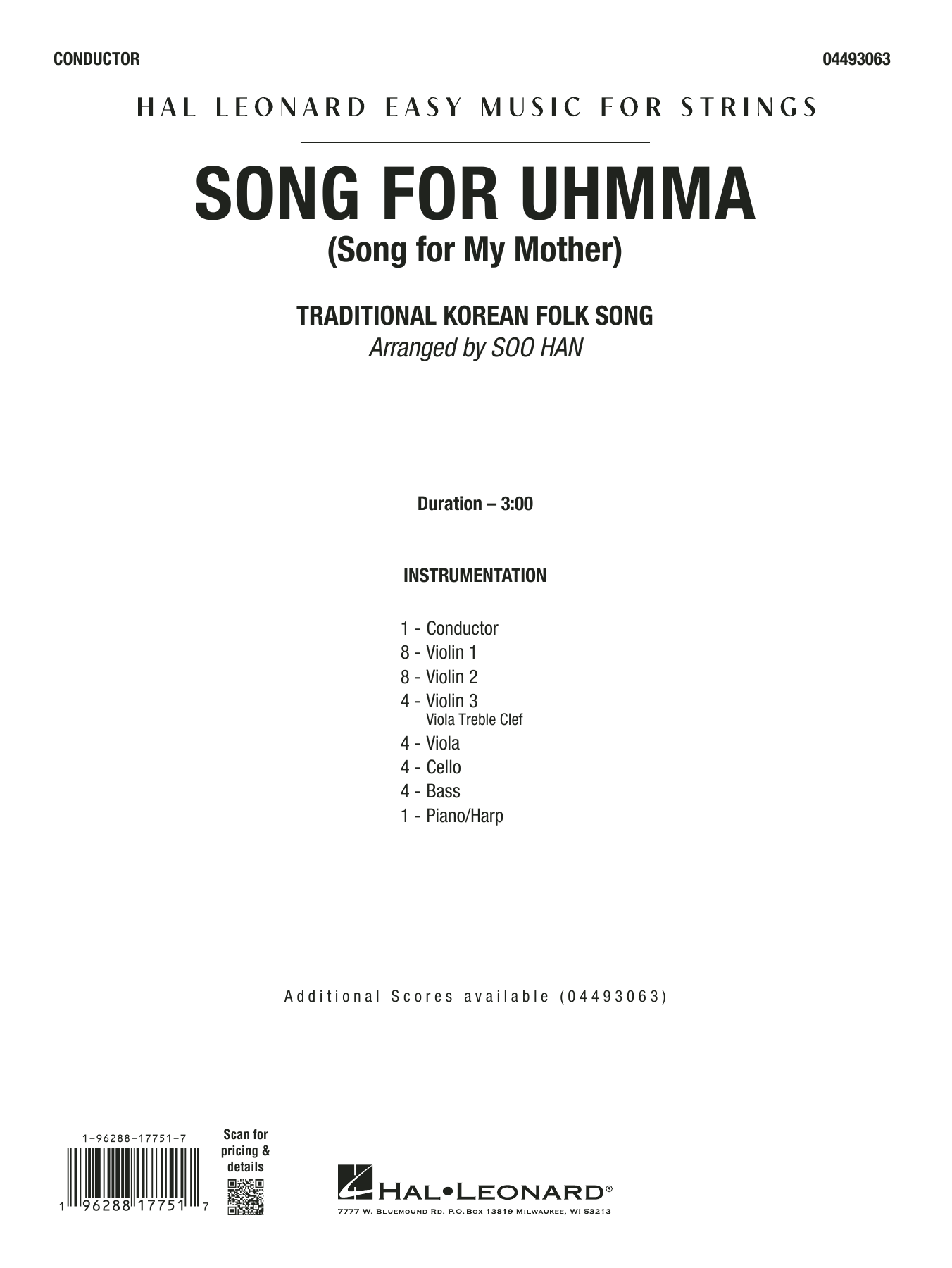

Song for UhmMa (Song for My Mother) (arr. Soo Han): String Orchestra Conductor Score & Parts
Arranged by Soo Han
Grade: 2
Item: 35-PK01291480
$55.00
Pickup currently not available
Buy Extra Parts (Digital PDF Download)
Parts Added to Cart!
Description
Traditional Korean Folk Song


Song for UhmMa (Song for My Mother) (arr. Soo Han): String Orchestra Conductor Score & Parts isn't in MakeMusic Cloud just yet...but it could be. Let us know you'd like to see it, and you'll help shape what comes next. In the meantime, start a free trial and dive into thousands of interactive titles your students can play along with today.
Request This Title
Tell us you want it.
Start Your Free Trial
Explore everything that's ready to play right now.
Sample Audio
No sample audio found.
Sample Video
No sample videos found.
Additional Details
Publisher:
Hal Leonard
SKU:
35-PK01291480
More about this title
About the Arranger: Soo Han
Soo Han is an arranger deeply invested in making traditional Korean music accessible to young string musicians. Her work focuses on preserving cultural repertoire while writing idiomatically for student ensembles, ensuring that arrangements serve both musical and educational goals.
Why we love this
This arrangement brings a beloved Korean lullaby into the string orchestra curriculum in a way that feels genuine rather than exoticized. Grade 2 students get their first real exposure to non-Western musical traditions, and the writing respects both the folk melody and the players' developing skills.
What to expect
Tender and intimate, with the quality of a mother's voice transmitted through the strings. The arrangement opens gently, allowing the melody to unfold naturally while the lower voices provide a warm, supportive harmonic bed that never intrudes.
Who it's for
String orchestras at the early intermediate level, particularly programs looking to expand cultural representation in their concert season. This works equally well for schools with significant Korean families in the community and for ensembles discovering this repertoire for the first time.
How to get the most out of it
- Shape the melody with a singing, sustained tone in the first violins; this folk song lives or dies on the warmth of the primary line.
- Balance accompaniment textures so the harmonic support never overwhelms the tune; use rehearsal to test dynamics in context rather than in isolation.
- Allow space for breath within phrases, even in a continuous flow; younger players often lock down rhythmically when they should breathe musically.
How to use it
Pair this with other cultural folk song arrangements for a thematic concert set, or feature it as a shorter work that gives the ensemble a moment of reflection between more technically demanding pieces. It also works beautifully as an opening number to settle an audience and establish an emotional tone for the concert.
Skills your students will build
- Sustaining lyrical melodic lines with consistent tone quality
- Balancing melody and accompaniment within an ensemble texture
- Reading and playing folk melodies from non-Western traditions
- Responding to cultural and emotional context while performing
- Coordinating phrase shapes across multiple string voices