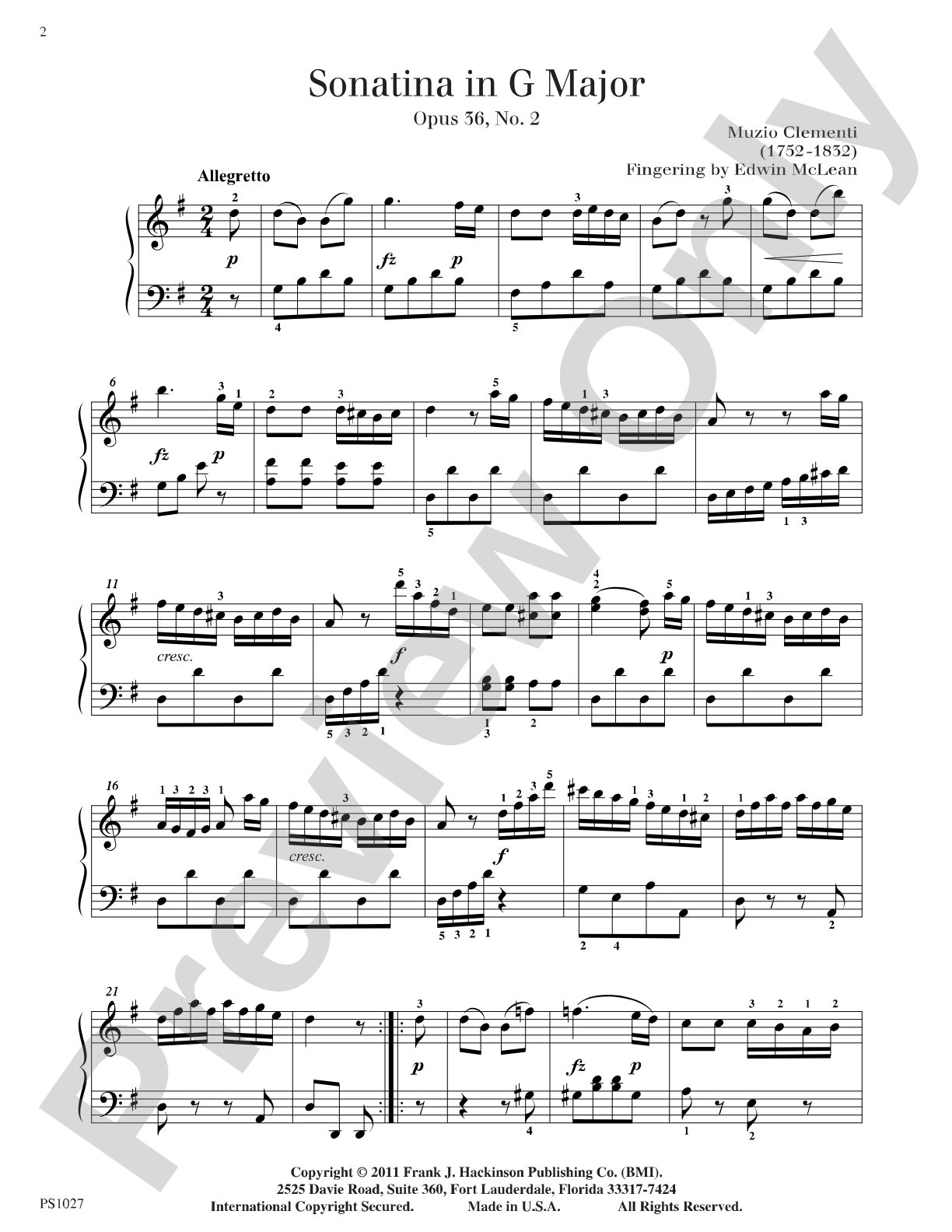
Sonatina in G Major, Op.36, No.2 Sheet Music Preview

Sonatina in G Major, Op.36, No.2: Piano

By Muzio Clementi / ed. Edwin McLean

Item: 98-DPS1027

Digital Download
$3.95
Description
This Urtext edition of Clementi's second sonatina from Opus 36 is based on the earliest published sources. Newly engraved, with fingering by Edwin McLean, this charming three-movement sonatina is popular pedagogic material for your intermediate students.

Sonatina in G Major, Op.36, No.2: Piano isn't in MakeMusic Cloud just yet...but it could be. Let us know you'd like to see it, and you'll help shape what comes next. In the meantime, start a free trial and dive into thousands of interactive titles your students can play along with today.

Sample Audio
No sample audio found.
Sample Video
Additional Details
Series: The FJH Piano Solo Series
Publisher: The FJH Music Company, Inc.
SKU: 98-DPS1027

More about this title

About the Composer: Muzio Clementi

Muzio Clementi (1752-1827) was an Italian composer and pianist whose keyboard sonatas and sonatinas became foundational repertoire for generations of music students. A virtuoso performer in his own right, Clementi understood the mechanics of piano technique intimately and wrote music that was both musically engaging and technically purposeful. His pedagogical works bridged the gap between simple exercises and concert music, establishing him as a key figure in the development of modern piano pedagogy.

Why we love this

Clementi's Op. 36 sonatinas occupy a sweet spot in intermediate repertoire: they demand genuine musicality and finger work without overwhelming students with dramatic scope. This Urtext edition respects the composer's original intentions while Edwin McLean's fingering offers practical guidance for students navigating the passagework and hand positions. The three-movement structure gives students a complete musical arc to work with, making it rewarding both to learn and to perform.

What to expect

Elegant, conversational, and full of light. The three movements unfold with the natural grace of an 18th-century parlor performance, neither precious nor heavy-handed. Clementi's writing sparkles with charm and directness, inviting the performer to find clarity and grace within a straightforward musical conversation.

Who it's for

Intermediate pianists who are ready to move beyond simple folk song arrangements and explore the Classical sonata form. Students working toward recital performances will find this sonatina substantial enough to anchor a program and rewarding to master fully. It is also an excellent choice for students beginning to understand the architecture of multi-movement works.

How to get the most out of it

  • Attend to the articulation markings as notated; Clementi's touches are deliberate and contribute to the sonatina's character across all three movements.
  • Shape the phrases with gentle dynamic contours rather than playing each section at the same level; the Classical aesthetic rewards forward momentum within a restrained palette.
  • Balance clarity in the left hand with a singing right hand, particularly in the slow movement where the accompaniment figures support the melodic line.
  • Practice the hand position shifts and fingering suggestions early so you can focus on musical interpretation rather than technical problem-solving closer to performance.

How to use it

Program this sonatina as a centerpiece for a student recital, pairing it with a contemporary piece to show stylistic range. In a studio curriculum, it serves as an introduction to sonata-form thinking and multi-movement planning before advancing to more substantial works. It also makes an excellent choice for competition or evaluation settings where students need to demonstrate solid technique and musical awareness at the intermediate level.

Skills your students will build

  • Three-movement form and development of sonata structure
  • Baroque-to-Classical transition in harmonic language and ornamentation
  • Finger independence and hand position management in scalar and arpeggiated passages
  • Dynamic control within a restrained range
  • Legato and non-legato touch articulation
  • Pedal use appropriate to Classical-era sound

You May Also Like