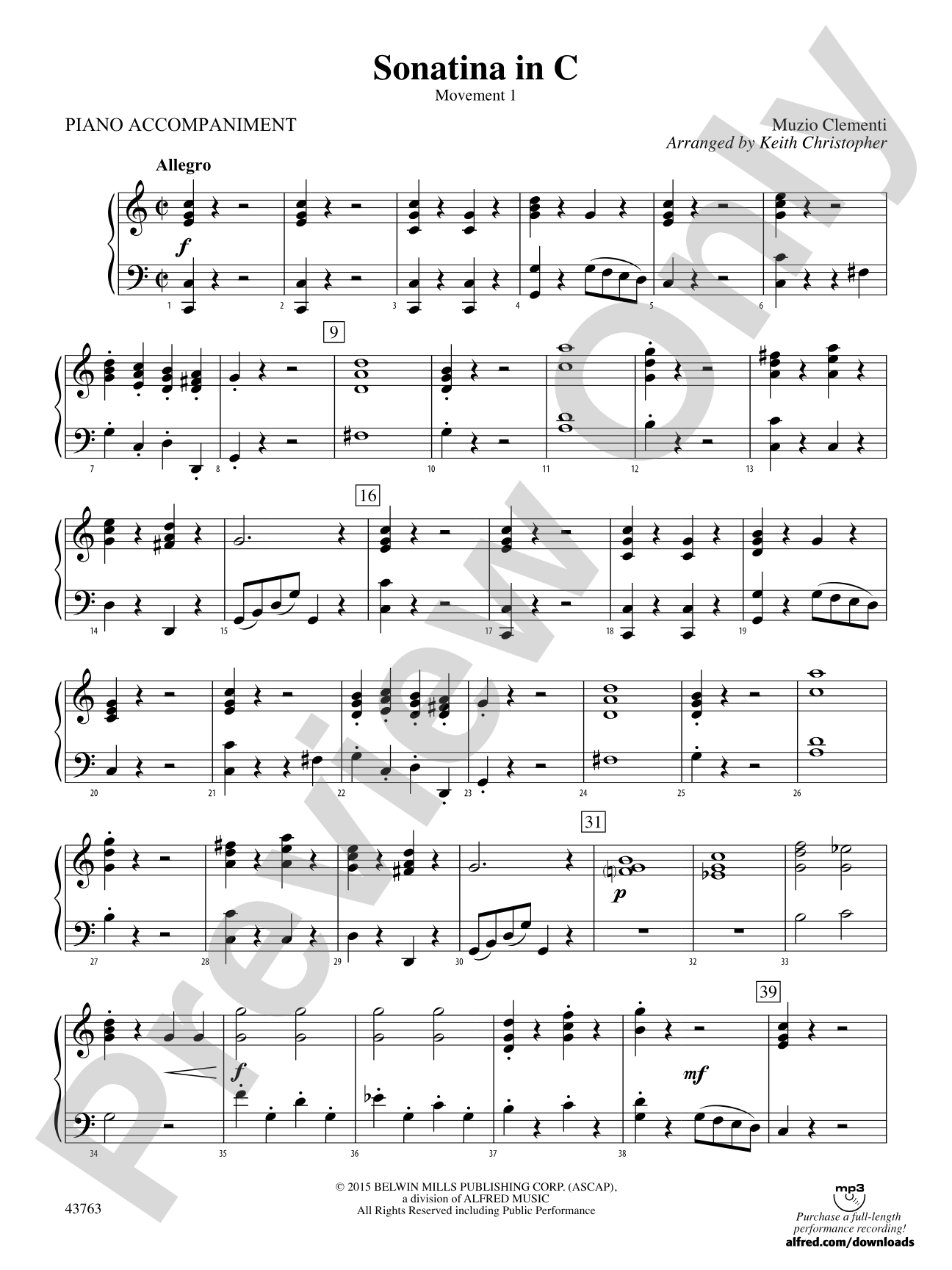
Sonatina in C: Piano Accompaniment Sheet Music Preview

Sonatina in C: Piano Accompaniment

Movement 1

By Muzio Clementi / arr. Keith Christopher

Grade: 2.5

Item: 00-PC-0016867_K

Digital Download
$5.99
Description
Students will learn cut time, rhythmic accuracy, how to achieve clean staccato technique, musical form, and an idea of classical style in this engaging piece. Just plain fun to play! (1:55)

Don't just read it, hear it, play along with it, and watch your students grow with it. In MakeMusic Cloud, Sonatina in C: Piano Accompaniment comes alive with professional accompaniment, adjustable tempo, and built-in practice tools that turn solo practice into real progress.

Sample Audio
0:00
0:00
Sample Video
Additional Details
Series: Belwin Intermediate String Orchestra
Publisher: Alfred Music
Page Count: 148
SKU: 00-PC-0016867_K

More about this title

About the Composer: Muzio Clementi

Muzio Clementi (1752-1832) was an Italian composer and keyboard virtuoso whose sonatas became cornerstones of the classical repertoire. Though overshadowed by his contemporaries Mozart and Beethoven, Clementi's writing shaped how composers approached both the pianoforte and the orchestra, blending Italian lyricism with Germanic formal clarity.

Clementi's works remain essential in music education because they embody classical principles without unnecessary complexity. His melodies are memorable, his structures transparent, and his textures grateful to play. Teachers and students recognize in his music the clarity of classical form in its most approachable form.

Why we love this

This arrangement captures everything that makes classical form memorable without requiring an advanced orchestra to execute it cleanly. Keith Christopher's scoring preserves Clementi's elegant melodic writing while giving younger string players genuine classical repertoire to perform, not simplified approximations. The piece delivers concert-ready results in a grade 2.5 package, which is increasingly rare.

What to expect

Elegantly proportioned and charming, with the confidence of classical balance. The staccato writing gives it articulate, almost playful character, while the harmonic language feels sophisticated without being dense. At nearly two minutes, it rewards focused listening and delivers the satisfaction of complete musical architecture.

Who it's for

String orchestra directors at the intermediate level who want their ensembles to experience genuine classical masterworks while building technical consistency. Students benefit from the clear formal and stylistic anchors Clementi provides; this piece teaches how classical composers think.

How to get the most out of it

  • Isolate the staccato passages in sectionals before full rehearsals. Have each section lock the articulation within the part before adding it to the ensemble.
  • Conduct cut time with a clear, two-beat pulse from the start of rehearsals. This tempo subdivision shapes how students hear phrase structure and prevents dragging.
  • Balance the first and second violin lines carefully so the melody remains audible even when both are playing simultaneously. Quick rebalancing during full rehearsals prevents muddiness.
  • Work through the form visually on the score so students hear how Clementi returns to key thematic material. This awareness transforms the piece from note-reading into structural listening.

How to use it

Open a concert with this piece to establish classical style early and warm the audience to your orchestra's musicianship. It also pairs well on a program with later-period masterwork arrangements, helping audiences trace the evolution of form and orchestration from Clementi's era forward.

Skills your students will build

  • Reading and performing in cut time
  • Clean staccato technique with rhythmic precision
  • Recognizing sonata form and its restatement of thematic material
  • Balancing melody and accompaniment within ensemble texture
  • Understanding classical era style conventions and articulation

You May Also Like