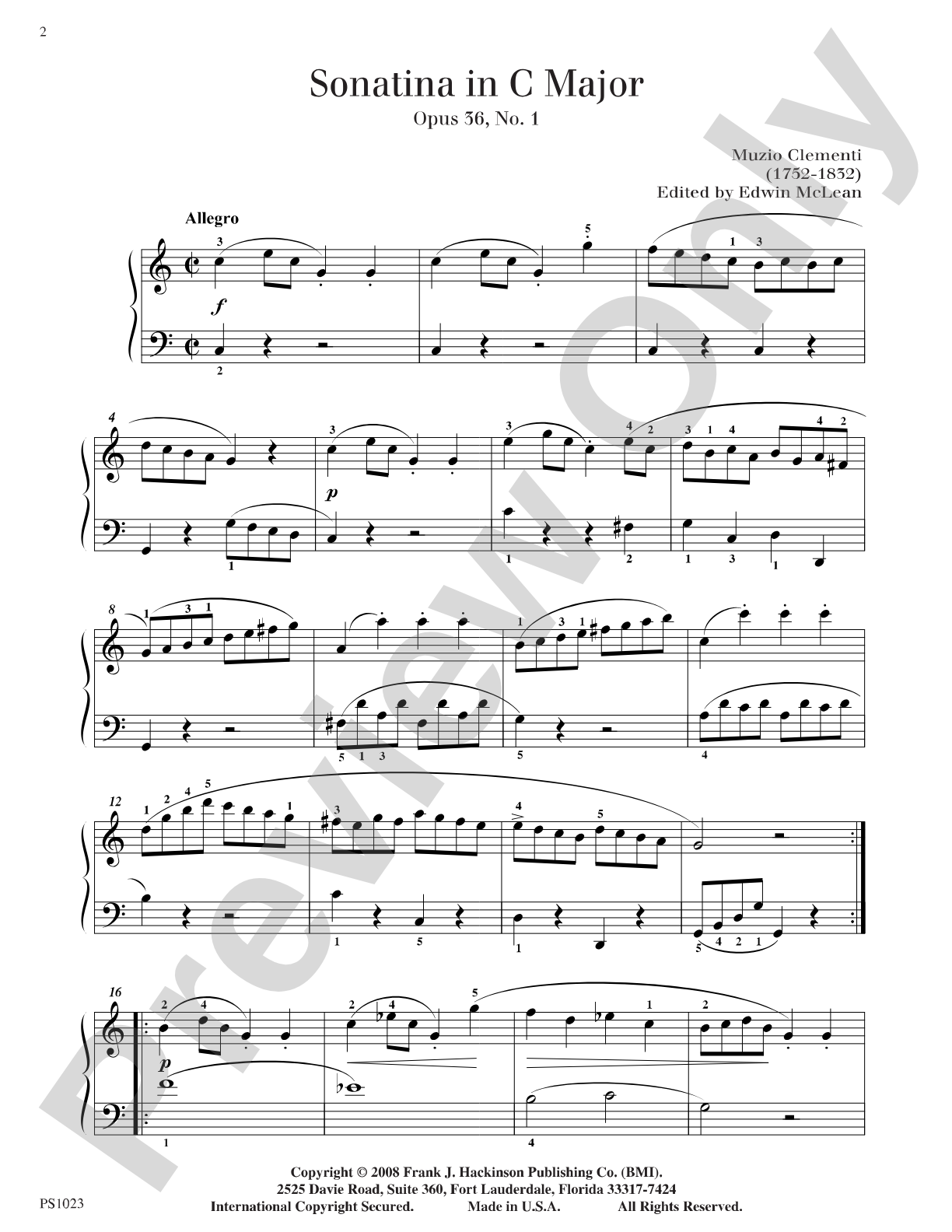
Sonatina in C Major, Op. 36, No. 1 Sheet Music Preview

Sonatina in C Major, Op. 36, No. 1: Piano

By Muzio Clementi / ed. Edwin McLean

Item: 98-DPS1023

Digital Download
$6.50
Description
This renowned standard in student repertoire is presented here in its original form newly engraved and edited by Edwin McLean. As a standard in every piano studio, this complete three movement Sonatina is an essential part of the repertoire for every developing pianist.

Sonatina in C Major, Op. 36, No. 1: Piano isn't in MakeMusic Cloud just yet...but it could be. Let us know you'd like to see it, and you'll help shape what comes next. In the meantime, start a free trial and dive into thousands of interactive titles your students can play along with today.

Sample Audio
No sample audio found.
Sample Video
Additional Details
Series: The FJH Piano Solo Series
Publisher: The FJH Music Company, Inc.
SKU: 98-DPS1023

More about this title

About the Composer: Muzio Clementi

Muzio Clementi (1752-1832) was an Italian composer and pianist whose keyboard sonatas and sonatinas became foundational pillars of piano pedagogy. A virtuoso performer and shrewd music publisher, Clementi shaped the technical and musical expectations of the developing pianist through works that balance Classical elegance with genuine pianistic difficulty. His sonatinas remain essential precisely because they demand growing technical facility while refusing to compromise on musical substance.

Clementi's influence on piano teaching extends beyond his compositions. His pedagogical clarity, harmonic sophistication, and understanding of what students could achieve at different levels made his works trusted standards in studios worldwide. Teachers value his sonatinas as models of balanced three-movement form and as gateways into the Classical repertoire.

Why we love this

This sonatina is the reliable anchor in the intermediate classical repertoire. Its three-movement structure teaches form without oversimplifying it, and the fingering and phrasing challenges feel authentic rather than contrived. Clementi's harmonic language remains fresh after centuries because it was never mannered to begin with.

What to expect

Elegant and purposeful. The opening theme feels naturally at home, neither grand nor miniature, with a gentle forward motion that invites the listener in immediately. The Andante offers genuine expressiveness without sentimentality, while the finale sparkles with clean articulation and balanced phrasing that rewards rhythmic precision and light touch.

Who it's for

Intermediate pianists who have mastered basic sonata form and are ready to engage seriously with Classical structure and style. This is the piece that many teachers assign at the threshold between early and mid-level study, often around grades 4-6 of the Royal Conservatory or similar curricula.

How to get the most out of it

  • Shape the opening theme of the Allegro with gentle dynamic contours rather than playing it straight through. The simplicity invites linear playing, but listening for the natural peaks and valleys in the melody transforms it.
  • In the Andante, resist the urge to slow down excessively. Clementi's andante marking sits closer to a moving moderate tempo, and rhythmic clarity matters more than sustained sweetness.
  • Observe all repeat signs. The structural purpose of repeats becomes apparent when you actually play them, especially the contrast they create before the development section.
  • Balance hand independence carefully in passages where the left hand moves while the right holds a note. These moments expose whether the hands are truly independent or relying on a shared pulse.

How to use it

Program this as the Classical anchor in a student recital, pairing it with a Baroque prelude or invention and a Romantic character piece to create a stylistically balanced set. It also works beautifully as a stepping stone into the Beethoven sonatinas or Haydn piano works, bridging the gap between early Classical and more demanding repertoire.

Skills your students will build

  • Three-movement sonata form (allegro-andante-rondo/minuet structure)
  • Classical phrasing and voice leading across both hands
  • Pedal use appropriate to Classical style
  • Hand independence in accompaniment figurations
  • Dynamic control and tonal clarity in scalar passages
  • Ornament execution and stylistic interpretation

You May Also Like