
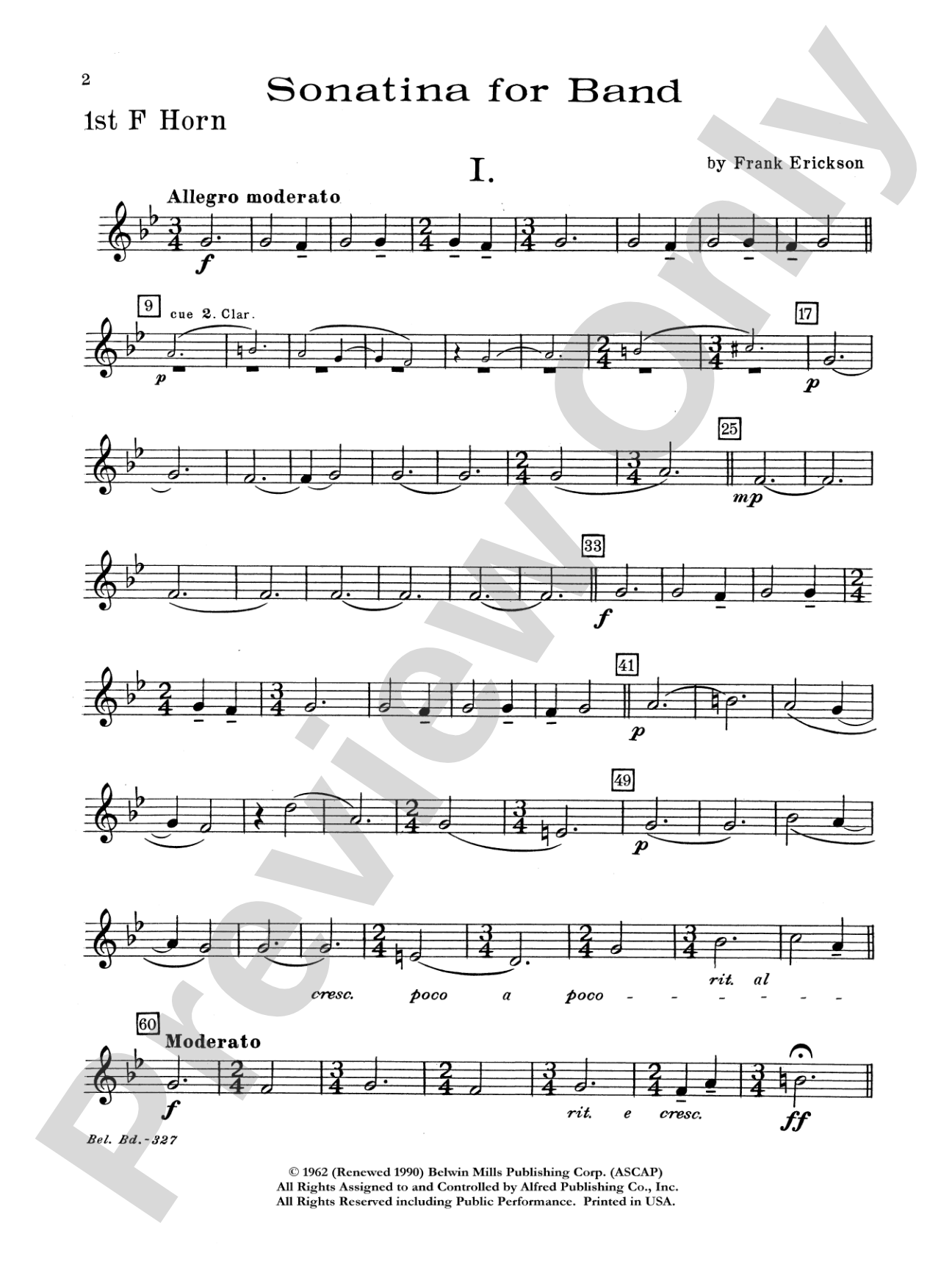

Sonatina for Band: 1st F Horn
I. Allegro moderato, II. Andantino, III. Allegro moderato
By Frank Erickson
Grade: 2.5 (Medium Easy)
Item: 00-PC-0001964_H1
$3.00
Pickup currently not available
Description
This piece, one of hundreds of successful original concert band works by Frank Erickson, is a suite of three brief movements. The three movements investigate harmonic structuring, contrasting moods, and styles as the work progresses from a simple opening to a dramatic conclusion. Revered as one of Erickson's most approachable works for developing bands, it remains on contest and festival lists nation-wide. This edition, now with a full score and freshly re-engraved parts, signifies this cherished work's addition to the Belwin Classic Band series. (5:00) This title is available in MakeMusic Cloud.


Don't just read it, hear it, play along with it, and watch your students grow with it. In MakeMusic Cloud, Sonatina for Band: 1st F Horn comes alive with professional accompaniment, adjustable tempo, and built-in practice tools that turn solo practice into real progress.
Open in the Player
Jump straight in and assign it today.
Start Your Free Trial
Open this title and explore the full library in minutes.
Sample Audio
1
Audio File
--:--
0:00
0:00
Sample Video
No sample videos found.
Additional Details
Series:
Belwin Classic Band
Publisher:
Alfred Music
Page Count:
220
SKU:
00-PC-0001964_H1
More about this title
About the Composer: Frank Erickson
Frank Erickson (1923-1996) composed and arranged hundreds of works for young and developing bands, establishing himself as one of the most prolific and practical voices in American concert band literature. His gift lay in writing music that challenged students without overwhelming them, balancing educational value with genuine musical substance. Erickson's pieces appear on contest and festival schedules across the country, and many remain standard repertoire for Grade 2-3 ensembles nearly three decades after his death.
Erickson's approach to band composition prioritized clarity of orchestration and accessibility without sacrificing musicality. He understood the constraints and capabilities of developing musicians, and his works reflect decades of experience working directly with school bands. His legacy rests not on avant-garde innovation but on the enduring practicality and musical integrity of works like Sonatina for Band.
Why we love this
This three-movement structure teaches harmonic and formal thinking without requiring complex technical demands from individual players. The progression from approachable opening to climactic conclusion gives your band a genuine sense of musical narrative and accomplishment, making it ideal for building confidence in ensembles still developing their foundational skills.
What to expect
Sonatina for Band unfolds with understated elegance, beginning in a straightforward harmonic language before exploring richer textures and bolder dramatic gestures. The middle movement provides contrast and breathing room, while the final movement builds genuine excitement through Erickson's skillful handling of orchestration and harmonic tension rather than sheer technical difficulty.
Who it's for
Conductors of developing concert bands at the Grade 2.5 to 3 level who need a substantial three-movement work that builds musicianship without overwhelming inexperienced players. Solo and section leaders will find clear parts with manageable ranges and rhythmic content, while the score offers the conductor transparent orchestration and pedagogical balance.
How to get the most out of it
- Balance the three movements as distinct musical statements. Each movement has its own character and harmonic language; resist the temptation to rush transitions. Let each section breathe.
- Pay close attention to dynamics and articulation markings in the woodwind choir, especially in the first movement. Clean releases and consistent dynamic shapes will highlight Erickson's harmonic progressions.
- The dramatic conclusion demands ensemble unity and control. Build tension gradually through the final movement rather than forcing intensity early; let the harmonic rhythm and orchestration do the work.
- Shape phrase endings with slight ritardando where the score suggests it. Erickson's phrasing benefits from gentle breath points that feel natural rather than metronomic.
How to use it
Program this as a centerpiece for a fall or winter concert where you want to showcase ensemble growth and musical development without excessive technical demands. It pairs well alongside lighter or more rhythmically-driven pieces in the same program, and its contest-proven pedigree makes it an ideal choice for festival or solo-ensemble competition preparation.
Skills your students will build
- Reading three-movement concert band form with contrasting key areas and harmonic structures
- Blending dynamics within woodwind and brass choirs while maintaining independence from other sections
- Executing clean articulation and phrase shaping in moderate tempos
- Building ensemble unity across slower harmonic movement and structural transitions
- Sustaining tone and intonation in sustained passages that support harmonic progression