
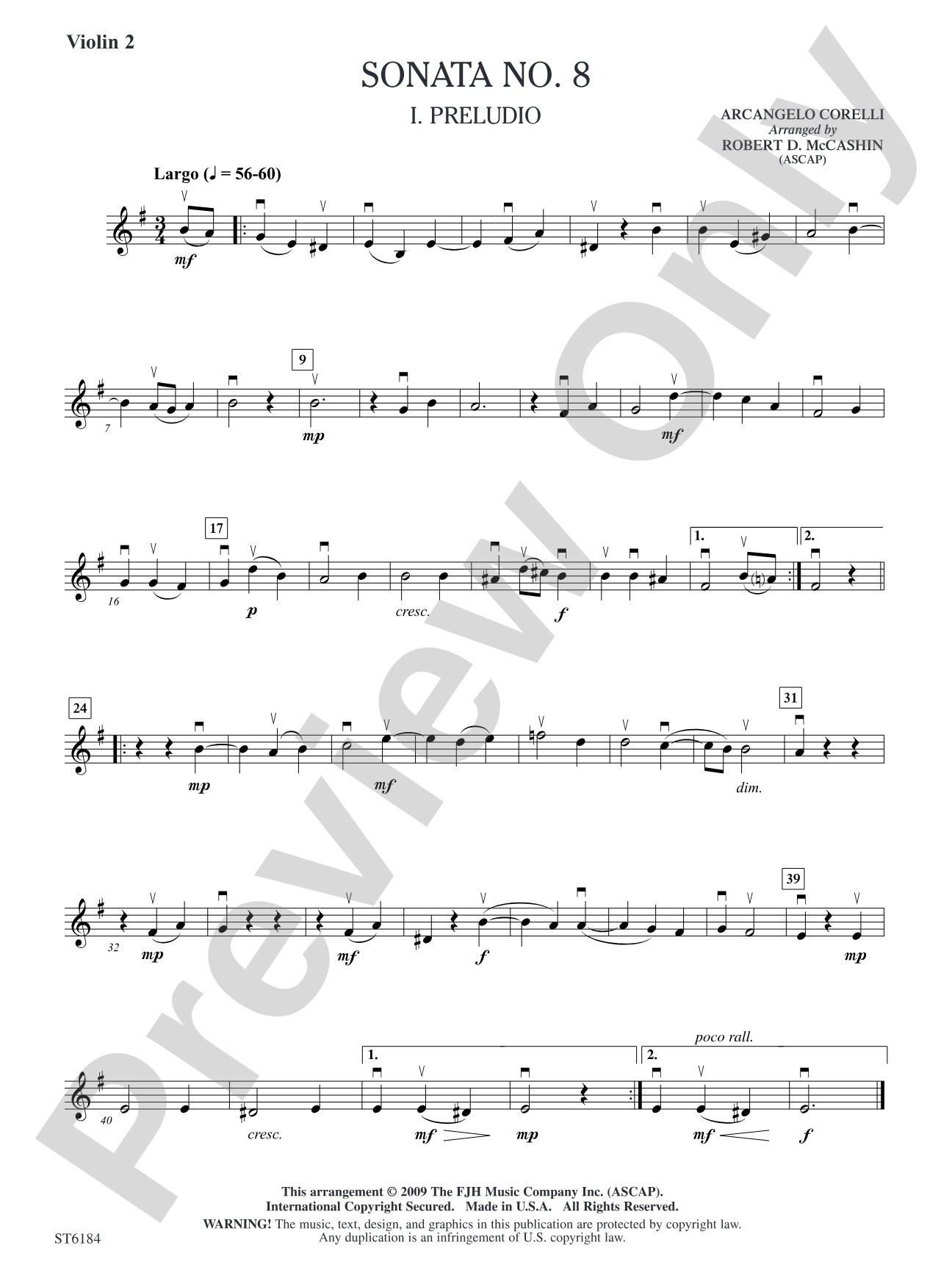

Sonata No. 8: Violin 2
By Arcangelo Corelli / arr. Robert D. McCashin
Grade: 3.5
Item: 98-PC-DST6184_VN2
$7.00
Pickup currently not available
Description
This two-movement work comes from Corelli's Sonata No. 8 and is an ideal way to expose your students to the work of a master composer. Originally for solo violin, this arrangement includes two contrasting movements (Preludio and Allemanda) that work extremely well for string orchestra. By choosing the source very carefully, McCashin has been able to completely maintain the integrity of the original. An ideal classical work for your next program.


Sonata No. 8: Violin 2 isn't in MakeMusic Cloud just yet...but it could be. Let us know you'd like to see it, and you'll help shape what comes next. In the meantime, start a free trial and dive into thousands of interactive titles your students can play along with today.
Request This Title
Tell us you want it.
Start Your Free Trial
Explore everything that's ready to play right now.
Sample Audio
1
Audio File
--:--
0:00
0:00
Sample Video
No sample videos found.
Additional Details
Series:
FJH String Orchestra
Publisher:
The FJH Music Company, Inc.
SKU:
98-PC-DST6184_VN2
More about this title
About the Composer: Arcangelo Corelli
Arcangelo Corelli (1653-1713) shaped the sound of the Baroque violin and established the foundation for modern string technique. Working in Rome during the late 17th century, he developed a systematic approach to violin playing that emphasized pure tone, clear articulation, and controlled vibrato. His twelve Concerti Grossi and twelve sonatas for solo violin remain cornerstones of string pedagogy because they balance technical demands with genuine musical substance.
Corelli's influence on music education extends far beyond his own era. His disciplined approach to compositional structure and his mastery of counterpoint made his works the standard repertoire for training serious string players. Teachers have long recognized that studying Corelli develops both technical facility and musical maturity, making his works invaluable for students moving from elementary to intermediate levels.
Why we love this
McCashin's arrangement preserves the essential character of Corelli's writing while making it accessible for developing string orchestras. The two contrasting movements provide natural opportunities for musical growth without requiring virtuosic demands, and programming a work by a master composer signals to your students that they're ready for serious repertoire. This is the kind of piece that builds genuine musicianship rather than just technical facility.
What to expect
The Preludio unfolds with the restrained elegance characteristic of Baroque chamber music, where each phrase breathes with intention and clarity cuts through the texture. The Allemanda dances with measured energy, its rhythmic profile both structured and conversational. Together, the two movements create a complete musical statement that feels authoritative yet accessible, allowing performers to discover why Corelli's work has endured for nearly 350 years.
Who it's for
String orchestra directors working with Grade 3.5 ensembles who want to introduce their students to authentic Baroque music without oversimplifying the composer's intent. Students benefit from experiencing Corelli's approach to melodic phrasing and harmonic clarity, and the arrangement scales appropriately for orchestras that may have variable instrumentation. This works well for programs that have established basic intonation and rhythmic accuracy and are ready to tackle substantive classical literature.
How to get the most out of it
- Attend carefully to the articulation markings throughout both movements. Corelli's style relies on clarity and separation of phrases, and these gestures define the Baroque sound in ways that sustained legato cannot.
- Balance the inner voices so that harmonic progressions remain audible. With two movements that span contrasting tempos and styles, clarity of texture will significantly strengthen the overall impact.
- Shape the Allemanda with forward motion through each measure; Corelli's dance rhythms only breathe when the ensemble stays rhythmically engaged rather than dragging.
- Work the ensemble toward unified bow direction in comparable passages across sections. This unifies the string sound and demonstrates control that's essential for this level of classical literature.
How to use it
This arrangement works particularly well as the classical foundation of a concert built around masterworks from different eras. Position it early enough in the rehearsal season to allow time for the kind of detailed musical work these two movements deserve, especially if your group is encountering Corelli for the first time. The moderate length and two-movement structure make it an excellent choice for a chamber performance context or as the anchor for a program exploring Baroque string writing.
Skills your students will build
- Baroque articulation and phrasing techniques
- Harmonic awareness through inner voice clarity
- Sustained intonation across contrasting tempos
- Unified bowings across string sections
- Dance meter interpretation (Allemanda rhythm)