Sonata in G: Violin 1 Sheet Music Preview

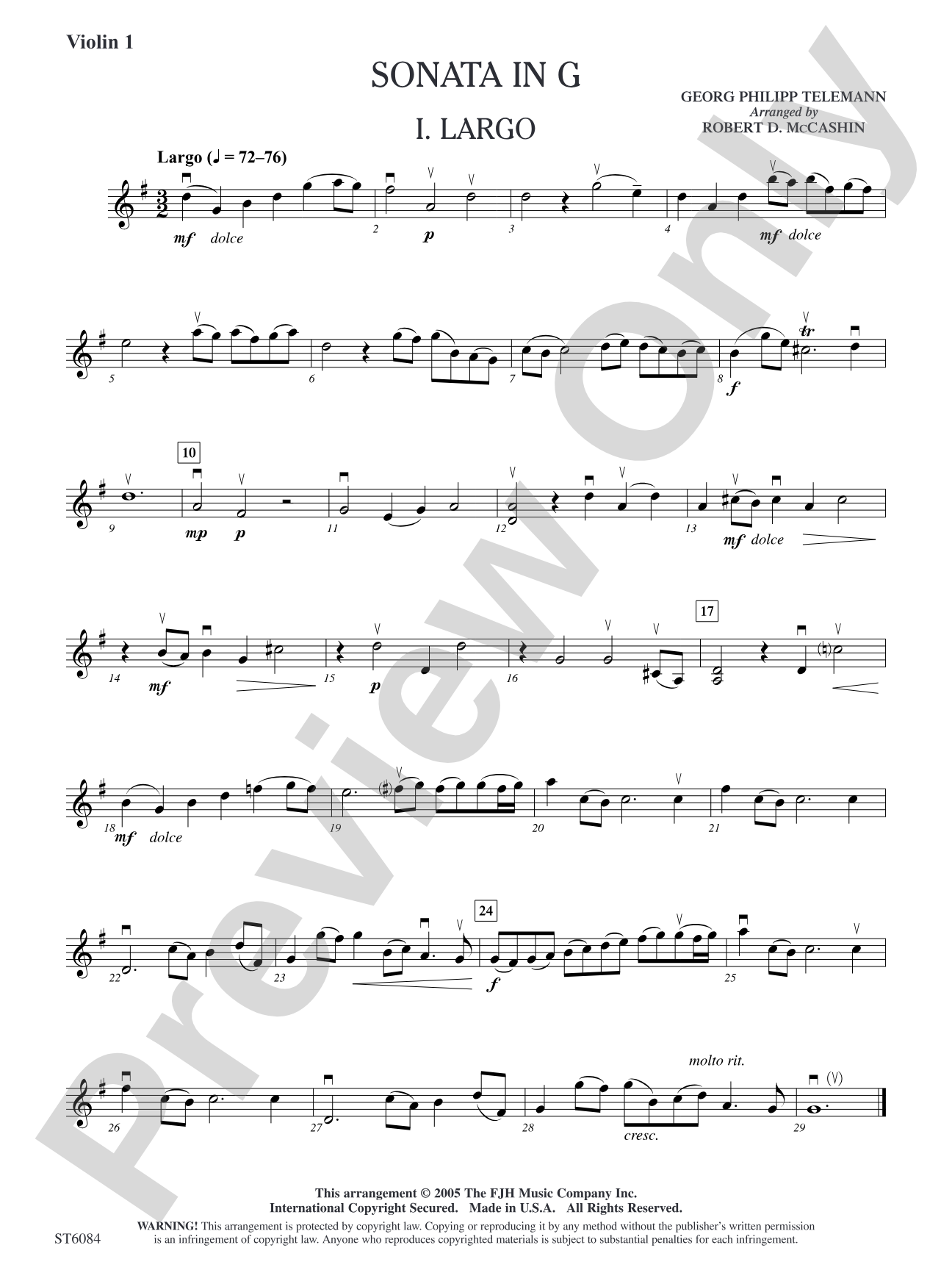
Sonata in G: Violin 1

By Georg Philipp Telemann / arr. Robert D. McCashin

Grade: 3.5

Item: 98-PC-DST6084_VN1

Digital Download
$7.00
Description
Originally for violin and piano, Robert D. McCashin has done an outstanding job of making the Largo and Allegro from Telemann's Sonata in G accessible to string orchestras. The opening movement offers beautiful and lush harmonic content with solo lines trading between the upper and lower string voices. The Allegro includes interesting and independent lines for all instruments, providing a substantive musical experience for each member of the ensemble.

Don't just read it, hear it, play along with it, and watch your students grow with it. In MakeMusic Cloud, Sonata in G: Violin 1 comes alive with professional accompaniment, adjustable tempo, and built-in practice tools that turn solo practice into real progress.

Sample Audio
0:00
0:00
Sample Video
Additional Details
Series: FJH String Orchestra
Publisher: The FJH Music Company, Inc.
SKU: 98-PC-DST6084_VN1

More about this title

About the Composer: Georg Philipp Telemann

Georg Philipp Telemann (1681-1767) was one of the most prolific composers of the Baroque era, with a catalog exceeding 3,000 works. A contemporary of Bach and Handel, Telemann held major positions in Frankfurt, Paris, and Hamburg, where he directed music for the city's principal churches and founded a collegium musicum that became a model for public concert life across Germany.

Telemann's music balances contrapuntal sophistication with melodic accessibility, making his works invaluable for music education. His instrumental sonatas, concertos, and orchestral suites remain staples of string orchestra repertoire because they combine engaging musical ideas with clear formal structures that students can follow and learn from.

Why we love this

McCashin's arrangement captures the lyrical elegance of Telemann's original without sacrificing the harmonic richness that makes this sonata worth teaching. The dialogue between upper and lower voices gives every string player a moment to lead, which keeps rehearsals engaging and allows you to feature different musicians across the two movements. At Grade 3.5, this sits perfectly for orchestras ready to tackle something more sophisticated than basic unison writing but not yet prepared for heavy technical demands.

What to expect

Graceful and unhurried in the Largo, with the warm harmonic language of the Baroque flowing between upper and lower strings like a conversation between old friends. The Allegro brightens the mood while maintaining elegance, with clean articulation and purposeful motion that feels both spirited and measured.

Who it's for

String orchestra directors at the intermediate level who want to program a recognized masterwork that sounds mature without requiring advanced technique from every player. This arrangement works well for orchestras with mixed ability levels because the essential musical content lands in the primary voices while secondary parts remain accessible.

How to get the most out of it

  • Balance the trading solo lines carefully in the Largo; the exchanges between violins and lower strings need clarity without losing the movement's lyrical continuity.
  • Shape each phrase with a slight taper at the end to enhance the singing quality that defines this work, especially in the opening movement.
  • Let the independent lines in the Allegro breathe as separate voices rather than harmonic filler; cue entries clearly so each section understands its role.
  • Use vibrato selectively in the Largo to add warmth to sustained passages, but pull back slightly in the Allegro to maintain clarity between the independent parts.

How to use it

Program this as a concert centerpiece that demonstrates your orchestra's growing musical maturity. It pairs naturally with lighter contemporary pieces or with other Baroque arrangements, and it works especially well in festival competitions where judges value musical substance and clarity of texture.

Skills your students will build

  • Reading and executing independent string lines within a homogeneous ensemble
  • Responding to cued entrances and following harmonic movement
  • Sustaining lyrical phrasing across longer phrases in the Largo
  • Balancing solo and accompaniment roles across two contrasting movements

You May Also Like