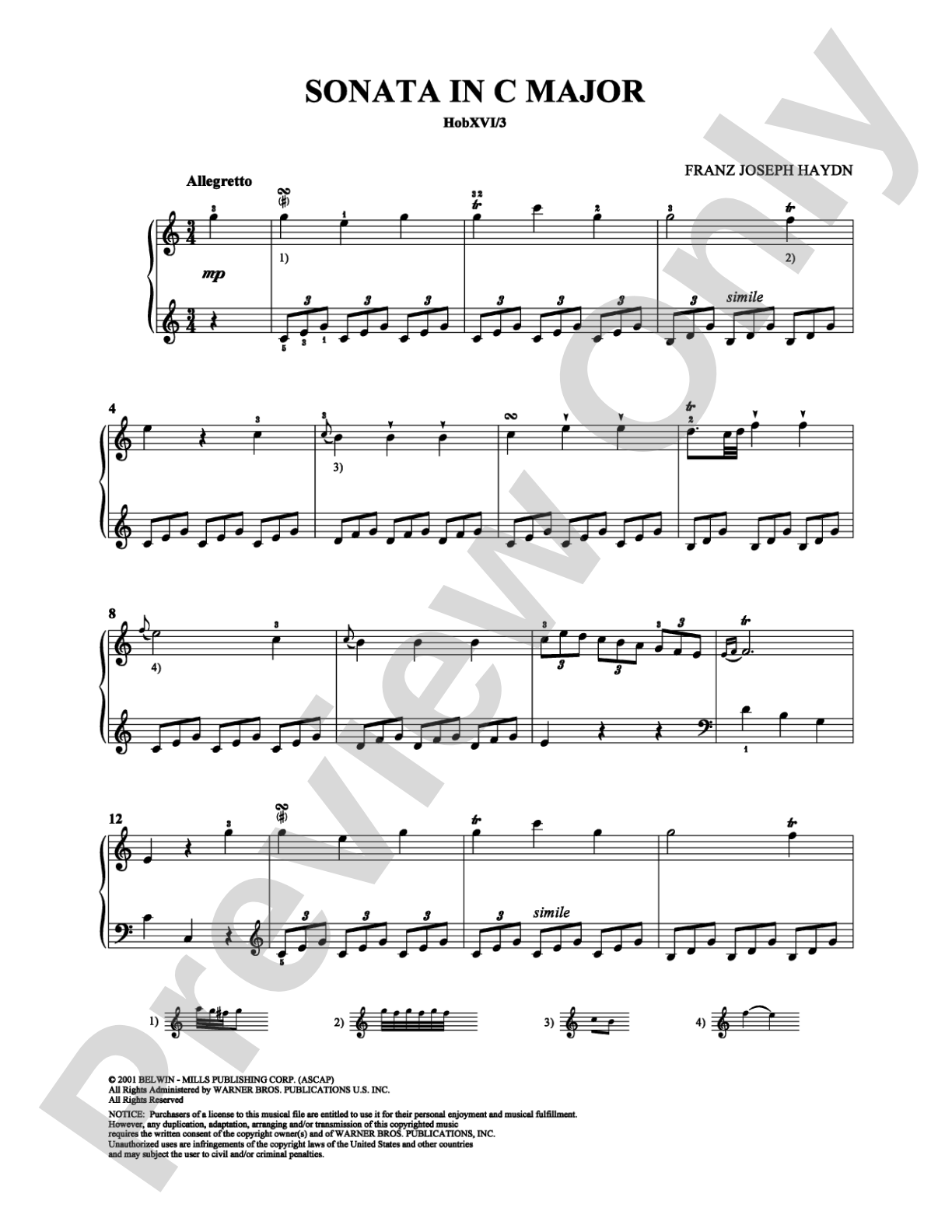
Sonata in C Major: Piano Digital Sheet Music

Sonata in C Major: Piano Digital Sheet Music

Franz Joseph Haydn

Item: 00-PS-0000215

Digital Download
$3.99
Description

Sonata in C Major: Piano Digital Sheet Music isn't in MakeMusic Cloud just yet...but it could be. Let us know you'd like to see it, and you'll help shape what comes next. In the meantime, start a free trial and dive into thousands of interactive titles your students can play along with today.

Sample Audio
No sample audio found.
Sample Video
Additional Details
SKU: 00-PS-0000215

More about this title

About the Composer: Franz Joseph Haydn

Franz Joseph Haydn (1732-1809) shaped the Classical sonata form and orchestral tradition during a career spanning more than five decades. As composer for the Esterházy court and later as an independent master, he established conventions that Mozart and Beethoven would inherit and transform.

Haydn's keyboard works remain essential repertoire for pianists developing Classical technique and interpretive clarity. His sonatas balance structural sophistication with genuine lyricism, offering performers a direct path into the aesthetic principles of the Classical era.

Why we love this

Haydn's C Major Sonata distills everything that makes Classical form intellectually satisfying and musically rewarding. The writing sits comfortably under the hands while demanding genuine attention to phrase architecture and harmonic clarity—exactly what intermediate pianists need to move beyond note-reading into real musical thinking.

What to expect

Clear morning light and architectural grace define this sonata. Haydn's C Major opens with uncluttered elegance and moves through logical harmonic progressions that feel inevitable rather than contrived, creating a sense of rightness and proportion throughout.

Who it's for

Pianists at the intermediate to early advanced level who are ready to study Classical form through authentic repertoire. Music students preparing for conservatory auditions or exams that require Classical sonata repertoire will find this work both accessible and substantive.

How to get the most out of it

  • Observe Haydn's texture carefully; passages that appear simple often contain subtle voice leading that deserves audible separation rather than homogeneous pedal.
  • Shape phrases by gently lifting at cadences and breathing at structural points, allowing the form's logic to emerge naturally without over-pedaling.
  • Treat ornaments (trills, turns) as integral to phrasing rather than embellishments; they mark structural articulation points in Classical design.
  • Balance the dialogue between right and left hand with clean articulation; let accompaniment patterns support rather than overwhelm the melodic line.

How to use it

Include this in student recitals as a complete sonata movement or pair it with Romantic or contemporary works to frame a program that traces stylistic evolution. This work serves equally well as the anchor in a Classical-period recital or as evidence of foundational technique for auditions emphasizing traditional repertoire.

Skills your students will build

  • Understanding Classical phrase structure and cadential forms
  • Balancing texture in Alberti bass patterns with audible voice leading
  • Interpreting period-appropriate ornamentation and articulation
  • Shaping longer forms through harmonic awareness rather than rubato
  • Developing evenness and clarity in scalar and arpeggio passages

You May Also Like