Sonata in A Major (Mvt. 4): Cello Sheet Music Preview

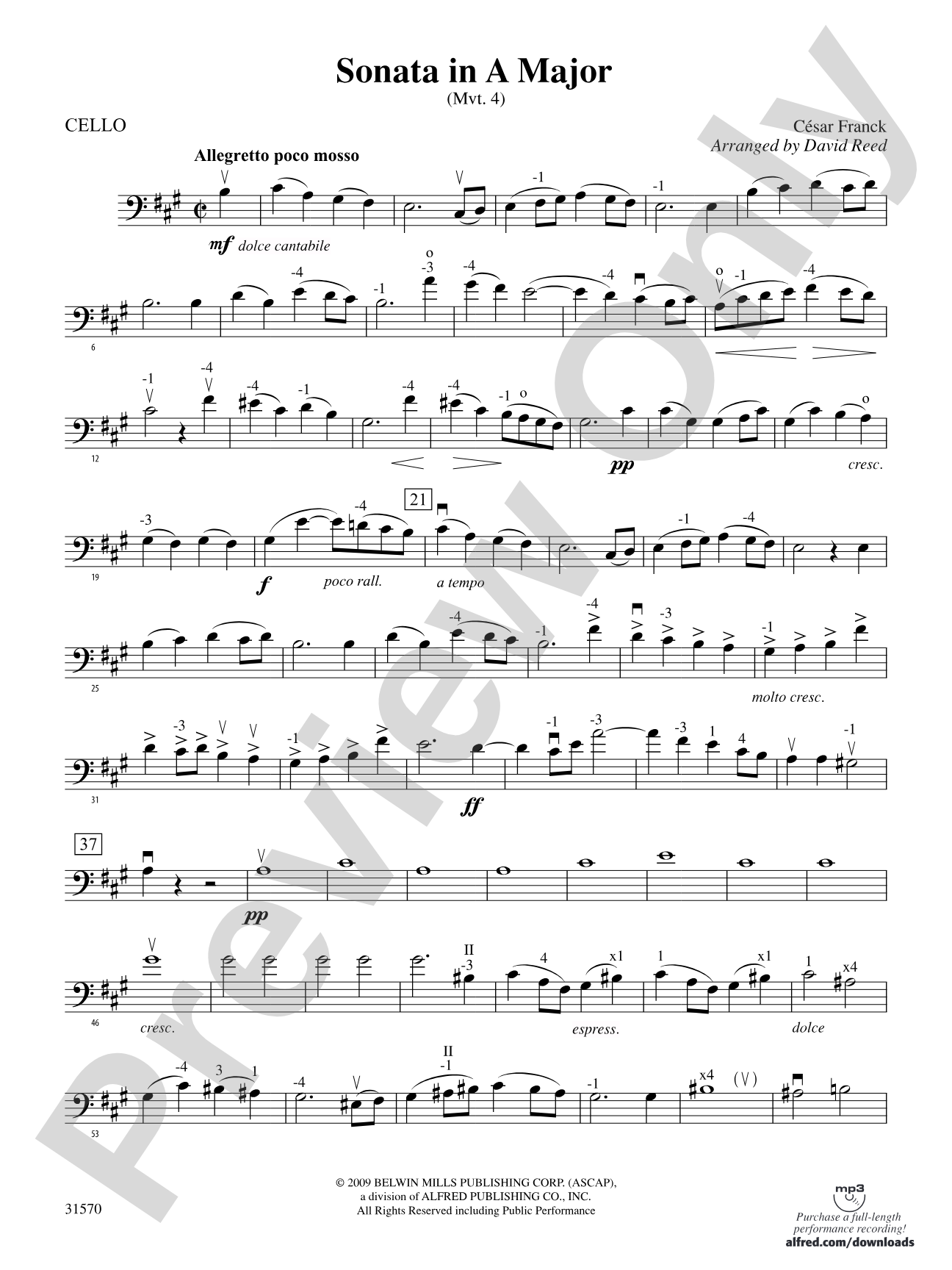
Sonata in A Major (Mvt. 4): Cello

By César Franck / arr. David Reed

Grade: 5

Item: 00-PC-0001744_VC1

Digital Download
$5.99
Description
Some of the earliest tunes that we learn as children are rounds and canons. This piece takes it to a whole new level. One of the most expressive piano and violin sonatas, this piece is well suited to the string orchestra and offers every section the opportunity to develop beautiful phrases. This piece also offers very challenging harmonic and chromatic sequences. This title is available in MakeMusic Cloud.

Don't just read it, hear it, play along with it, and watch your students grow with it. In MakeMusic Cloud, Sonata in A Major (Mvt. 4): Cello comes alive with professional accompaniment, adjustable tempo, and built-in practice tools that turn solo practice into real progress.

Sample Audio
0:00
0:00
Sample Video
Additional Details
Series: Belwin Concert String Orchestra
Publisher: Alfred Music
Page Count: 124
SKU: 00-PC-0001744_VC1

More about this title

About the Composer: César Franck

César Franck (1822–1890) was a Belgian-born composer and organist who spent most of his career in Paris, where he became one of the most influential figures of the Romantic era. His chamber works, particularly his sonatas for violin and piano, represent some of the finest achievements in 19th-century instrumental music, combining lyrical melodies with sophisticated harmonic language and rigorous structural thinking. Franck's influence on French composition was profound; his students included Vincent d'Indy and Henri Duparc, and his emphasis on cyclical form and emotional depth shaped the direction of French Romantic music.

Franck's sonatas are prized for their balance of technical challenge and expressive warmth. This Fourth Movement exemplifies his gift for writing memorable thematic material that allows each voice to sing, while his harmonic inventiveness keeps the music intellectually engaging for both performers and listeners.

Why we love this

This arrangement honors the intimate beauty of Franck's original sonata while giving every section in your string orchestra substantial musical responsibility. Reed's orchestration preserves the cyclical thematic approach that makes Franck's work so compelling, and Grade 5 students gain exposure to genuine masterwork harmonies without oversimplification.

What to expect

Expressive and introspective, with moments of quiet intensity. The music unfolds with the emotional directness and structural coherence of Franck's chamber writing, offering stretches of sustained singing interrupted by passages of chromatic restlessness that keep the ear engaged throughout.

Who it's for

String orchestras at the intermediate-advanced level who are ready for Romantic-era harmonic language and capable of executing complex rhythmic and chromatic passages. This is ideal for programs building toward festival or contest performance and looking to program substantive arranged masterworks alongside original string literature.

How to get the most out of it

  • Shape the phrase contours carefully across sections; Franck's melodies demand singing legit even when multiple parts share the line.
  • Balance the harmonic and chromatic sequences so inner voices support without obscuring the primary melodic strand.
  • Rehearse the transitions between contrasting material deliberately; Franck's architecture rewards clarity of form.
  • Use the score to help students hear how themes recur and transform; this cyclical writing is a hallmark of Franck's style and worth calling out explicitly.

How to use it

Program this as a centerpiece for a Romantic-era concert, perhaps pairing it with original string pieces from the same period. Its festival-appropriate difficulty and substantial musical content make it an excellent choice for competitive programming, where the arrangement's respect for Franck's original voice will resonate with adjudicators.

Skills your students will build

  • Reading and executing chromatic sequences and advanced harmonic progressions
  • Shaping long lyrical phrases across section boundaries
  • Understanding cyclical form and thematic transformation
  • Balance and blend in multi-part string textures
  • Sight-reading complex rhythmic and harmonic material in Romantic idiom

You May Also Like