Sonata for Tuba and Piano Sheet Music Preview

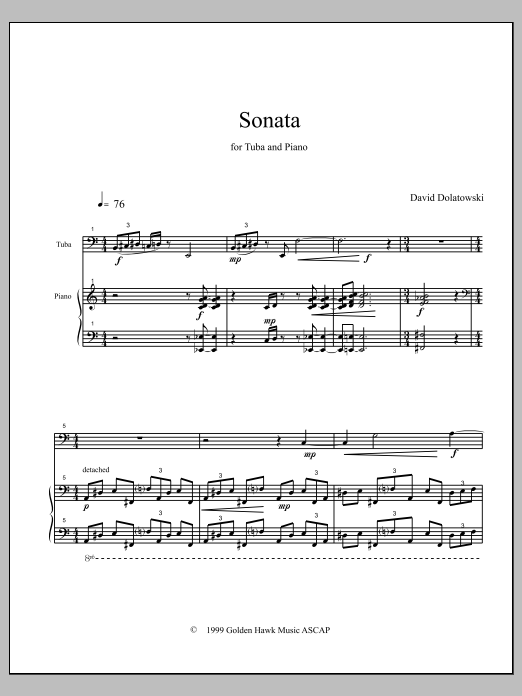
Sonata for Tuba and Piano

Arranged by David Dolatowski

Item: 35-PK00274646

Digital Download
$4.85

Buy Extra Parts (Digital PDF Download)

Parts Added to Cart!

Description
Composed for Harvey Phillips "Octuba Fest" while I was a student at Indiana University, School of Music. The work is atonal, in 3 movements with a unique harmonic language. Many performances in the US! Duration: 10:00

Sonata for Tuba and Piano isn't in MakeMusic Cloud just yet...but it could be. Let us know you'd like to see it, and you'll help shape what comes next. In the meantime, start a free trial and dive into thousands of interactive titles your students can play along with today.

Sample Audio
No sample audio found.
Sample Video
Additional Details
Publisher: Hal Leonard
SKU: 35-PK00274646

More about this title

Why we love this

Dolatowski's sonata captures the virtuosic energy and harmonic adventurousness that defined the Octuba Fest tradition at Indiana University. The three-movement structure gives tuba soloists a complete concert work that showcases both lyrical warmth and technical command, with a compositional voice that respects the instrument's expressive range while pushing into contemporary harmonic territory.

What to expect

The sonata moves through three distinct emotional landscapes without relying on traditional tonal anchors. Expect moments of lyrical reflection alongside stretches of angular, searching harmony that keeps both performer and listener engaged in active listening.

Who it's for

Advanced tuba soloists preparing recital repertoire or competing at regional and national festivals. This work attracts serious players who have studied in college music programs and are ready for the technical and interpretive demands of contemporary classical writing.

How to get the most out of it

  • Study the atonal language carefully with your pianist before rehearsals begin; the harmonic context shifts frequently, so both players need secure internal landmarks rather than relying on traditional functional harmony.
  • Allow the full ten minutes to settle in the listener's ear. Atonal writing rewards patient listening when the performance is clean and committed.
  • Coordinate dynamics closely between tuba and piano to ensure the solo voice projects clearly through passages where the accompaniment becomes texturally dense.

How to use it

Feature this as the centerpiece of a tuba solo concert, pairing it with one or two earlier twentieth-century works to create a program that traces evolving approaches to tonal language. It also works well as a season finale showcase for your studio's advanced student.

Skills your students will build

  • Reading and performing atonal melodies without harmonic scaffolding
  • Intonation stability in unusual harmonic contexts
  • Collaborative interpretation with a pianist when traditional functional harmony is absent
  • Stamina and focus across a substantial ten-minute work
  • Stylistic flexibility in contemporary classical performance

You May Also Like