
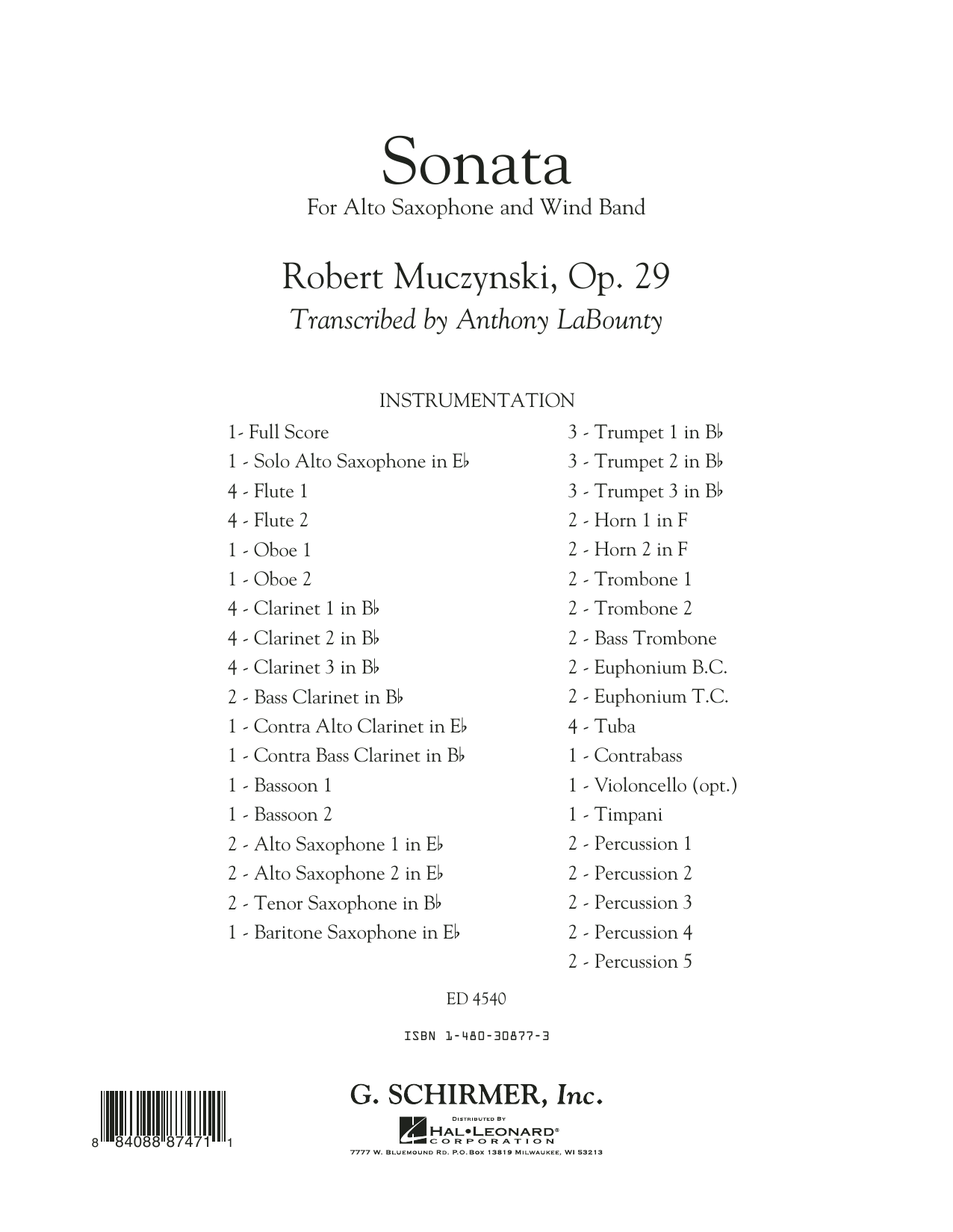

Sonata for Alto Saxophone, Op. 29: Concert Band Conductor Score & Parts
Arranged by Anthony LaBounty
Grade: 5
Item: 35-PK00330229
$95.00
Pickup currently not available
Buy Extra Parts (Digital PDF Download)
Parts Added to Cart!
Description
Transcription for solo alto saxophone and wind band
Written in 1970, Robert Muczynski's two-movement "Sonata for Alto Saxophone and Piano" has become a standard in the saxophone repertoire. Anthony LaBounty has skillfully adapted this work for wind band accompaniment, carefully preserving the intent and style of the original with its unique blend of modern tonalities and syncopated rhythmic drive.


Sonata for Alto Saxophone, Op. 29: Concert Band Conductor Score & Parts isn't in MakeMusic Cloud just yet...but it could be. Let us know you'd like to see it, and you'll help shape what comes next. In the meantime, start a free trial and dive into thousands of interactive titles your students can play along with today.
Request This Title
Tell us you want it.
Start Your Free Trial
Explore everything that's ready to play right now.
Sample Audio
No sample audio found.
Sample Video
No sample videos found.
Additional Details
Publisher:
Hal Leonard
SKU:
35-PK00330229
More about this title
About the Arranger: Anthony LaBounty
Anthony LaBounty brings deep experience in wind band transcription and orchestration, with a keen ear for adapting solo repertoire into ensemble settings without compromising artistic intent. His work centers on preserving the essential character of original compositions while creating idiomatic writing that serves both the featured soloist and the supporting ensemble.
Why we love this
LaBounty's arrangement respects Muczynski's compositional voice entirely, translating the sonata's modern harmonic language and rhythmic sophistication into wind band textures rather than simply orchestrating around the soloist. The result is a rare transcription where every instrumental section contributes meaningfully to the musical conversation, making this equally rewarding for your ensemble to play as it is for your saxophonist to perform.
What to expect
Modern yet approachable, with angular harmonic twists that never stray into obscurity. The syncopated rhythmic drive gives the piece contemporary energy while Muczynski's melodic gift keeps everything grounded in genuine expression rather than technical display.
Who it's for
Concert bands at the Grade 5 level looking to feature a strong alto saxophonist within a substantive chamber work. Directors seeking standard repertoire that expands beyond typical wind band fare will find this a genuine asset to their programming toolkit.
How to get the most out of it
- Establish clear communication with your alto saxophonist about the balance point between soloist and ensemble; Muczynski's writing demands that the band support rather than overwhelm, so sectional dynamics matter as much as the featured part.
- Pay attention to the syncopated rhythmic figures in the accompaniment. These aren't merely accompaniment patterns but integral melodic components that give the arrangement its forward momentum and modern edge.
- Shape the two movements as distinct entities. The contrasting moods require different ensemble colors and articulative approaches, so rehearse them with clear tonal and textural goals in mind.
How to use it
Ideal for a spring concert featuring solo spotlights, or as a centerpiece in a program mixing classical transcriptions with original wind band works. The two-movement format also makes it suitable for solo and ensemble festival competitions where a substantial but focused performance is valued.
Skills your students will build
- Reading and executing syncopated rhythmic patterns across multiple ensemble sections
- Balancing solo projection with ensemble support
- Interpreting modern tonalities and harmonic language in a wind band context
- Coordinating rhythmic independence between soloist and accompaniment
- Dynamic shaping across contrasting formal sections