Sonata alla Scarlatti (Encore Plus, Book 3) Sheet Music Preview

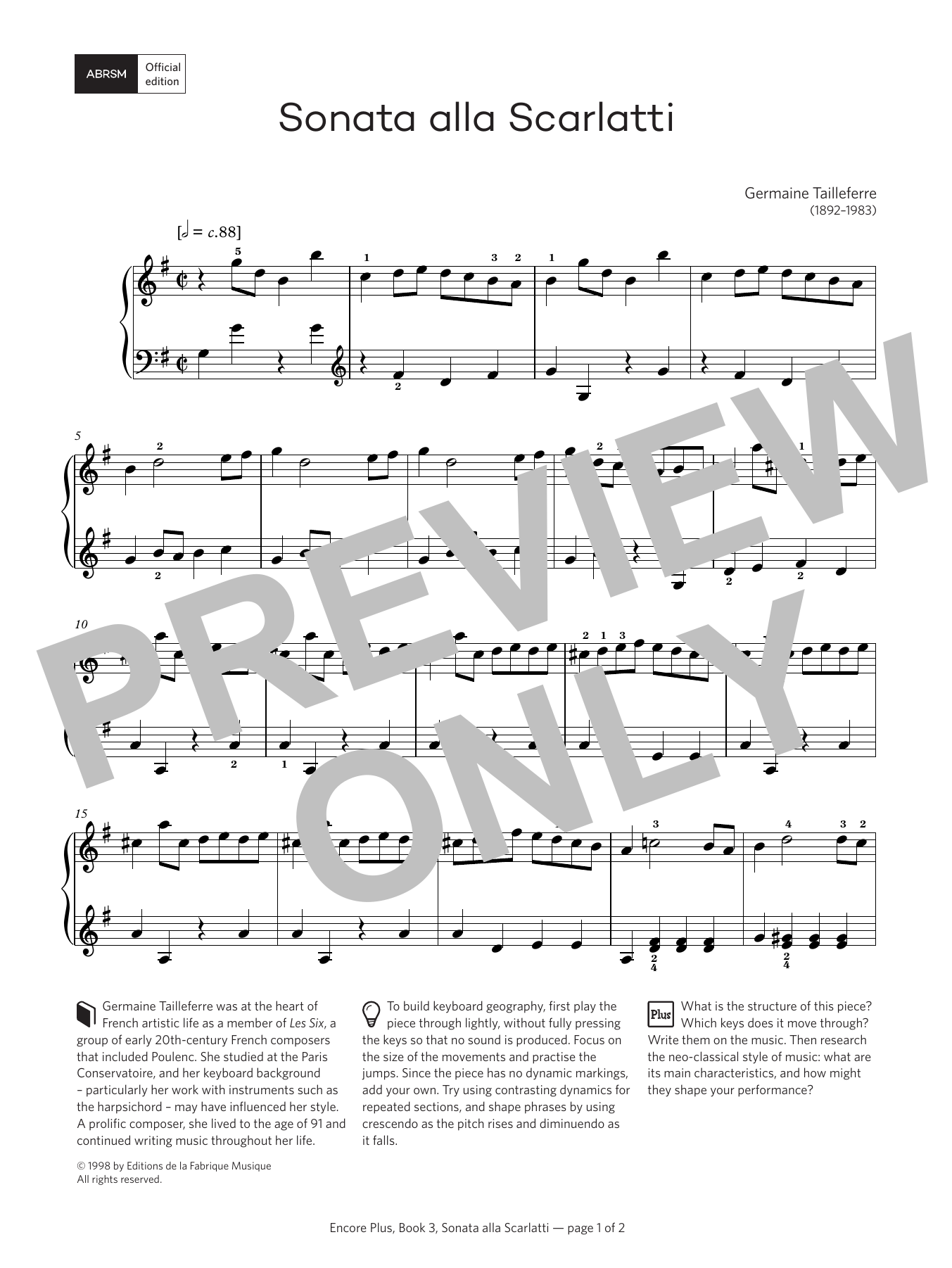
Sonata alla Scarlatti (Encore Plus, Book 3): Piano Solo

By Germaine Tailleferre

Grade: 6

Item: 35-DS01989525

Digital Download
$4.99
Description

Discover MakeMusic Cloud: thousands of interactive titles your students can play along with today.

Sample Audio
No sample audio found.
Sample Video
Additional Details
Publisher: Hal Leonard
Page Count: 2
SKU: 35-DS01989525

More about this title

About the Composer: Germaine Tailleferre

Germaine Tailleferre (1892-1983) was a French composer and pianist who spent her long career bridging salon music and concert hall repertoire. Though often overshadowed by her male contemporaries, she maintained a distinctive voice rooted in clarity, elegant phrasing, and rhythmic vitality. Her keyboard works remain accessible entry points into twentieth-century classical language without abandoning the structural rigor of traditional forms.

Tailleferre's pedagogical compositions reveal her gifts as a teacher. She understood how young pianists learn, and she wrote music that challenges without overwhelming. Her work for piano students sits comfortably between the Romantic tradition and modernist exploration, making her an ideal voice for advancing intermediate players.

Why we love this

This piece succeeds because it respects the intelligence of grade 6 pianists while refusing to sound like a study. The Scarlatti homage gives students authentic exposure to binary form and hand independence without the technical brutality that often accompanies "real" Baroque repertoire. A two-page work that teaches genuine musical architecture rather than filling time.

What to expect

Brisk and witty, with the precision of a harpsichord translated through a modern sensibility. The writing dances across the keyboard with an almost conversational ease, yet every note carries weight. It evokes the spirit of the Scarlatti tradition: stylized, formally balanced, and deceptively simple.

Who it's for

Grade 6 pianists ready to engage with twentieth-century compositional language without abandoning traditional structures. Teachers looking to program repertoire that sounds modern while remaining genuinely playable for intermediate students.

How to get the most out of it

  • Shape the opening gesture decisively. The first three notes set the entire character; rush them, and the piece loses its poise.
  • Attend to the articulation carefully. Tailleferre often pairs detached writing with legato passages; the contrast itself is the expressive tool.
  • Balance texture by listening to what the left hand contributes. This is not a melody-plus-accompaniment piece; both hands speak equally.
  • Trust the silence. Brief rests in this work function as punctuation, not nervous pauses. Hold them fully.

How to use it

Pair this with other twentieth-century keyboard works for a concert exploring how composers reinvented classical forms. It works beautifully as a contrast piece in a recital dominated by Romantic repertoire, offering students and audiences a different rhythmic and harmonic palette. Consider programming it in the middle of a student concerto competition where it will brighten an otherwise heavy sequence.

Skills your students will build

  • Binary form recognition and execution
  • Hand independence and balanced two-voice writing
  • Rhythmic precision in moderately brisk tempos
  • Articulation control (legato versus detached)
  • Twentieth-century harmonic language within a tonal framework

You May Also Like