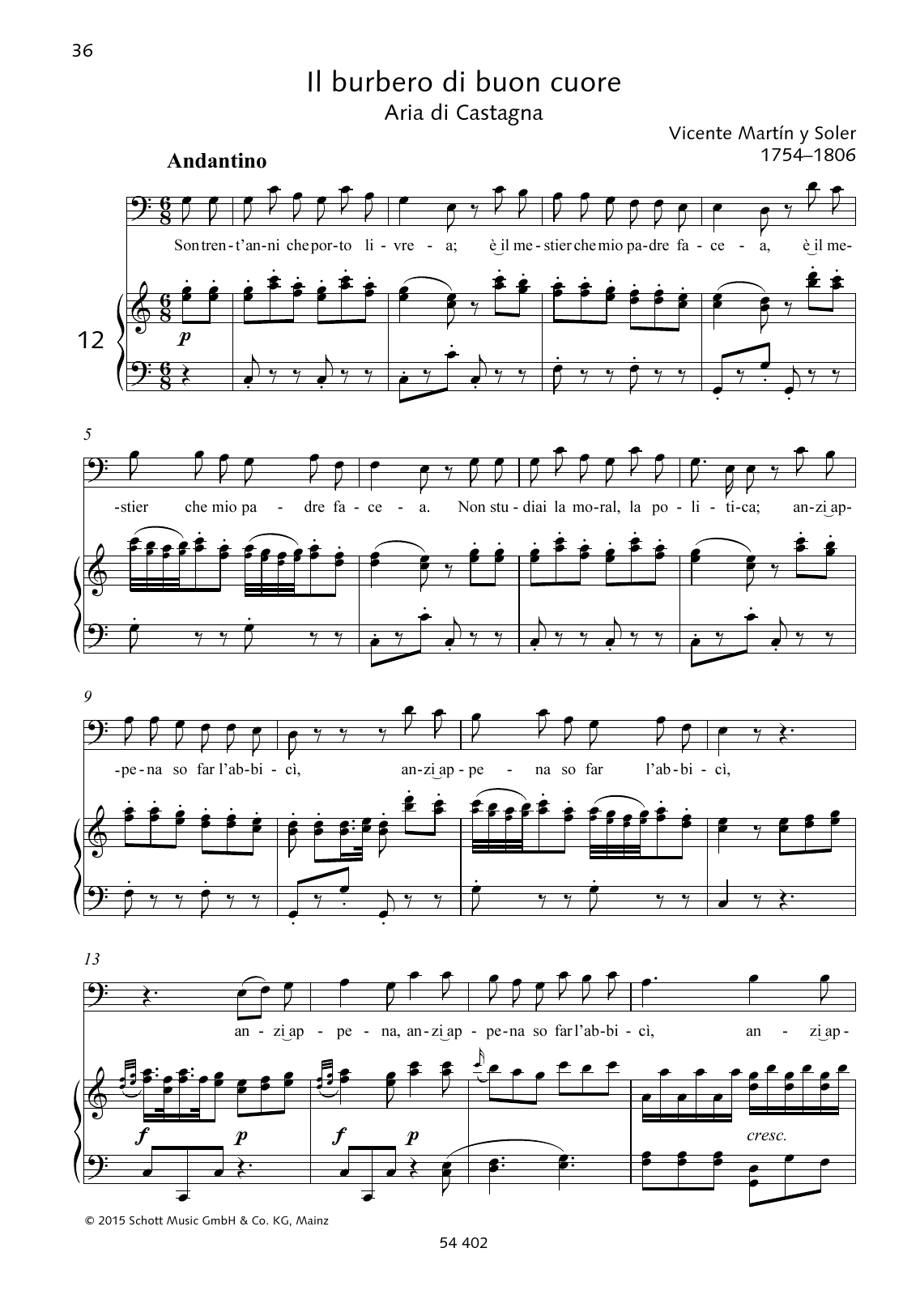
Son trent'anni che porto livrea Sheet Music Preview

Son trent'anni che porto livrea: Piano Vocal

By Vicente Martín y Soler / Edited by Claudia Eder / Edited by Wolfgang Birtel

Item: 35-DS00371291

Digital Download
$4.99
Description

Son trent'anni che porto livrea: Piano Vocal isn't in MakeMusic Cloud just yet...but it could be. Let us know you'd like to see it, and you'll help shape what comes next. In the meantime, start a free trial and dive into thousands of interactive titles your students can play along with today.

Sample Audio
No sample audio found.
Sample Video
Additional Details
Publisher: Hal Leonard
Page Count: 6
SKU: 35-DS00371291

More about this title

About the Composer: Vicente Martín y Soler

Vicente Martín y Soler (1754–1806) was a Spanish composer who achieved considerable success across Europe, particularly in Italy and Russia. His gifts for melody and theatrical drama made him a sought-after opera composer in the late 18th century, and he worked extensively in Vienna, where he studied with Haydn's contemporaries and absorbed the Classical style that defines his output.

Martin y Soler's operas were performed alongside Mozart's works, and his facility with the human voice remains evident in every phrase he wrote for singers. His ability to craft singable, memorable lines within formally sophisticated structures makes his vocal music valuable for students learning to navigate Classical vocal writing with genuine musicality.

Why we love this

This aria captures the elegance of late 18th-century operatic writing without the grandiosity that can overwhelm young singers. The vocal line sits naturally in the voice, the harmonic language is clear and purposeful, and the emotional arc is genuine. It's a rare find for recital programming at the intermediate level where students can actually sing music of real compositional substance.

What to expect

Graceful and contemplative, with the conversational directness of Classical opera at its best. The melody unfolds with natural phrasing, inviting the singer to communicate clearly while the piano provides gentle harmonic support. There is dignity here, and a kind of understated emotional weight that rewards careful attention.

Who it's for

Intermediate and advanced vocalists seeking Classical opera repertoire that sits comfortably in the voice without excessive technical demands. This piece works well for singers preparing recital programs, auditions, or students exploring the operatic tradition beyond the most frequently performed arias.

How to get the most out of it

  • Shape the phrase architecture by identifying the two or three longer melodic arcs within the piece rather than treating every measure as equally important. This prevents the singer from running out of breath and gives the accompanist a framework for support.
  • Balance the vocal line against the piano part without sacrificing intimacy. The accompaniment is written with care; it deserves to be heard, yet the voice must remain the primary focus.
  • Find the dramatic situation implicit in the text to ground your interpretation. Even without staging, understanding what the character is saying and why creates authenticity in the delivery.

How to use it

Position this as a centerpiece in a recital exploring Spanish or lesser-known Italian opera composers from the Classical era. It pairs well with other opera arias of similar scope and style, or as a standalone offering for singers building mixed-language recital programs with depth.

Skills your students will build

  • Phrasing in extended vocal lines without large intervallic leaps
  • Singing in Italian with authentic stylistic understanding
  • Balancing textual clarity with musical legit in the Classical idiom
  • Collaborating with a pianist to shape an operatic accompaniment

You May Also Like