
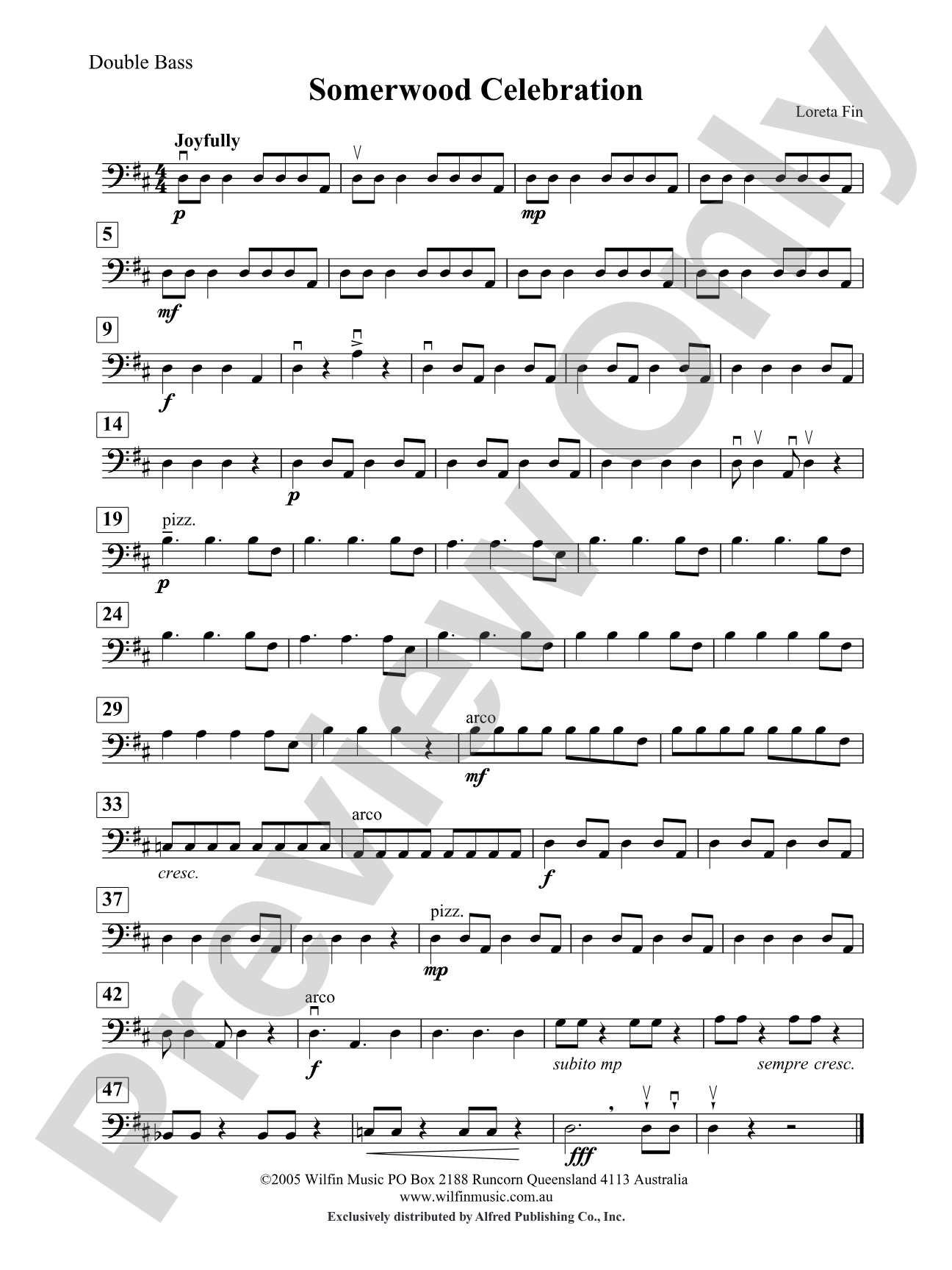

Somerwood Celebration: String Bass
By Loreta Fin
Grade: 2-2.5
Item: 76-PC-0000033_SB
$5.99
Pickup currently not available
Description
Written as the grand finale for a combined school string festival, this piece is dedicated to the Junior String players of Somerville House Girls' School, Queenwood School for Girls, Sydney and Brisbane Boys' College. The piece is challenging and fun, and will prove an excellent addition to your school's concert program. Suitable for advanced middle or intermediate high school. The piano covers the bass and essential harmonies.


Somerwood Celebration: String Bass isn't in MakeMusic Cloud just yet...but it could be. Let us know you'd like to see it, and you'll help shape what comes next. In the meantime, start a free trial and dive into thousands of interactive titles your students can play along with today.
Request This Title
Tell us you want it.
Start Your Free Trial
Explore everything that's ready to play right now.
Sample Audio
No sample audio found.
Sample Video
No sample videos found.
Additional Details
Series:
Wilfin String Orchestra: Young String Ensemble Series
Publisher:
Wilfin Music
Page Count:
68
SKU:
76-PC-0000033_SB
More about this title
About the Composer: Loreta Fin
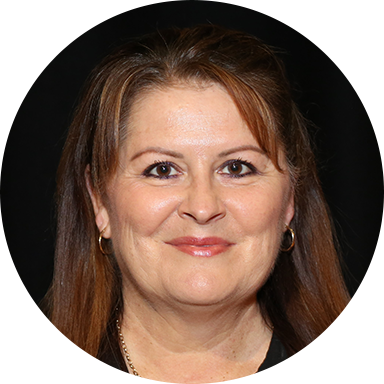
Loreta Fin AM is a Brisbane-based educator, conductor, and composer whose career spans performance, teaching, and advocacy across Australia's string community. A graduate of the Sydney Conservatorium of Music and former first violinist with the Sydney Youth Orchestra, she has held the position of Director of Strings at Somerville House School since 1993 and has spent more than 25 years as Principal Viola player with the Queensland Pops Orchestra.
Fin's contributions to string education are substantial and widely recognized. She has composed over 100 works for string orchestra, published internationally by Alfred Music, and has adjudicated at major competitions and festivals throughout Australia. Her expertise and leadership have shaped the field through her service as State and National President of the Australian Strings Association, her work as a State Advisor for Strings, and her regular conducting of Honours Ensembles Programs across Queensland and nationally. She has presented at multiple Australian National Music Conferences and two American National String Teachers' Conferences, and in 2019 received the National Award for Services to Music and String Teaching in Australia.
Why we love this
Fin writes for the ensemble she knows best: young string players at the moment they're ready to tackle something genuinely rewarding. This piece celebrates that transition without condescending to it, balancing technical challenge with the sheer pleasure of collaborative sound. A composer who has spent three decades in the classroom recognizes exactly what advanced middle and intermediate high school orchestras need to sound their best.
What to expect
A celebration that earns its title through genuine musical substance rather than spectacle. The writing balances lyrical passages with rhythmic vitality, giving every section moments to shine while maintaining forward momentum typical of a grand finale.
Who it's for
Advanced middle school and intermediate high school string orchestras preparing for concert performance or festival competition. This score and parts set works equally well for conductors seeking a substantial finale that honors ensemble growth or for directors programming a mixed festival repertoire.
How to get the most out of it
- Balance the piano accompaniment carefully; it provides harmonic foundation and bass support but should never obscure the string lines. The keyboard player needs clear eye contact with the conductor.
- Mark the rhythmic landmarks in each part during sectional rehearsals. At this level, players benefit from identifying where their line intersects with adjacent voices rather than watching full scores.
- Spend early rehearsals establishing a unified bow direction in tutti passages. Consistent articulation across the ensemble will emerge from this foundation.
- Record a run-through and listen as a group. Young orchestras often discover their own balancing issues this way and take ownership of solutions.
How to use it
Commission this as your spring concert closer or festival finale, where the full orchestra can showcase technical progress and ensemble refinement. The piece's dedication to multiple schools and its origins as a combined festival work make it especially fitting for collaborative or inter-school performances.
Skills your students will build
- Sustaining intonation across full orchestra textures
- Balancing multiple string lines in homophonic and contrapuntal sections
- Responding to conductor cueing in moderately complex formal structures
- Coordinate with keyboard accompaniment
- Reading part patterns common to Grade 2-2.5 string writing