Someone You Loved (arr. Frank de Vreeze) Sheet Music Preview

Someone You Loved (arr. Frank de Vreeze): SAB Choral Octavo

As performed by Lewis Capaldi / Arranged by Frank de Vreeze

Item: 35-DS00491926

Digital Download
$2.99
Description

Someone You Loved (arr. Frank de Vreeze): SAB Choral Octavo isn't in MakeMusic Cloud just yet...but it could be. Let us know you'd like to see it, and you'll help shape what comes next. In the meantime, start a free trial and dive into thousands of interactive titles your students can play along with today.

Sample Audio
No sample audio found.
Sample Video
Additional Details
Publisher: Hal Leonard
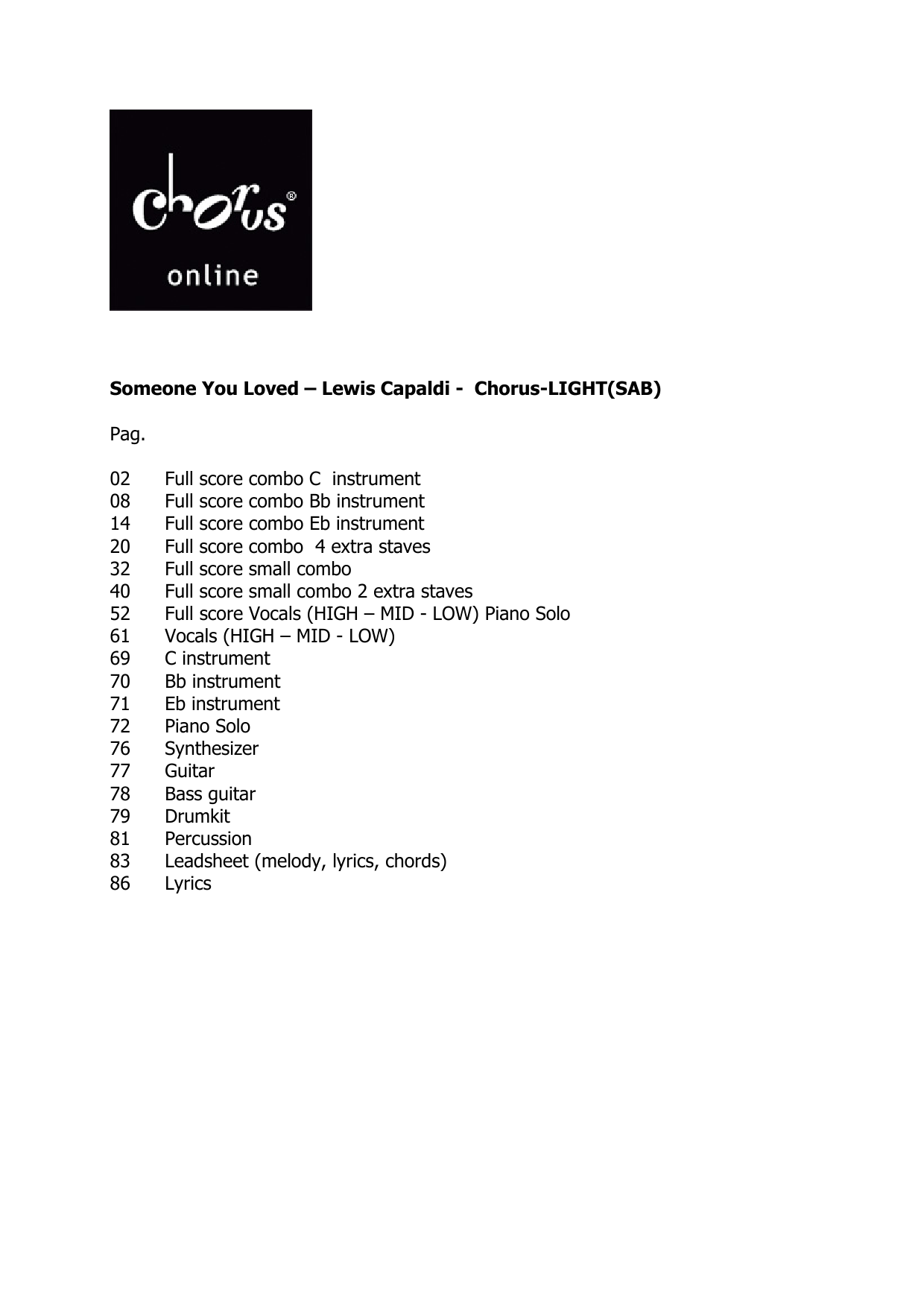
Page Count: 86
SKU: 35-DS00491926

More about this title

About the Artist: Lewis Capaldi

Lewis Capaldi emerged from West Lothian, Scotland, with a gift for writing emotionally direct pop songs that cut through commercial production with raw vocal delivery. His 2018 debut album achieved global success, particularly through ballads that showcase his ability to convey vulnerability at scale. In educational settings, his work demonstrates how contemporary songwriting can anchor choir repertoire in music students genuinely connect with.

Why we love this

Frank de Vreeze has crafted an arrangement that honors the song's emotional core while making it genuinely singable for developing choirs. The SAB voicing gives you flexibility in how you cast it, and the 86 pages of score include both the arrangement and support materials that make rehearsal efficient. Programming a contemporary ballad this well-written signals to your singers that pop songs deserve the same musical attention you give to any art song.

What to expect

Honest and unflinching. The song sits in the emotional space between grief and acceptance, with harmony that feels modern but grounded in functional progressions singers can latch onto. De Vreeze's arrangement preserves Capaldi's trademark restraint, letting the text carry weight rather than drowning it in arrangement complexity.

Who it's for

Directors programming contemporary pop at the middle school or early high school level will find this accessible without being simplistic. The arrangement works equally well for community choirs or all-state repertoire seeking to diversify stylistic offerings. Choirs that have sung some light choral pop but are ready for material with greater harmonic sophistication will benefit from both the musical challenge and the emotional engagement.

How to get the most out of it

  • Establish the harmonic foundation early by having sopranos and altos lock their cadence figures before adding the alto melody line; this prevents the arrangement from feeling thin during verses.
  • Shape the dynamics across the entire form rather than treating each section independently. Map a long arc from restraint in the opening through gradual intensification to a controlled peak, then pull back strategically to let the final phrases breathe.
  • Balance the baritone line carefully; it often provides crucial harmonic color but can accidentally obscure the soprano melody if not monitored in sectional rehearsals.
  • Record a rehearsal mix early and listen to it between sessions. Hearing how the parts interact outside the room helps singers understand their role within the larger texture.

How to use it

Consider this for a concert that pairs contemporary songs with art song or art music, positioning it as a bridge between classical and popular idioms that your audience encounters daily. It also works as a featured piece in a spring concert focused on singer-songwriters, or as an opening number that establishes an intimate mood before moving into other repertoire. The emotional honesty makes it particularly effective in contexts where you're highlighting student voice and musical maturity.

Skills your students will build

  • Balancing independent melodic lines within a four-part harmonic texture
  • Sustaining emotional legit while navigating contemporary pop harmonies
  • Part independence in SAB voicing with close harmonic spacing
  • Text expression in a contemporary idiom with minimal melismatic writing
  • Dynamic control across extended phrases without dramatic tempo shifts

You May Also Like