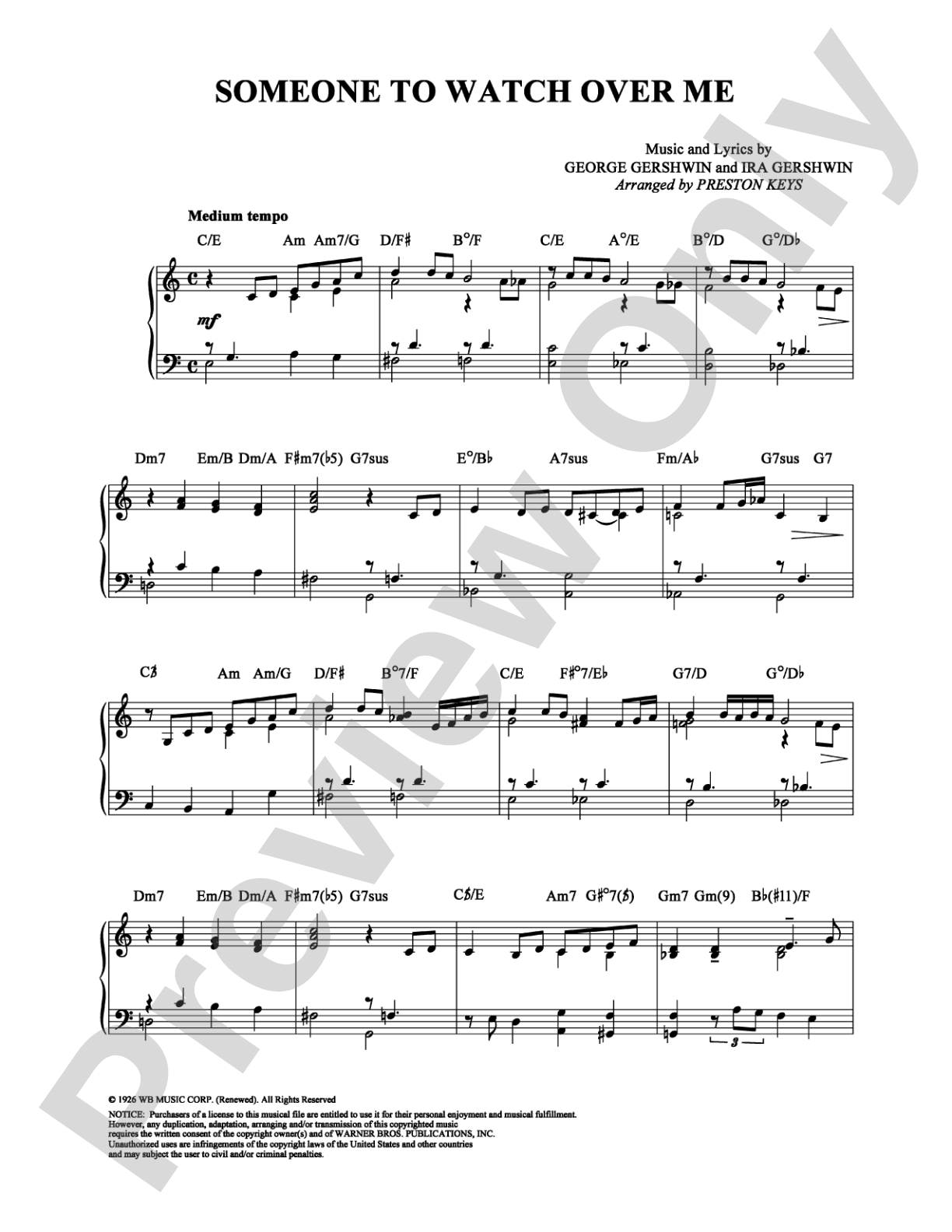
Someone To Watch Over Me: Piano Digital Sheet Music

Someone To Watch Over Me: Piano Digital Sheet Music

George Gershwin, Ira Gershwin

Item: 00-PS-0008660

Digital Download
$3.99
Description

Someone To Watch Over Me: Piano Digital Sheet Music isn't in MakeMusic Cloud just yet...but it could be. Let us know you'd like to see it, and you'll help shape what comes next. In the meantime, start a free trial and dive into thousands of interactive titles your students can play along with today.

Sample Audio
No sample audio found.
Sample Video
Additional Details
SKU: 00-PS-0008660

More about this title

About the Creator

George Gershwin and Ira Gershwin created "Someone to Watch Over Me" for the 1926 musical "Oh, Kay!" The song became one of the most enduring standards of the American songbook, recorded by virtually every major jazz and popular vocalist of the past century. Its accessible melody and emotionally direct lyrics have made it a perennial favorite in both concert halls and casual settings.

Why we love this

This standard has earned its place in the repertoire for good reason: the melody is singable, the harmonic movement is sophisticated enough to keep pianists engaged, and the emotional arc builds naturally from tender opening to full-voiced climax. It's a piece that reveals more the more you inhabit it, making it rewarding at multiple levels of study.

What to expect

Tender and wistful, with a yearning quality that settles into the hand through sustained harmonic progressions. The melody floats over gentle accompaniment patterns that suggest intimacy and introspection, creating an atmosphere of quiet devotion.

Who it's for

Pianists working at the intermediate to advanced level who want to deepen their understanding of standards repertoire and jazz harmony. This piece suits students ready to explore rubato, voiced chord voicings, and the interpretive flexibility that jazz-influenced classics demand.

How to get the most out of it

  • Shape the opening melody with rubato, allowing slight breath at phrase endings before moving forward into the next idea.
  • Balance melody and accompaniment carefully in the middle section; the supporting figures should enhance rather than overshadow the tune.
  • Build harmonic tension gradually as you move toward the bridge, using pedal judiciously to blend chord changes without muddying the texture.

How to use it

Feature this in a recital devoted to American songbook standards, or pair it with other Gershwin works to show the depth of his gift for memorable melody. It also works beautifully as a transition piece between more dramatic or technical selections, offering audiences a moment of genuine warmth.

Skills your students will build

  • Interpreting rubato and expressive timing in melodic lines
  • Voicing jazz chords and understanding harmonic substitutions
  • Balancing melody against accompaniment textures
  • Using pedal strategically to enhance harmonic color without losing clarity

You May Also Like