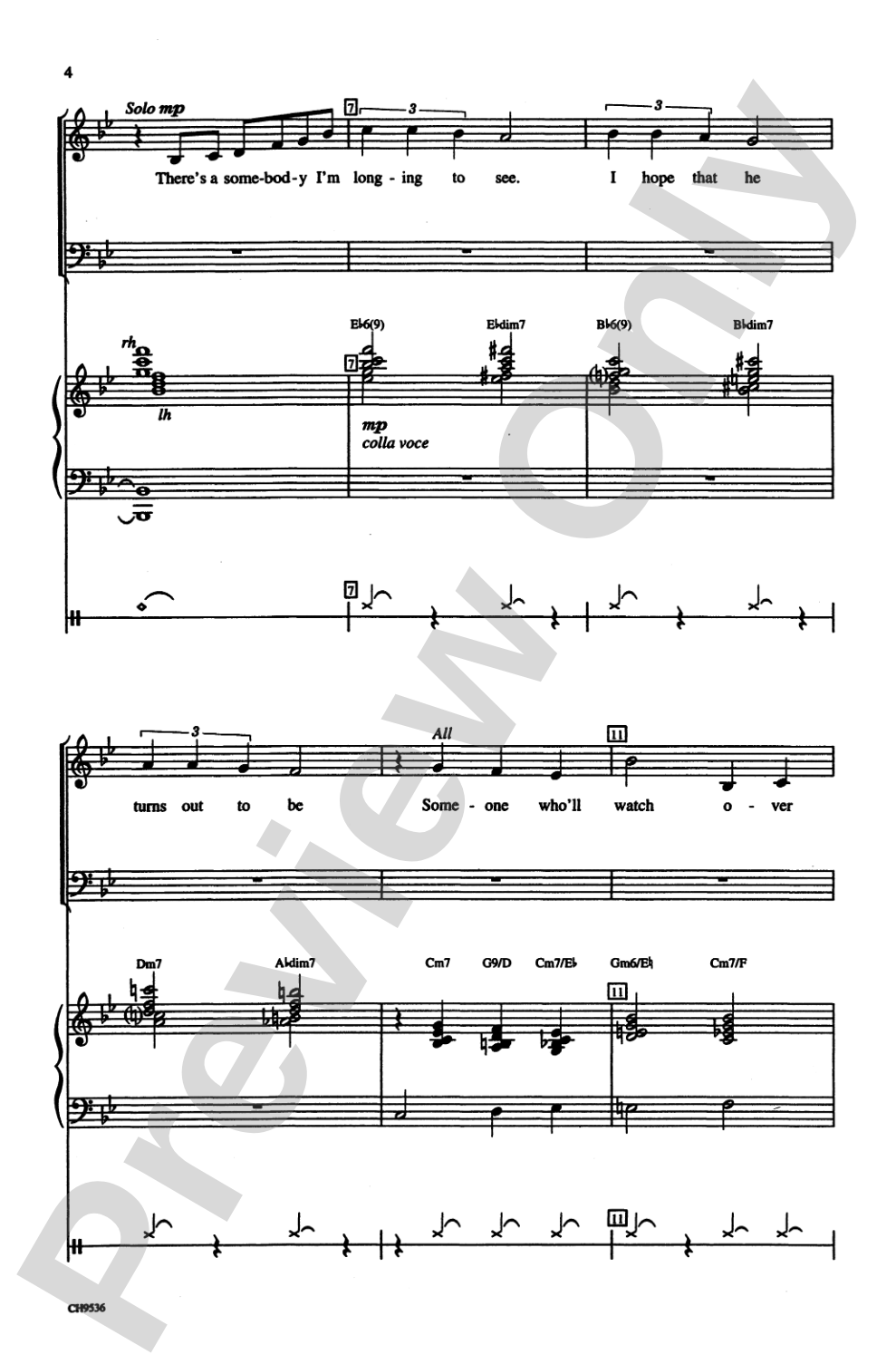
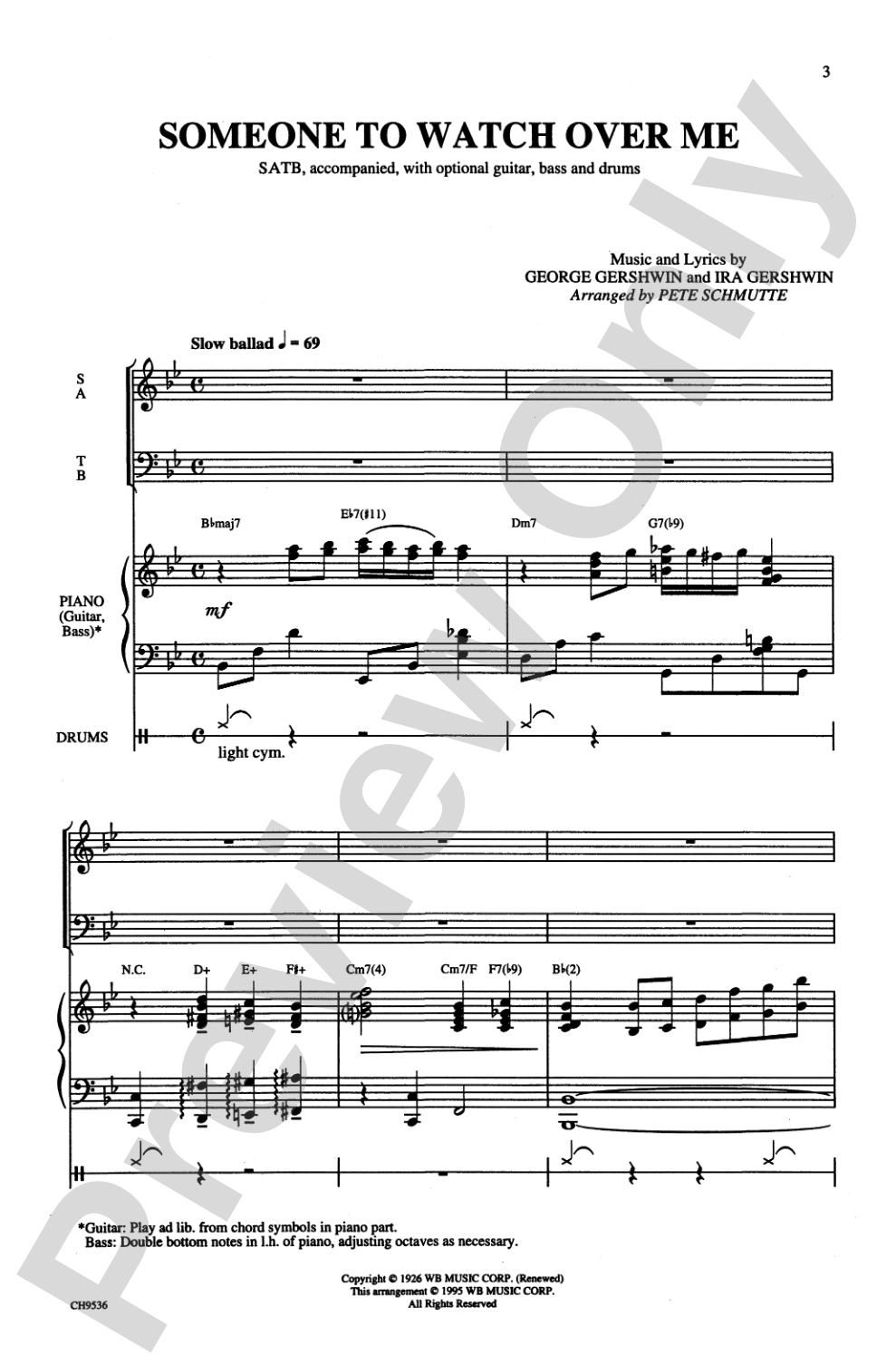
Someone to Watch Over Me Sheet Music Preview

Someone to Watch Over Me: SATB Choral Octavo

By George Gershwin and Ira Gershwin / arr. Pete Schmutte

Level: Moderate

Item: 00-PO-0004701

Digital Download
$2.25

Minimum order quantity: 20 copies

One moment…

Description
Pete's arrangement of George Gershwin's classic is uniquely captivating. The piano accompaniment sparkles with tastefully composed fills. Perfect for concert or show performance, this arrangement will stand the test of time.

Someone to Watch Over Me: SATB Choral Octavo isn't in MakeMusic Cloud just yet...but it could be. Let us know you'd like to see it, and you'll help shape what comes next. In the meantime, start a free trial and dive into thousands of interactive titles your students can play along with today.

Sample Audio
No sample audio found.
Sample Video
Additional Details
Series: Alfred Archive Edition: Alfred Pop Choral Series
Publisher: Alfred Music
Page Count: 12
SKU: 00-PO-0004701

More about this title

About the Composer: George Gershwin

George Gershwin (1898-1937) bridged the concert hall and Broadway stage in ways few composers have matched. His gift for melody and harmonic innovation shaped American music in the 1920s and 1930s, and his works remain central to both classical and popular repertoires. "Someone to Watch Over Me," from the 1926 operetta "Oh, Kay!" (with lyrics by his brother Ira), exemplifies his ability to craft songs that feel both sophisticated and immediately memorable.

For choral directors, Gershwin's legacy offers repertoire that students recognize and connect with instantly. His melodies sit naturally in the voice, and his harmonic language opens conversations about jazz influence, blues tonality, and the distinctly American sound he helped define. Teaching his work means engaging students with a composer whose popularity never diminished and whose craft repays careful study.

Why we love this

Pete Schmutte's arrangement captures the elegant simplicity of this standard while adding textural sophistication that keeps singers engaged without overwhelming them. The piano writing sparkles with character, offering accompanists rewarding material that complements rather than competes with the voices. At Grade 3, it strikes the right balance for choirs ready to tackle a recognized masterwork with confidence.

What to expect

Gershwin's melody carries warmth and yearning; there's intimacy in the harmonic movement and sincerity in the lyric. The arrangement honors that emotional core while the piano accompaniment adds subtle sophistication, creating a piece that feels both timeless and gently contemporary. Singing this feels like inhabiting a moment of quiet vulnerability.

Who it's for

Intermediate to advanced treble and lower voice singers who are ready for a recognizable standard arranged with harmonic depth. Any choir that wants to program a Gershwin masterwork at a level that challenges without frustrating. Perfect for groups building confidence in phrasing and musical storytelling.

How to get the most out of it

  • Shape the melody phrases with legit, sustained tone; this is a song about devotion, not a novelty number. Avoid over-phrasing or punching syllables.
  • Balance the four voices so the melody sings through clearly while inner parts provide harmonic warmth. Test ensemble balance during early rehearsals without the piano.
  • Work with your accompanist on the piano fills and underscore passages. These aren't filler; they define the arrangement's character and deserve rehearsal time together.
  • Take time with diction, especially in slower passages. "Someone to watch over me" needs to feel conversational and sincere, not rushed.

How to use it

Pair this with other American standard arrangements to frame a concert around the Great American Songbook, or program it alongside other 20th-century secular choral works to show stylistic range. It works equally well as a closing ballad or as a moment of lyrical contrast in a concert built around more energetic material.

Skills your students will build

  • Sustaining legit vocal tone across a full phrase without crescendo or pitch drift
  • Balancing four-part harmony to maintain melodic clarity
  • Understanding jazz-influenced harmonic movement and chromatic voice leading
  • Shaping text and musical line to convey emotional narrative
  • Listening to and responding to piano accompaniment texture

You May Also Like