
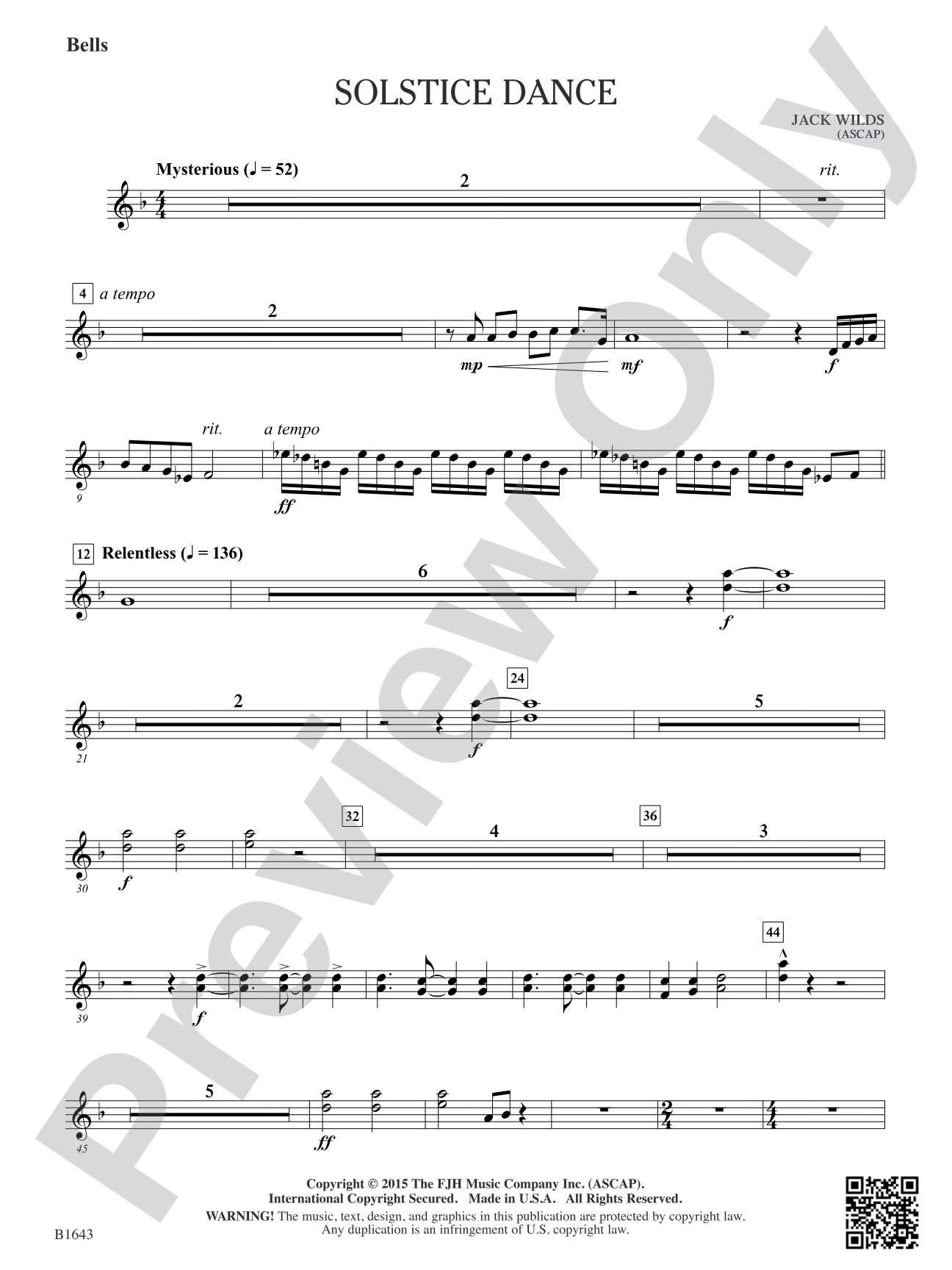

Solstice Dance: Bells
By Jack Wilds
Grade: 2.5
Item: 98-PC-DB1643_B
$7.00
Pickup currently not available
Description
Experience a magical winter solstice ceremony at the Megalithic Newgrange site in Ireland. A smooth, mystical introduction leads to a hypnotic dance groove as open fifths, driving drones and percussion ostinatos give the piece an ancient feel. Eventually the music builds one final time as it barrels to the powerful conclusion!


Don't just read it, hear it, play along with it, and watch your students grow with it. In MakeMusic Cloud, Solstice Dance: Bells comes alive with professional accompaniment, adjustable tempo, and built-in practice tools that turn solo practice into real progress.
Open in the Player
Jump straight in and assign it today.
Start Your Free Trial
Open this title and explore the full library in minutes.
Sample Audio
1
Audio File
--:--
0:00
0:00
Sample Video
No sample videos found.
Additional Details
Series:
FJH Young Band
Publisher:
The FJH Music Company, Inc.
SKU:
98-PC-DB1643_B
More about this title
About the Composer: Jack Wilds

Jack Wilds composes across an unusually wide range of settings, from children's ensembles to professional orchestras, grounding his work in visual art, literary texts, and deep musical thinking. His catalog includes over 40 published works for developing musicians, and his wind band pieces appear on festival required repertoire lists across multiple continents. He has taught composition and theory at Texas State University, serves as Co-Director of Music at First Presbyterian Church in San Marcos, and maintains an active schedule as clinician and adjudicator throughout the United States.
Wilds studied composition with Michael Ippolito at Texas State and with Chris Trapani and Donald Grantham at the University of Texas. His chamber works have been performed by the Attacca Quartet, members of the New York Philharmonic and Atlanta Symphony, and ensembles throughout North America and Asia. Before his university appointment, he directed public school bands, experience that clearly informs his gift for writing music that respects where young musicians are while challenging them toward genuine artistry.
Why we love this
Wilds has crafted something genuinely atmospheric here: the solstice setting isn't window dressing but shapes every harmonic and rhythmic choice, from the mystical open fifths to the hypnotic ostinatos that anchor the middle section. The arc from ceremony to celebration to climax gives conductors clear dramatic shape to work with, and the Grade 2.5 writing makes it accessible without ever feeling thin or oversimplified.
What to expect
You're standing at Newgrange at solstice, suspended in sacred quiet as the ceremony unfolds. The mystical opening gives way to something primal and hypnotic, a ritualistic dance that pulls you deeper with each repeated phrase. The final push toward conclusion feels inevitable and powerful, like witnessing something ancient awakening.
Who it's for
Young concert bands at the Grade 2.5 level, particularly ensembles with solid intonation and rhythmic precision who are ready for modal harmony and layered textures. This works equally well for festival programming, winter concert repertoire, or a piece that asks students to move beyond marchlike construction and into genuine musical storytelling.
How to get the most out of it
- Shape the introduction with restraint and space; let the opening mystery breathe rather than rushing toward the dance groove. Stillness here will make the transition to the hypnotic section land with real impact.
- Treat the percussion ostinatos as the pulse engine of the piece. Lock the rhythm section (mallets, timpani, bass drum) into a single, unwavering groove; everything else locks around that foundation.
- Balance the open fifths and drones so they shimmer rather than muddy. Encourage wind players to listen through the texture to hear the harmonic movement underneath.
- Build the final climax gradually across at least 16-20 bars before the peak. Resist the urge to arrive at full volume too early; let dynamics and instrumental density accumulate measure by measure.
How to use it
Program this alongside other pieces that explore timeless or ritualistic themes for a thematic winter concert, or pair it with music from different cultures that share similar harmonic or rhythmic languages. It also serves as an excellent festival selection, offering judges a chance to hear young musicians navigate atmospheric writing and ensemble cohesion at a manageable technical level.
Skills your students will build
- Playing with sustained, controlled tone in sparse textures (open fifths and drones)
- Locking into hypnotic rhythmic ostinatos and maintaining ensemble precision across repeated patterns
- Reading and performing modal harmony and non-traditional harmonic movement
- Building dynamic intensity gradually over many measures rather than abruptly
- Blending pitched and unpitched percussion ostinatos with harmonic parts