Solitude Sheet Music Preview

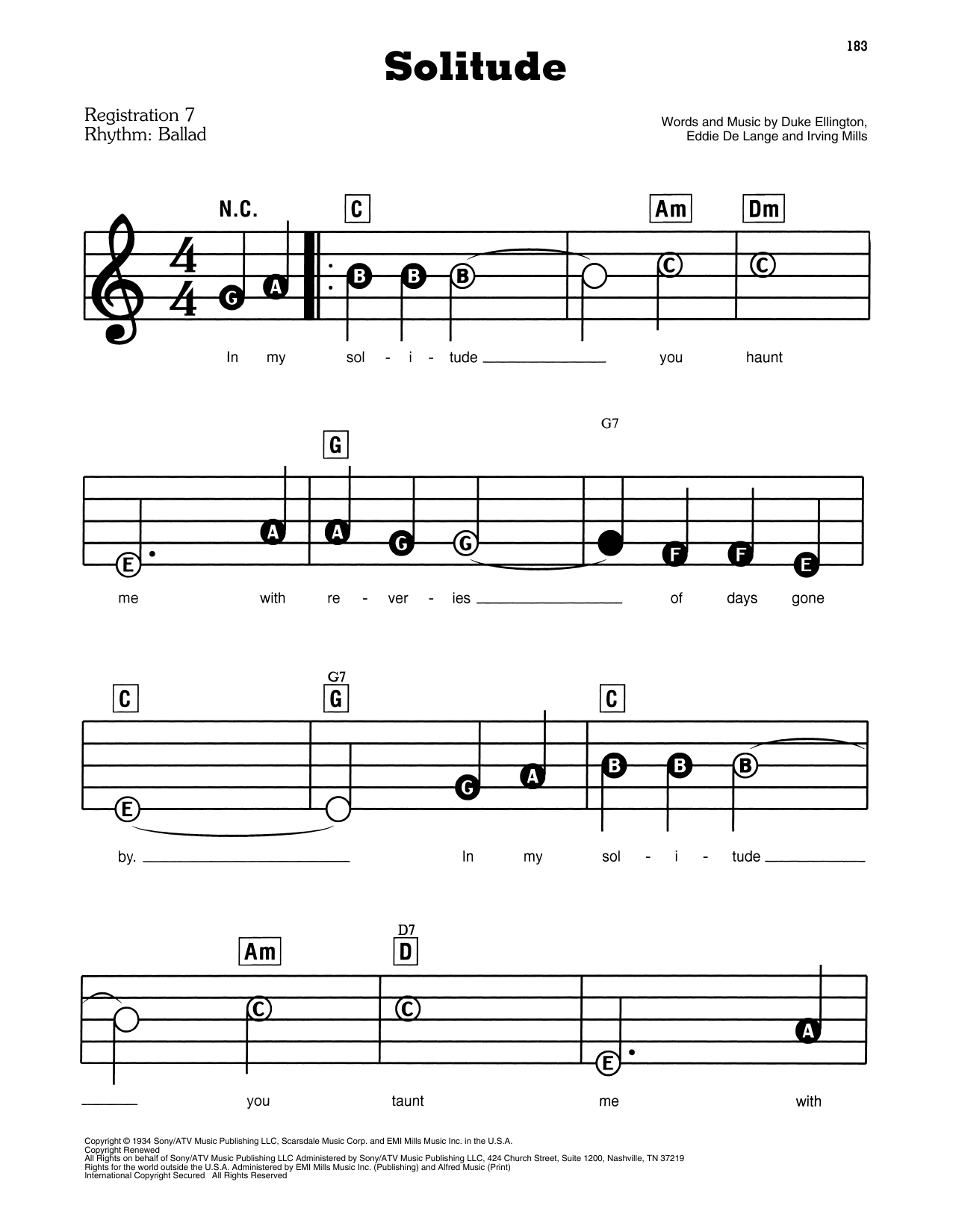
Solitude: E-Z Play Today

As performed by Duke Ellington

Item: 35-DS00450583

Digital Download
$4.99
Description

Solitude: E-Z Play Today isn't in MakeMusic Cloud just yet...but it could be. Let us know you'd like to see it, and you'll help shape what comes next. In the meantime, start a free trial and dive into thousands of interactive titles your students can play along with today.

Sample Audio
No sample audio found.
Sample Video
Additional Details
Publisher: Hal Leonard
Page Count: 3
SKU: 35-DS00450583

More about this title

About the Artist: Duke Ellington

Duke Ellington stands as one of the most prolific composers in American music history, creating a vast catalog that transcends jazz boundaries and influences classical composers, film scorers, and popular musicians alike. His harmonic sophistication, orchestral imagination, and gift for melody made him a master of extended forms, and his work remains essential study for any musician seeking to understand 20th century music.

Why we love this

Ellington's piano writing balances accessibility with genuine sophistication, making this standard achievable for intermediate pianists without sacrificing the harmonic richness that defines his sound. The E-Z Play format opens the door to jazz repertoire for students who might otherwise find lead sheets or complex transcriptions intimidating.

What to expect

Solitude invites introspection through Ellington's unhurried melody and warm harmonic palette. The piece settles into a contemplative mood, moving with quiet dignity rather than urgency.

Who it's for

This arrangement serves intermediate pianists ready to explore jazz standards with harmonic substance. It works equally well for jazz ensemble pianists seeking solo repertoire and for classical pianists wanting to develop stylistic flexibility.

How to get the most out of it

  • Shape the melody with subtle rubato rather than metronomic precision; Ellington's lines breathe and suggest rather than demand.
  • Listen closely to how the harmony moves underneath the melody, then use touch and pedal to color those chord changes.
  • Balance accompaniment texture so the right hand melody stays foremost without the left hand disappearing into accompaniment blur.

How to use it

Position this as a jazz solo feature in a mixed recital, or pair it with classical romantic repertoire to demonstrate how jazz composers approach the tradition of the art song. It also works beautifully as a closing selection for a recital focused on American composition.

Skills your students will build

  • Interpreting jazz harmony and chord substitutions
  • Managing rubato and phrasing in a non-classical context
  • Balancing melody projection with accompaniment texture
  • Navigating Ellington's sophisticated harmonic language

You May Also Like