
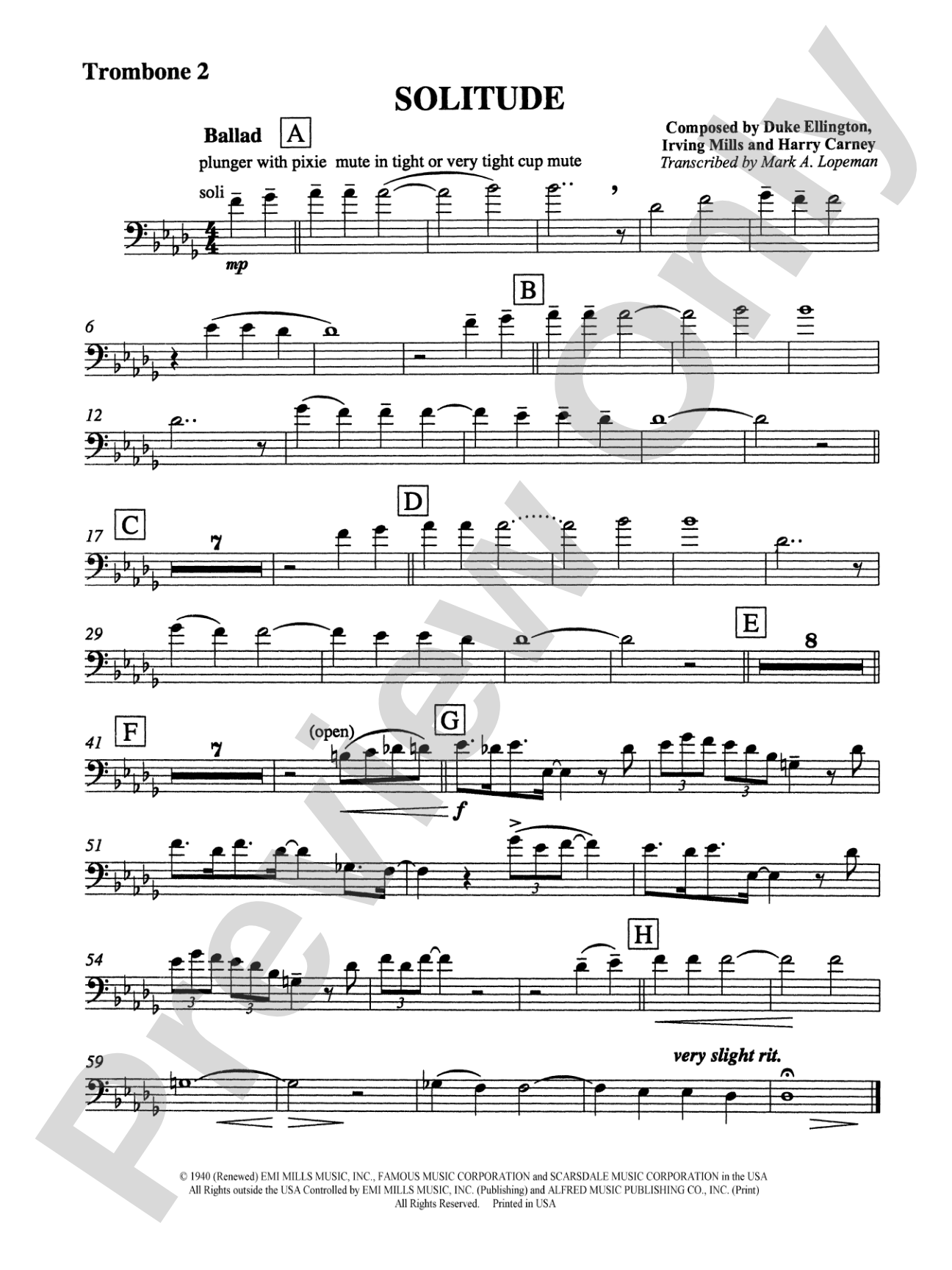

Solitude: 2nd Trombone
By Duke Ellington, Irving Mills and Harry Carney
Grade: 5 (Advanced / Difficult)
Item: 00-PC-0015229_TN2
$5.99
Pickup currently not available
Description
Warner Bros. Publications is proud to present this important new series, Jazz at Lincoln Center Library. Each selection was selected by the Center's musical director, Wynton Marsalis, for Essentially Ellington: The Second Annual Jazz at Lincoln Center High School Jazz Band Competition. Each transcription is direct from the recordings of the immortal Duke Ellington, and they are not only authentic, they are perfect for your jazz ensemble. Features information about the original recording, rehearsal notes from Jon Faddis and Brent Wallarab, and performance suggestions from Wynton Marsalis. These classic tunes represent jazz at its finest!


Don't just read it, hear it, play along with it, and watch your students grow with it. In MakeMusic Cloud, Solitude: 2nd Trombone comes alive with professional accompaniment, adjustable tempo, and built-in practice tools that turn solo practice into real progress.
Open in the Player
Jump straight in and assign it today.
Start Your Free Trial
Open this title and explore the full library in minutes.
Sample Audio
No sample audio found.
Sample Video
No sample videos found.
Additional Details
Series:
Essentially Ellington: Jazz at Lincoln Center Library
Publisher:
Alfred Music
Page Count:
40
SKU:
00-PC-0015229_TN2
More about this title
About the Composer: Duke Ellington
Duke Ellington (1899-1974) stands as one of the most prolific and innovative composers in American music history. His career spanned five decades, during which he created thousands of compositions ranging from three-minute jazz standards to extended concert works, fundamentally expanding what jazz could express and accomplish.
Ellington's genius lay in his ability to write for the specific voices of his band members while creating harmonically sophisticated music that sounds both timeless and deeply rooted in the jazz tradition. His influence on composition, orchestration, and ensemble playing remains the foundation of jazz education and practice today.
Why we love this
Wynton Marsalis selected these transcriptions specifically for the Essentially Ellington competition, meaning your students are working with pieces vetted by one of jazz's most authoritative voices and arranged directly from the original Ellington recordings. The inclusion of rehearsal notes from Jon Faddis and Brent Wallarab, plus performance guidance from Marsalis himself, transforms this into a masterclass on how to approach Duke's harmonic language and orchestral textures.
What to expect
Solitude carries the contemplative elegance that Ellington mastered. The arrangement creates intimate moments within the full ensemble texture, with graceful voice leading and warm harmonic colors that reward careful listening and refined execution from every section.
Who it's for
Advanced high school jazz ensembles and college-level jazz bands ready to tackle sophisticated harmonic writing and authentic Duke Ellington arrangements. This material suits ensembles preparing for competitions like Essentially Ellington or those building a repertoire of jazz standards played at the highest level.
How to get the most out of it
- Study the original recording provided with your parts. Ellington's orchestrations rely on subtle voice leading and timbral contrast; hearing how the original band voices each section will illuminate intonation and blend challenges your ensemble will face.
- Pay close attention to the rehearsal notes from Faddis and Wallarab regarding section balance. Jazz ensemble parts often sit in ranges that require active listening and adjustment from players to maintain the intended voicing.
- Approach the harmonic language with precision. Ellington's chord qualities and extensions demand accurate intonation and clear articulation; any sloppiness in ensemble fundamentals will expose weaknesses in complex voicings.
- Use Marsalis's performance suggestions as interpretive anchors. His guidance on phrasing and articulation is grounded in decades of playing this music and will help your ensemble understand the stylistic intent.
How to use it
Program this as a centerpiece in a jazz-focused concert or competition set. The piece pairs well with other Ellington selections from this series, allowing you to build a thematic program that showcases the depth of his compositional voice. It also serves as a teaching tool for studying how a master orchestrator voices a jazz ensemble.
Skills your students will build
- Reading and interpreting authentic jazz transcriptions
- Voice leading accuracy in extended jazz harmonies
- Sectional balance and blend within large ensemble textures
- Stylistic phrasing and articulation specific to Ellington's compositional voice
- Listening skills to distinguish orchestral colors and timbral intent
- Ensemble intonation with complex chord voicings