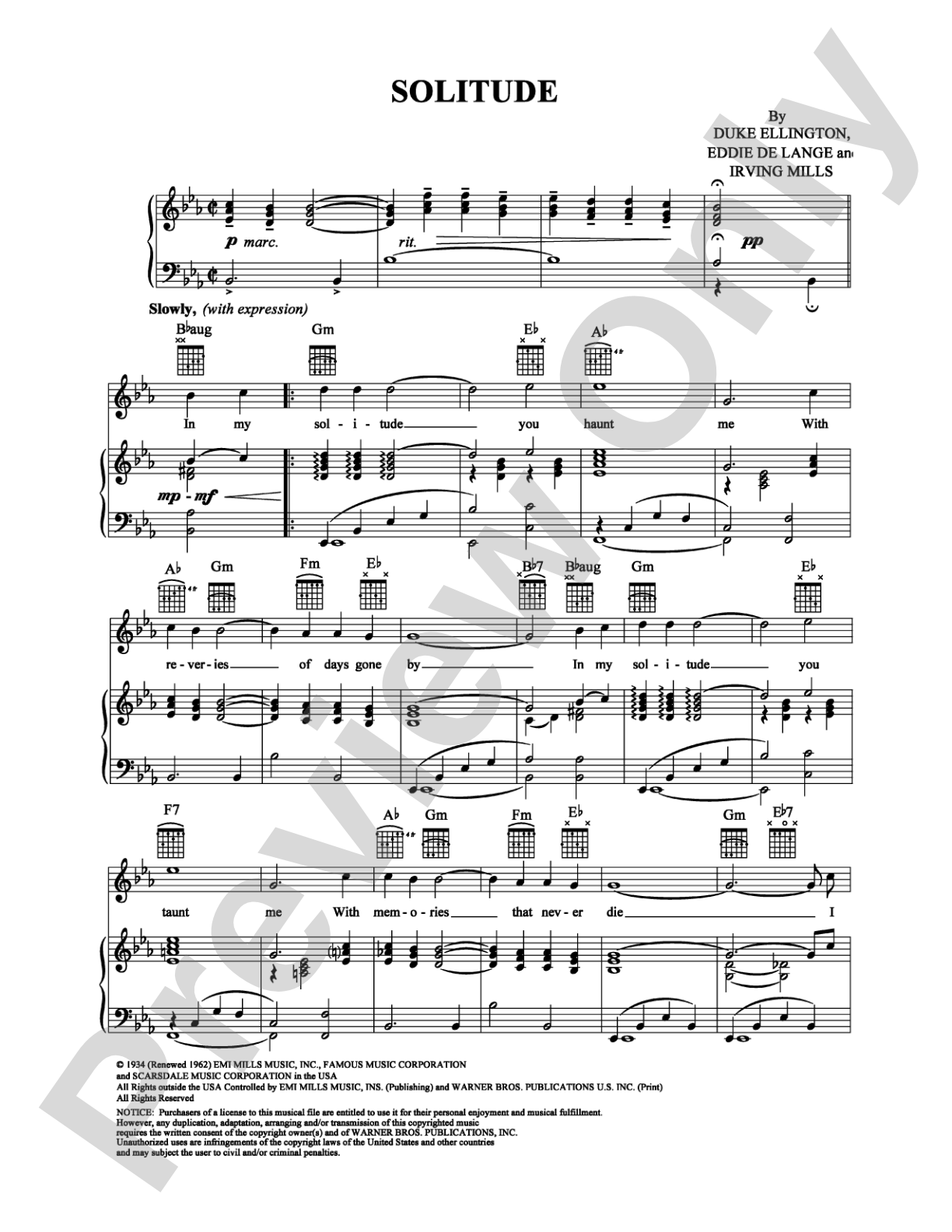
Solitude: Piano/Vocal/Chords Digital Sheet Music

Solitude: Piano/Vocal/Chords Digital Sheet Music

Duke Ellington, Irving Mills, Eddie DeLange

Item: 00-PS-0007622

Digital Download
$3.99
Description

Solitude: Piano/Vocal/Chords Digital Sheet Music isn't in MakeMusic Cloud just yet...but it could be. Let us know you'd like to see it, and you'll help shape what comes next. In the meantime, start a free trial and dive into thousands of interactive titles your students can play along with today.

Sample Audio
No sample audio found.
Sample Video
Additional Details
SKU: 00-PS-0007622

More about this title

About the Artist: Duke Ellington

Duke Ellington (1899-1974) shaped American music across seven decades as a composer, bandleader, and pianist whose harmonic sophistication elevated jazz to concert hall status. His output spanned thousands of compositions ranging from three-minute standards to extended works, each bearing his distinctive mark: rich chromatic harmonies, unexpected chord substitutions, and melodic lines that sing across every instrument. Ellington's influence on music education extends far beyond jazz; his songs have become foundational repertoire for musicians learning harmony, improvisation, and the art of elegant composition.

Why we love this

Ellington's harmonic language rewards close study, and 'Solitude' exemplifies why his standards endure in voice studios and jazz classrooms. The piece sits comfortably for singers while offering pianists genuine musical sophistication in the accompaniment. Teaching this song opens conversations about jazz melody, functional harmony with jazz extensions, and how to balance lyrical singing with the rhythmic flexibility a jazz standard demands.

What to expect

Despite its title, 'Solitude' carries quiet dignity rather than bleakness, with introspective moments balanced by Ellington's characteristic harmonic richness. The melody unfolds with lyrical grace over understated accompaniment, inviting the singer into intimate storytelling.

Who it's for

Singers developing jazz interpretation and pianists studying Ellington's harmonic sophistication will find this standard essential. It works equally well for intermediate-advanced vocalists exploring the American Songbook and jazz pianists building their comping vocabulary.

How to get the most out of it

  • Shape the melody with rubato, particularly at phrase endings; the piano can breathe slightly without losing groove
  • Approach chord substitutions as compositional choices rather than embellishments; they define Ellington's harmonic voice
  • Anchor the rhythm section feel by establishing the underlying pulse clearly, then allow tasteful flexibility within that foundation
  • Let silence speak; resist filling every moment with busy accompaniment patterns

How to use it

Pair this with other Ellington standards in a jazz or vocal recital program to demonstrate the range of his compositional voice. It serves as an excellent anchor piece for a singer specializing in jazz standards or for a jazz combo exploring the American Songbook.

Skills your students will build

  • Reading jazz chord symbols and understanding common substitutions
  • Interpreting melody with rubato over a steady harmonic rhythm
  • Balancing lyrical phrasing with jazz swing feel
  • Understanding chromatic voice leading in jazz harmony
  • Developing tasteful comping patterns that support rather than overshadow the melody

You May Also Like