
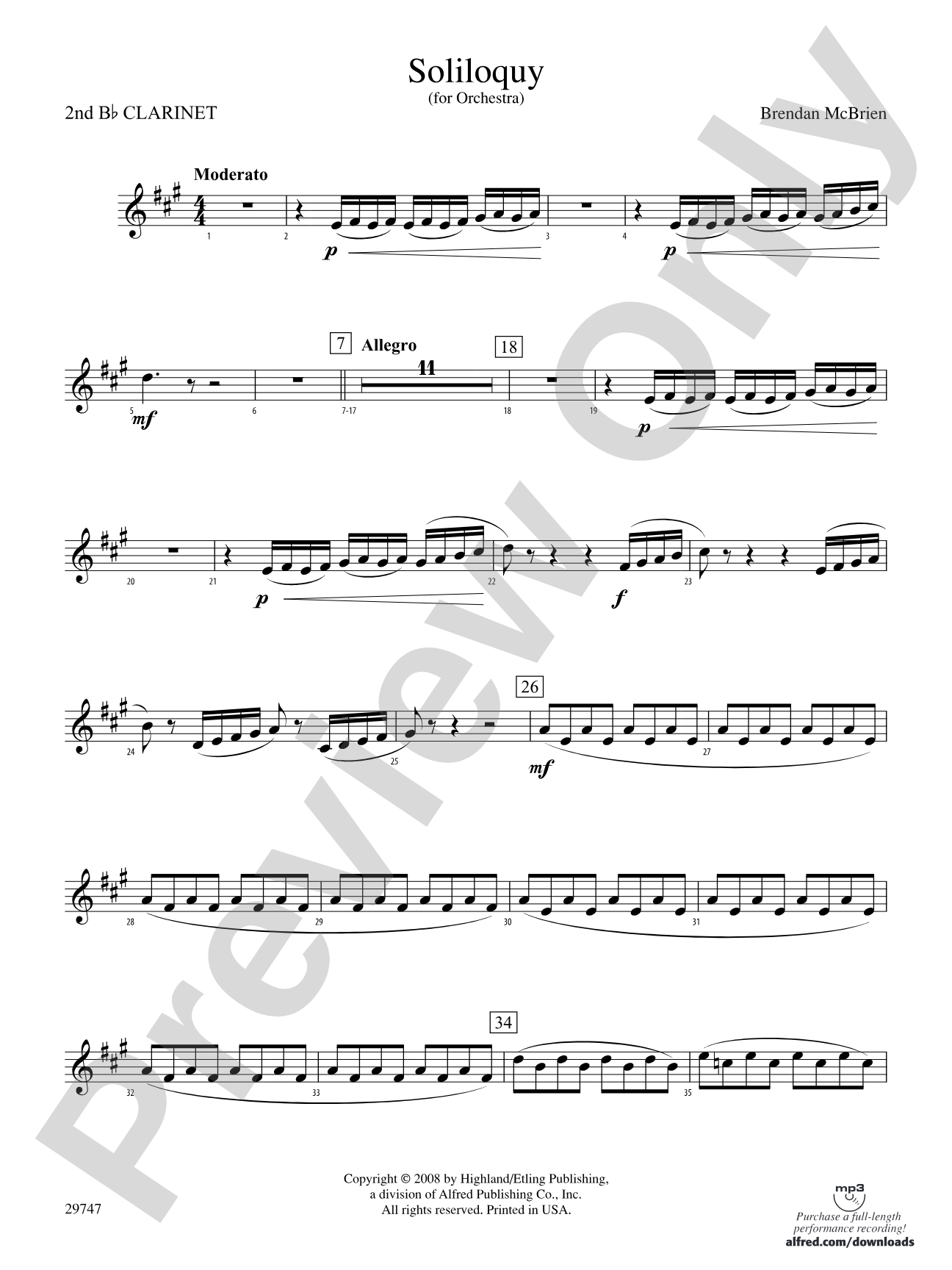

Soliloquy for Orchestra: 2nd B-flat Clarinet
By Brendan McBrien
Grade: 3.5
Item: 00-PC-0001599_C2
$3.00
Pickup currently not available
Description
Soliloquy (for Orchestra) is an original and dynamic work that features exciting dialogues between sections of the orchestra and uses thematic transformation to develop the work. This colorful tribute to the composer's friend and mentor expresses the challenges and triumphs of a life in music education. It will be a unique addition to any program, and a concert favorite with your musicians and audience alike. (4:40)


Don't just read it, hear it, play along with it, and watch your students grow with it. In MakeMusic Cloud, Soliloquy for Orchestra: 2nd B-flat Clarinet comes alive with professional accompaniment, adjustable tempo, and built-in practice tools that turn solo practice into real progress.
Open in the Player
Jump straight in and assign it today.
Start Your Free Trial
Open this title and explore the full library in minutes.
Sample Audio
1
Audio File
--:--
0:00
0:00
Sample Video
No sample videos found.
Additional Details
Series:
Highland/Etling Full Orchestra
Publisher:
Alfred Music
Page Count:
184
SKU:
00-PC-0001599_C2
More about this title
About the Composer: Brendan McBrien

Brendan McBrien began his musical life as a fourth-grader in Sunnyvale, California, where he picked up the French horn. He earned both his bachelor's and master's degrees in music composition and conducting from California State University, Long Beach, and spent more than three decades as a professional French horn player in the Los Angeles and Orange County orchestral scenes, performing for symphonies, television, and film. His compositions and arrangements for band and orchestra circulate internationally through Alfred, Kendor, Kjos, and Wingert-Jones Music.
McBrien has shaped music education as a teacher, adjudicator, clinician, and honor group conductor. He received the Middle School Teacher of the Year award from the Irvine Unified School District and served four terms on the board of the Southern California School Band and Orchestra Association. Currently, he directs bands and orchestras at Rancho San Joaquin Middle School and teaches music arranging at California State University, Long Beach.
Why we love this
McBrien draws from his own career as both a performer and educator to craft a score that speaks directly to orchestral musicians. The work balances sectional drama with sophisticated thematic development, giving every section of the orchestra a moment to shine while maintaining musical substance that audiences genuinely remember. At Grade 3.5, it delivers concert impact without requiring virtuosic technique, making it an intelligent choice for programming alongside more technically demanding repertoire.
What to expect
Soliloquy unfolds like a personal reflection, moving between moments of quiet introspection and passages of confident momentum. The orchestral colors shift and interweave, giving the impression of different instruments speaking their own truths before finding common ground, all building toward a satisfying sense of shared purpose and achievement.
Who it's for
This score and parts set works for middle school, high school, and community orchestras with balanced sections and mixed instrumentation. It's ideal for conductors building a concert around accessible, contemporary orchestral writing that still challenges musicians musically and rewards audiences with genuine dramaturgy.
How to get the most out of it
- Balance the sectional dialogues by rehearsing them as conversations rather than isolated parts; the drama emerges from how clearly each section's voice responds to what came before.
- Use the thematic transformations as structural signposts during rehearsal so musicians hear how the piece develops rather than feeling like it shifts randomly.
- Pay attention to articulation and color changes as they signal new material; they're essential to the piece's identity and worth separate rehearsal attention.
- Let the musicians know this is a personal tribute to a mentor in music education; context often deepens their investment in the performance.
How to use it
Program this as a centerpiece on a concert featuring newer American orchestral works, or pair it with classic repertoire to showcase the range of your ensemble's musicianship. Its four-minute-forty-second length fits comfortably into festival competitions or concert formats where you need both substance and strategic pacing.
Skills your students will build
- Balancing sectional independence within ensemble textures
- Following thematic development across key sections of the orchestra
- Responding to transitioned cues and sectional entries with precision
- Interpreting articulation and dynamic shifts as musical storytelling
- Maintaining musicality and phrasing while playing within mixed ensemble colors