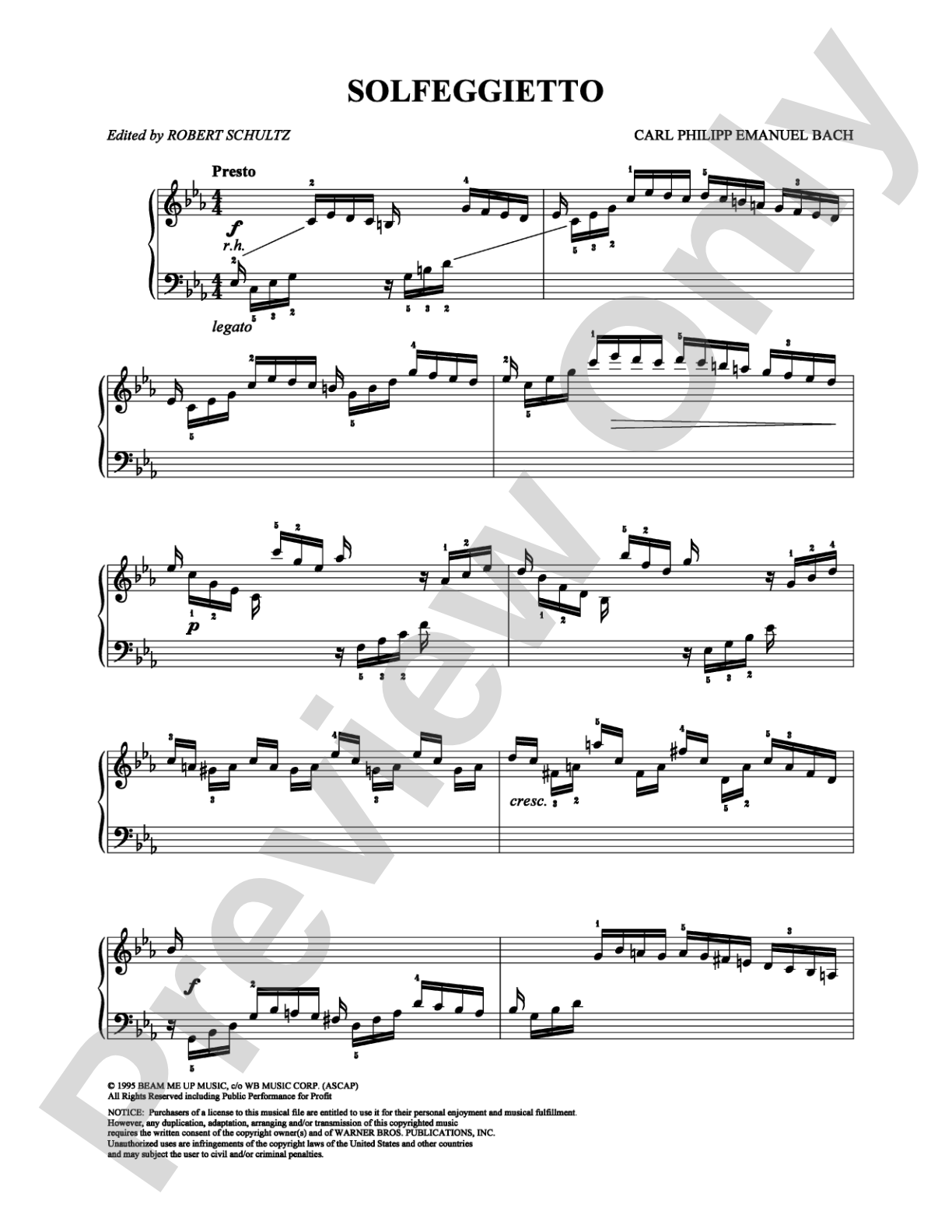
Solfeggietto: Piano Digital Sheet Music

Solfeggietto: Piano Digital Sheet Music

Carl Philipp Emanuel Bach

Item: 00-PS-0009978

Digital Download
$3.99
Description

Solfeggietto: Piano Digital Sheet Music isn't in MakeMusic Cloud just yet...but it could be. Let us know you'd like to see it, and you'll help shape what comes next. In the meantime, start a free trial and dive into thousands of interactive titles your students can play along with today.

Sample Audio
No sample audio found.
Sample Video
Additional Details
SKU: 00-PS-0009978

More about this title

About the Creator: Carl Philipp Emanuel Bach

Carl Philipp Emanuel Bach (1714-1788) was a composer of extraordinary technical and musical ambition who bridged the Baroque and Classical eras. The son of J.S. Bach, he established himself as a keyboard virtuoso and prolific composer in his own right, serving at the court of Frederick the Great in Berlin before moving to Hamburg. His keyboard works are marked by dramatic harmonic shifts, unexpected modulations, and a conversational style that influenced Haydn, Mozart, and Beethoven.

Bach's approach to keyboard writing was revolutionary for its time. He championed the fortepiano over the harpsichord and demanded expressive depth from performers, publishing influential treatises on performance practice. His Solfeggietto exemplifies this ideal: a piece that is both a technical study and a genuine musical statement.

Why we love this

Solfeggietto is a compact masterpiece that teaches fluency without sacrificing musicality. The relentless sixteenth-note figuration demands technical precision, yet the harmonic language and spirited character make it rewarding to practice and exciting to hear performed well.

What to expect

Restless energy. The sixteenth-note runs tumble forward with urgency while surprising harmonic turns keep the listener slightly off-balance. There's a conversational quality beneath the technical surface, as if the composer is thinking out loud at the keyboard.

Who it's for

Intermediate to advanced pianists who are ready for genuine Baroque keyboard writing. This piece serves equally well as a technical etude and as a performance work for recitals, studio juries, or competitions.

How to get the most out of it

  • Shape the opening sixteenth-note runs with subtle dynamic weight on downbeats rather than maintaining a flat, undifferentiated texture.
  • Keep the tempo steady; the piece gains drama from its forward momentum, not from rhythmic flexibility.
  • Balance finger work with arm weight to achieve even passagework without fatigue or tension in the forearm.
  • Observe Bach's dynamic markings closely; they signal harmonic turning points and create structure within the figuration.

How to use it

Include this in a Baroque or keyboard-focused recital alongside works by Scarlatti or J.S. Bach to show period style command. It also works as a solo performance piece at student recitals when you want to highlight a player's technical maturity and interpretive insight.

Skills your students will build

  • Even sixteenth-note passagework at a brisk tempo
  • Voice independence and hand coordination
  • Baroque phrasing and harmonic listening
  • Technical endurance without tension
  • Reading and interpreting Baroque notation and ornamentation

You May Also Like