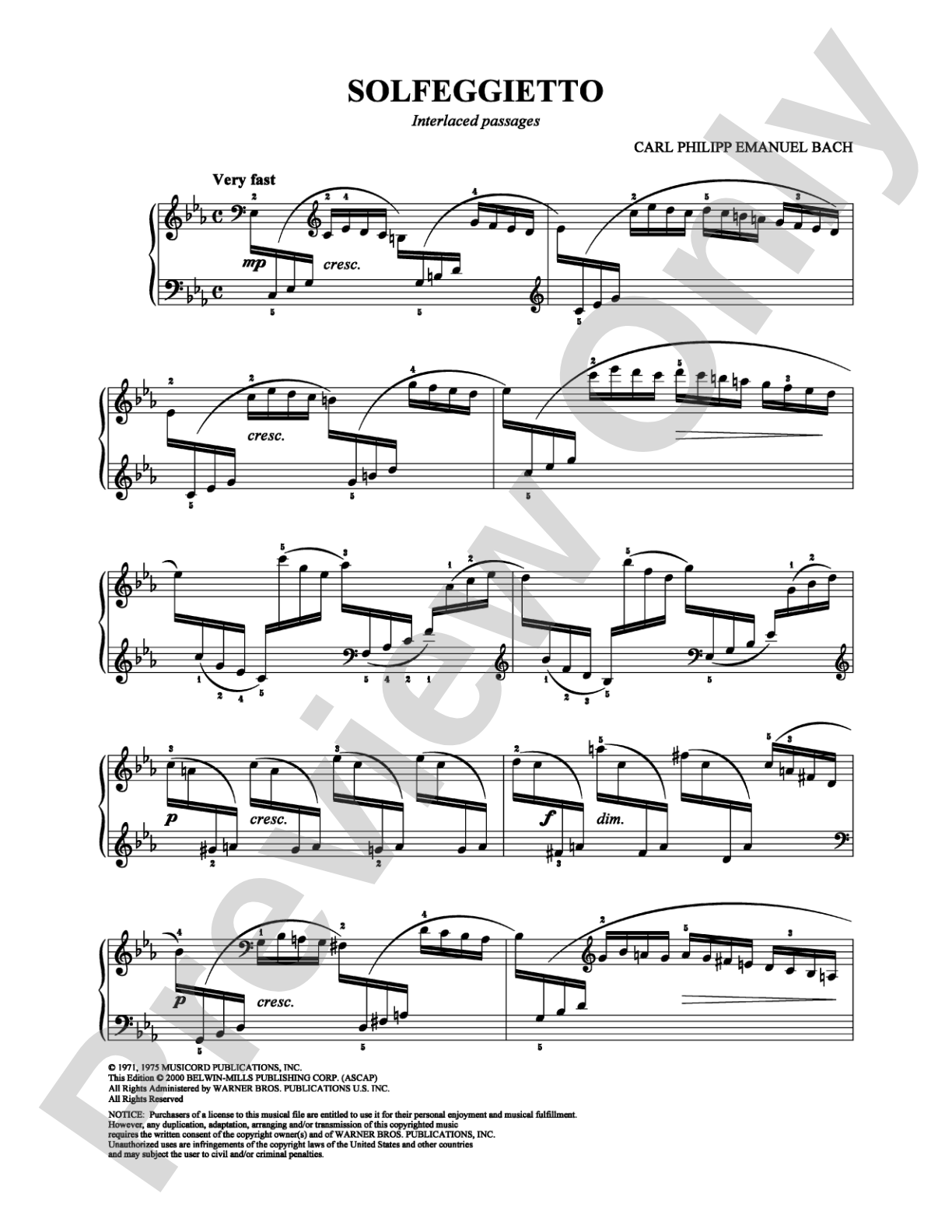
Solfeggietto: Piano Digital Sheet Music

Solfeggietto: Piano Digital Sheet Music

Carl Philipp Emanuel Bach

Item: 00-PS-0003571

Digital Download
$3.99
Description

Solfeggietto: Piano Digital Sheet Music isn't in MakeMusic Cloud just yet...but it could be. Let us know you'd like to see it, and you'll help shape what comes next. In the meantime, start a free trial and dive into thousands of interactive titles your students can play along with today.

Sample Audio
No sample audio found.
Sample Video
Additional Details
SKU: 00-PS-0003571

More about this title

About the Creator: Carl Philipp Emanuel Bach

Carl Philipp Emanuel Bach (1714, 1788) was a towering figure in keyboard music who bridged the Baroque and Classical worlds. The eldest son of J.S. Bach, he surpassed his father's keyboard output and became the most performed keyboard composer of his lifetime, revered across Europe for works that combined technical brilliance with emotional depth.

Bach's keyboard compositions were laboratory experiments in what the instrument could express. He wrote prolifically for both harpsichord and the emerging fortepiano, and his six collections of keyboard sonatas shaped how later composers approached the form. His influence on Haydn, Mozart, and Beethoven was profound and direct.

Why we love this

Solfeggietto occupies a sweet spot for advancing pianists: genuinely challenging passage work without the length or structural complexity of a full sonata. The scale-based figuration teaches fluid hand position and finger independence while remaining musically coherent, and the piece delivers real musical satisfaction in under three minutes.

What to expect

Perpetual motion with purpose. The sixteenth-note figuration propels forward with restless energy while the underlying harmony shifts thoughtfully beneath, creating a piece that feels both virtuosic and contemplative. There's elegance in the simplicity of the writing and a genuine lift when it lands.

Who it's for

Pianists working toward the late Intermediate to early Advanced level who are ready for extended scalar passage work and want to develop control and musicality simultaneously. It suits students preparing for auditions or competitions and works well for teachers seeking material that bridges technique and artistry.

How to get the most out of it

  • Think of the sixteenth-note passages as vocal lines rather than pure technique exercises. Phrase them with the same attention you'd give to a melodic gesture, letting the shape breathe rather than grinding through evenly.
  • Lock the hand position early and keep wrist rotation minimal. The fluidity comes from finger action alone; excessive wrist motion muddies the clarity you're after.
  • Shape the dynamic contours across the larger spans of figuration. One long crescendo through two systems of sixteenths loses the piece's natural breathing points.
  • Observe the harmonic rhythm underneath the right-hand figuration. Knowing where the chords change helps anchor your phrasing and keeps the accompaniment from sounding like filler.

How to use it

This works perfectly as a recital opener or closer for a student showcase, especially when paired with a larger Baroque or Classical work. It also fits well in a studio class setting where multiple advanced students can perform the same piece in succession, allowing the audience to hear different approaches to the same technical and interpretive challenges.

Skills your students will build

  • Sustained evenness and control in rapid scalar passages
  • Finger independence and hand position stability
  • Phrasing and dynamic shaping across figuration-based writing
  • Reading and executing ornament-free Classical keyboard idiom
  • Balance between accompaniment and foreground material

You May Also Like