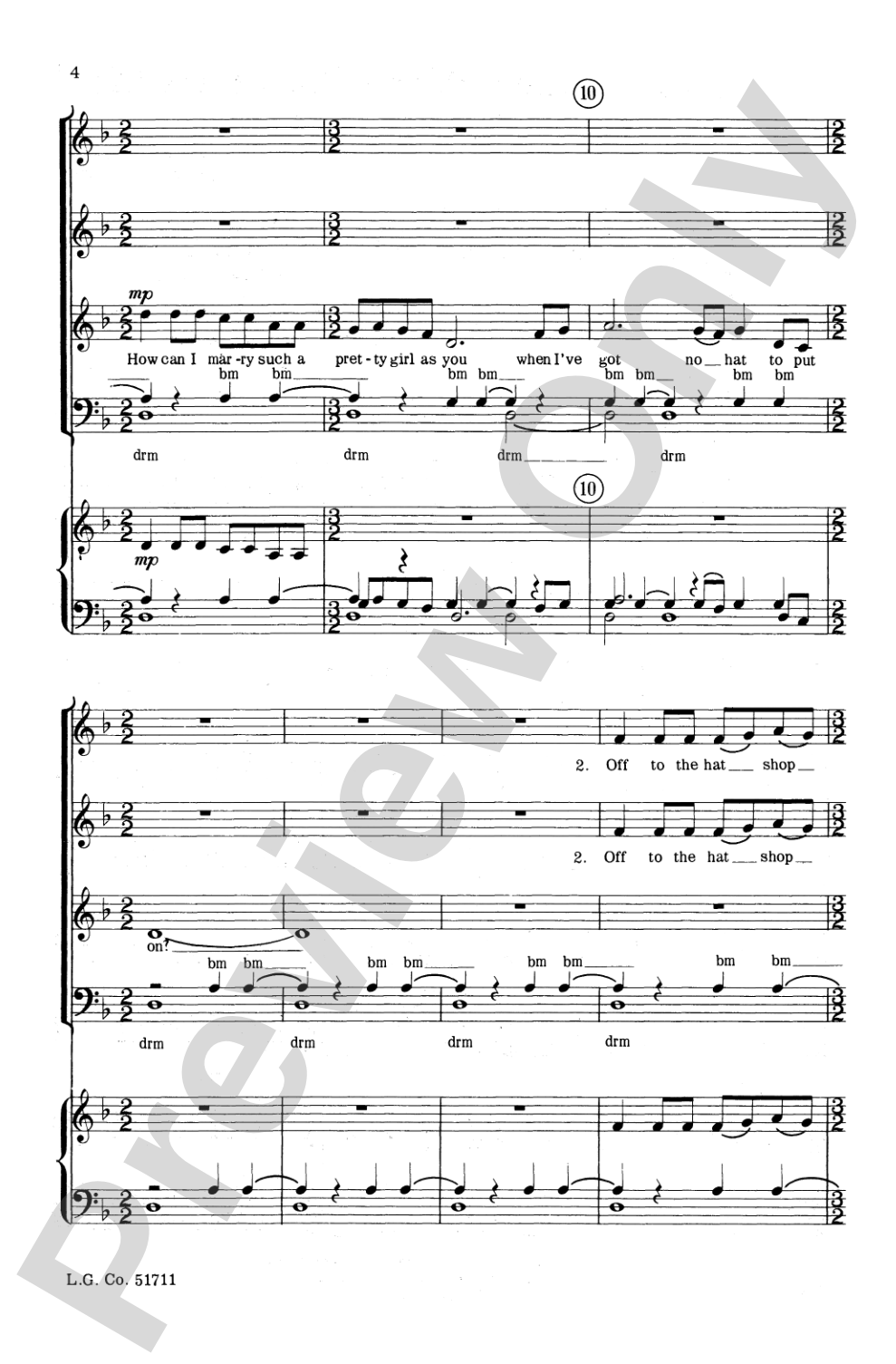
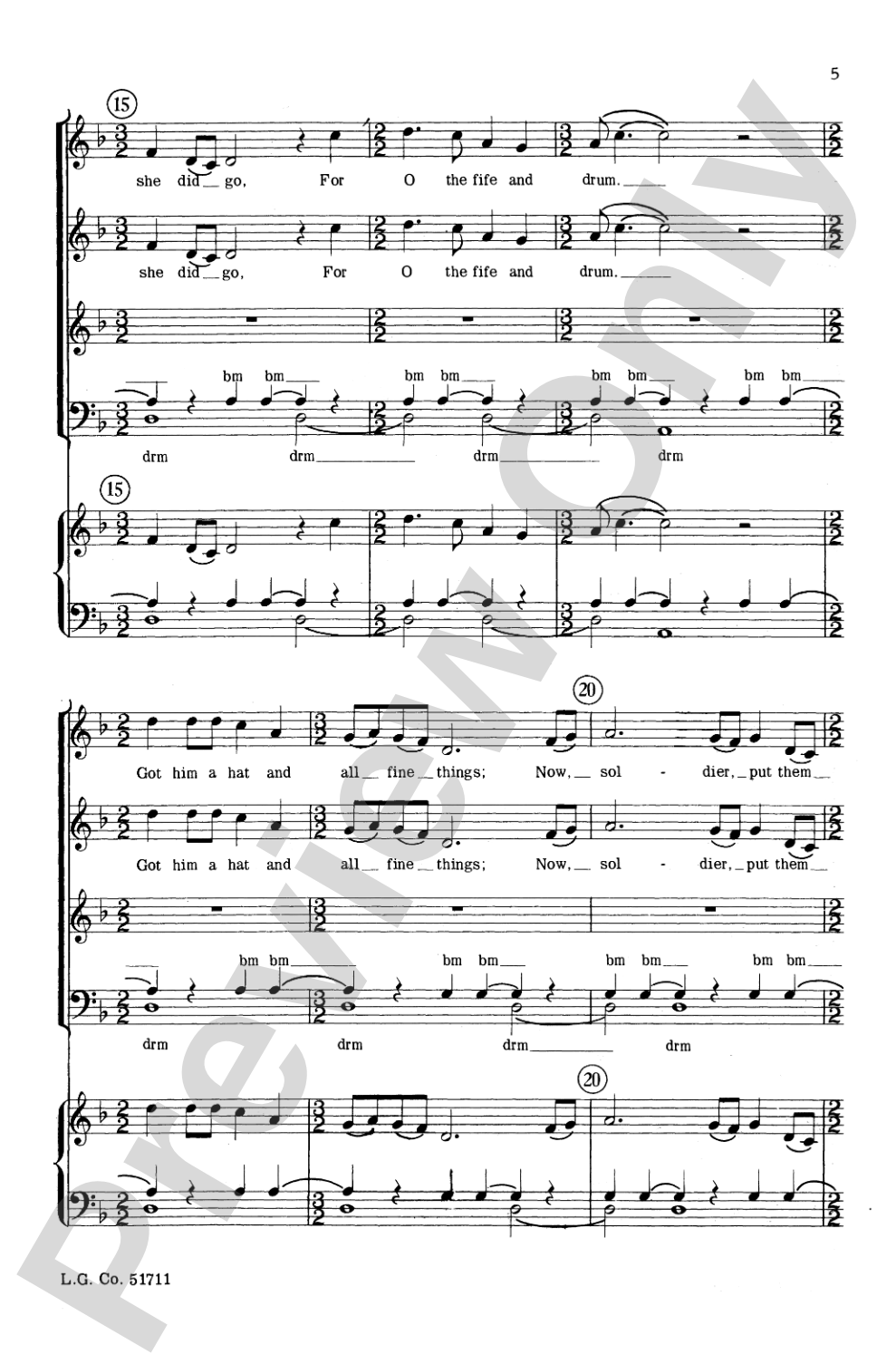
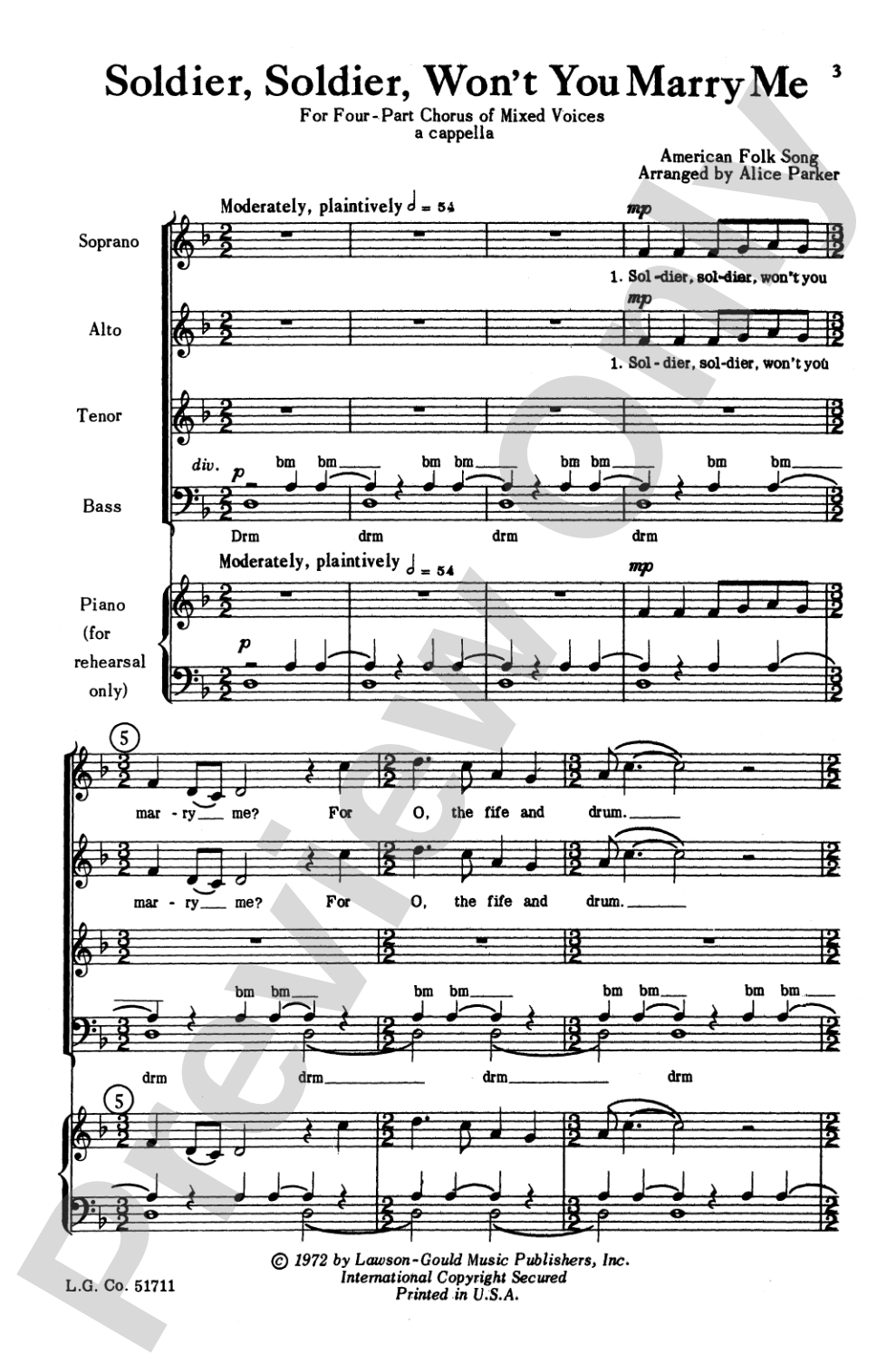
Soldier, Soldier, Won't You Marry Me? Sheet Music Preview

Soldier, Soldier, Won't You Marry Me?: SATB Choral Octavo

American Folk Song / arr. Alice Parker

Item: 00-PO-0005026

Digital Download
$2.95

Minimum order quantity: 20 copies

Description

Soldier, Soldier, Won't You Marry Me?: SATB Choral Octavo isn't in MakeMusic Cloud just yet...but it could be. Let us know you'd like to see it, and you'll help shape what comes next. In the meantime, start a free trial and dive into thousands of interactive titles your students can play along with today.

Sample Audio
No sample audio found.
Sample Video
Additional Details
Series: Alfred Archive Edition: Lawson-Gould Music Publishers
Publisher: Alfred Music
Page Count: 16
SKU: 00-PO-0005026

More about this title

About the Arranger: Alice Parker

Alice Parker

Alice Parker's work defines American choral music. She studied composition and conducting at Smith College and Juilliard, where she formed a vital creative partnership with Robert Shaw that would shape generations of choral singing. Together they created what remains one of the most performed collections of folksong arrangements in the world, drawing from American spirituals, hymns, and traditional melodies.

Parker's compositional output spans over five hundred published works across operas, cantatas, song cycles, and individual choral pieces. Beyond writing music, she established MELODIOUS ACCORD, INC. in 1985 to focus on the fundamental element of vocal music: the melody itself. She authored influential books on choral improvisation, melodic styles, and congregational singing that have shaped how directors approach vocal artistry. Her honors include the Robert Shaw Award from the American Choral Directors Association, the Harvard Glee Club Foundation Medal, six honorary doctorates, and recognition as Distinguished Composer of the Year by the American Guild of Organists.

Why we love this

Parker's arrangement respects the narrative vigor of this folk ballad while giving SATB voices genuine independence and musical interest. The setting demands singers to listen across parts rather than simply execute a melody, building the kind of ensemble awareness that defines mature choral singing. At 16 pages, it's substantial enough to give a program weight without overwhelming rehearsal time.

What to expect

The piece carries the wry humor and directness of its folk origins, yet Parker's harmonic language gives it textural depth and moments of genuine surprise. It settles comfortably between familiarity and sophistication, never winking at the audience but never pretending the song is heavier than it is.

Who it's for

This arrangement suits choirs with solid sight-reading skills and some experience blending parts independently. It works equally well in concert settings, community choral programs, and educational ensembles looking for folk material with musical substance beyond the obvious melody.

How to get the most out of it

  • Shape the story arc clearly across the verses so that each stanza builds narrative momentum rather than becoming routine repetition of the same harmonic gestures.
  • Attend to the independence of the inner parts, particularly where the arrangement gives them rhythmic or melodic character; this is not a melody-driven texture.
  • Balance the folk vernacular of the text with the harmonic sophistication Parker brings, letting both elements breathe without either overwhelming the other.
  • Use the recorded accompaniment (if available) as a rehearsal tool early on, but work toward unaccompanied singing so the chorus owns the harmonic framework.

How to use it

Program this as a centerpiece of an American folk or Americana-themed concert, where it can anchor a set of other traditional material. Its moderate length and accessible subject matter also make it a strong choice for community performances where varied audiences appreciate both the tune and the musical craftsmanship behind it.

Skills your students will build

  • Balancing part independence with ensemble blend
  • Interpreting folk material through contemporary harmonic language
  • Maintaining rhythmic precision across multiple independent lines
  • Understanding narrative structure in choral storytelling
  • Reading SATB voicings with chromatic and secondary harmony

You May Also Like