
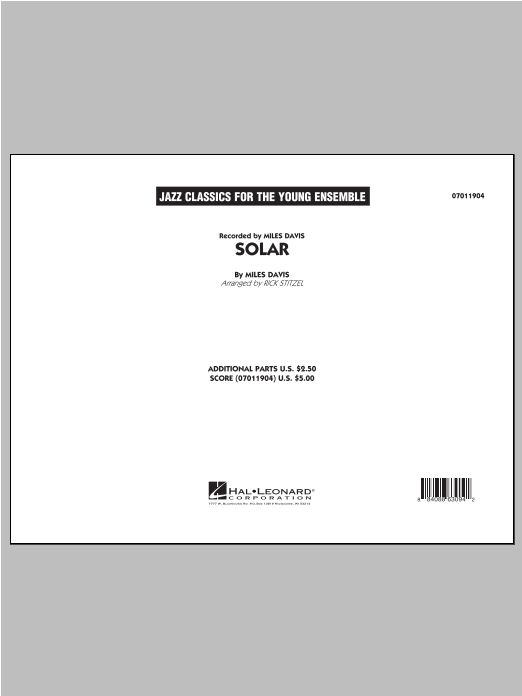

Solar: Jazz Ensemble Conductor Score & Parts
As performed by Miles Davis / Arranged by Rick Stitzel
Grade: 3
Item: 35-PK00228226
$50.00
Pickup currently not available
Buy Extra Parts (Digital PDF Download)
| Product | Price | Quantity |
|---|---|---|
| Solar - Full Score | $6.00 | |
| Solar - Alto Sax 1 | $6.00 | |
| Solar - Alto Sax 2 | $6.00 | |
| Solar - Tenor Sax 1 | $6.00 | |
| Solar - Tenor Sax 2 | $6.00 | |
| Solar - Baritone Sax | $6.00 | |
| Solar - Trumpet 1 | $6.00 | |
| Solar - Trumpet 2 | $6.00 | |
| Solar - Trumpet 3 | $6.00 | |
| Solar - Trumpet 4 | $6.00 | |
| Solar - Trombone 1 | $6.00 | |
| Solar - Trombone 2 | $6.00 | |
| Solar - Trombone 3 | $6.00 | |
| Solar - Trombone 4 | $6.00 | |
| Solar - Guitar | $6.00 | |
| Solar - Piano | $6.00 | |
| Solar - Bass | $6.00 | |
| Solar - Drums | $6.00 | |
| Solar - Vibes | $6.00 | |
| Solar - Solo Sheet | $6.00 |
Parts Added to Cart!
Description
One of the most enduring compositions from Miles Davis' early career is this medium swing tune recorded on the 1954 album "Walkin'". In this terrific chart for younger players, Rick Stitzel uses some nifty phrase extensions in the beginning, then alternates the full ensemble with statements by a small group. Solos for trumpet and tenor sax are also included.


Solar: Jazz Ensemble Conductor Score & Parts isn't in MakeMusic Cloud just yet...but it could be. Let us know you'd like to see it, and you'll help shape what comes next. In the meantime, start a free trial and dive into thousands of interactive titles your students can play along with today.
Request This Title
Tell us you want it.
Start Your Free Trial
Explore everything that's ready to play right now.
Sample Audio
No sample audio found.
Sample Video
No sample videos found.
Additional Details
Publisher:
Hal Leonard
SKU:
35-PK00228226
More about this title
About the Artist: Miles Davis
Miles Davis shaped modern jazz across seven decades, moving from bebop through cool jazz, modal experimentation, and fusion. His 1954 album "Walkin'" captured him at a pivotal moment, recording blues-based swing tunes that would become standards in the jazz repertoire. For educators, Davis represents the gold standard of jazz innovation: a musician who mastered the fundamentals of his craft before revolutionizing it.
Why we love this
Rick Stitzel's arrangement respects the tune's essential character while making it genuinely playful for younger ensembles. The phrase extensions at the opening give students something immediately interesting to latch onto, and the strategic contrast between full ensemble and small group writing keeps the energy dynamic without overwhelming developing players. Trumpet and tenor solos invite your strongest improvisers to step forward while the rest of the band locks into supportive ensemble figures.
What to expect
Solar swings with the ease of a classic: no overwrought harmonies, no frantic bebop runs, just a medium-tempo blues head that feels like settling into a conversation. The tune has an openness to it, a breathing quality that lets young soloists find their footing while the ensemble bounces along underneath. There's genuine warmth in this chart, the kind of writing that makes students want to get better at their instruments so they can do it justice.
Who it's for
Jazz ensembles working at Grade 3 who are ready to explore standards with real solo opportunities. This works equally well for intermediate high school bands or strong middle school groups seeking to deepen their understanding of swing-era composition. Directors looking for repertoire that teaches ensemble cohesion alongside improvisation will find this particularly useful.
How to get the most out of it
- Nail the articulation in those opening phrase extensions; they're short, punchy figures that need clarity and precision to land the compositional humor Stitzel built in.
- Balance the blend when the small group enters. Younger players often push too hard when they get exposed; remind them that less intensity with good intonation always sounds more mature than more volume with uncertainty.
- Have your trumpet and tenor soloists prepare variations over the changes rather than memorizing one solo. The best way to learn this tune is to treat it as a vehicle for improvisation, not a scripted solo to recite.
- Keep the swing section (piano, bass, drums) locked tight throughout. The ensemble figures land better when the rhythm section is genuinely swinging rather than keeping metronomic time.
How to use it
Pair this with other Davis-era standards if you're building a concert around timeless swing repertoire. It's also an ideal teaching piece for a concert where you're highlighting improvisation as part of your ensemble's work. Consider programming it mid-concert where the pacing of the small group section creates a natural lift in energy without requiring anything too virtuosic.
Skills your students will build
- Swing articulation and phrasing at medium tempo
- Ensemble balance and blend across full and reduced voicings
- Blues changes and implied harmonic motion
- Listening actively to other section members during phrase extensions
- Basic jazz improvisation over a blues form
- Part independence within a sectional framework