
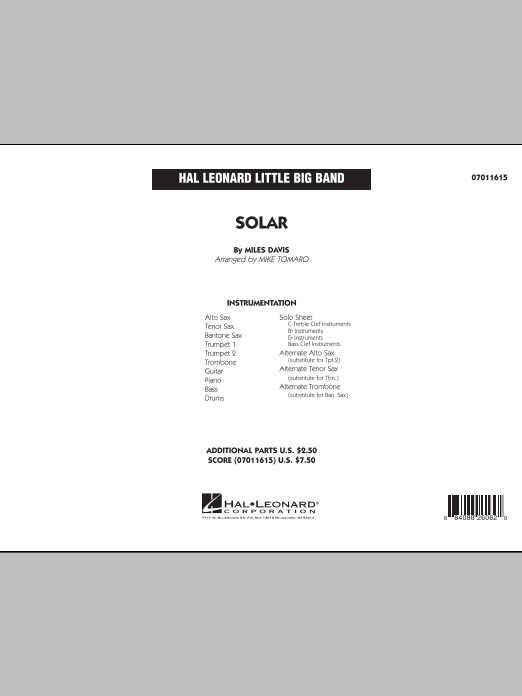

Solar: Jazz Ensemble Conductor Score & Parts
By Miles Davis / Arranged by Mike Tomaro
Grade: 4
Item: 35-PK00117879
$45.00
Pickup currently not available
Buy Extra Parts (Digital PDF Download)
| Product | Price | Quantity |
|---|---|---|
| Solar - Conductor Score (Full Score) | $7.50 | |
| Solar - Alto Sax | $6.00 | |
| Solar - Tenor Sax | $6.00 | |
| Solar - Baritone Sax | $6.00 | |
| Solar - Trumpet 1 | $6.00 | |
| Solar - Trumpet 2 | $6.00 | |
| Solar - Trombone | $6.00 | |
| Solar - Guitar | $6.00 | |
| Solar - Piano | $6.00 | |
| Solar - Bass | $6.00 | |
| Solar - Drums | $6.00 | |
| Solar - C Solo Sheet | $6.00 | |
| Solar - Bb Solo Sheet | $6.00 | |
| Solar - Eb Solo Sheet | $6.00 | |
| Solar - Bass Clef Solo Sheet | $6.00 | |
| Solar - Alternate Alto Sax | $6.00 | |
| Solar - Alternate Tenor Sax | $6.00 | |
| Solar - Alternate Trombone | $6.00 |
Parts Added to Cart!
Description
Classic Miles in a gem of a chart for small band.


Solar: Jazz Ensemble Conductor Score & Parts isn't in MakeMusic Cloud just yet...but it could be. Let us know you'd like to see it, and you'll help shape what comes next. In the meantime, start a free trial and dive into thousands of interactive titles your students can play along with today.
Request This Title
Tell us you want it.
Start Your Free Trial
Explore everything that's ready to play right now.
Sample Audio
No sample audio found.
Sample Video
No sample videos found.
Additional Details
Publisher:
Hal Leonard
SKU:
35-PK00117879
More about this title
About the Composer: Miles Davis
Miles Davis shaped modern jazz across seven decades, moving from bebop through cool jazz, modal exploration, and fusion. His approach to composition emphasized space, simplicity, and the power of a strong melodic idea, making his work enduringly relevant for teaching ensemble musicianship and small band arranging.
Davis's influence on jazz education runs deep. His recordings demonstrate how effective communication between soloist and accompaniment creates compelling ensemble conversation, and his compositional choices show young musicians that sophistication doesn't require complexity.
Why we love this
Tomaro has captured everything that makes 'Solar' tick: the restless harmonic motion, the lean voicings, and the space that lets soloists breathe. A Grade 4 chart at this level that doesn't oversimplify Miles's harmonic language is rare, and this one rewards both section players and featured improvisers without sacrificing the tune's essential cool.
What to expect
Poised and restless. The tune never settles; even during ensemble passages, the harmony keeps shifting underneath, creating a forward momentum that feels like walking through a city at night. It's introspective but never static.
Who it's for
Jazz ensembles at the advancing high school level or college jazz combos looking for a piece that teaches harmonic listening without overwhelming readers. Bandleaders who want to program authentic Miles while keeping the technical bar reasonable for their section players will find this arrangement does exactly that.
How to get the most out of it
- Balance the melody between trumpet and tenor in the head. The line belongs to both voices equally, so blend rather than feature one over the other.
- Keep the rhythm section locked in half-time feel even as the harmony moves. This tune's harmonic density can pull players into rushing if the time foundation wavers.
- Treat rests as part of the phrasing, not dead air. The silence in this tune is where the listener catches up with the changes.
- Let soloists know the chord progression cycles quickly. Two or three chorus limit works better than open soloing, which can expose harmonic uncertainty in the rhythm section.
How to use it
This works well as a second-set opener on a jazz concert, where the audience has settled in and you can ask them to follow a more sophisticated harmonic journey. It also pairs naturally with other Tomaro arrangements or other Davis compositions if you're building a themed program around a single composer's influence on the ensemble.
Skills your students will build
- Reading jazz chord changes in a modal/cyclic harmonic context
- Comping and listening skills for rhythm section players (piano, bass, drums)
- Improvising over extended harmony without losing harmonic center
- Balancing melody shared across multiple voices
- Time and feel in half-time swing